What kid doesn’t like a good game of Hide and Seek? Or I Spy with my Little Eye? Here is an activity that has finding-game vibes, but is also a way to give tidbits of information to get the game going.
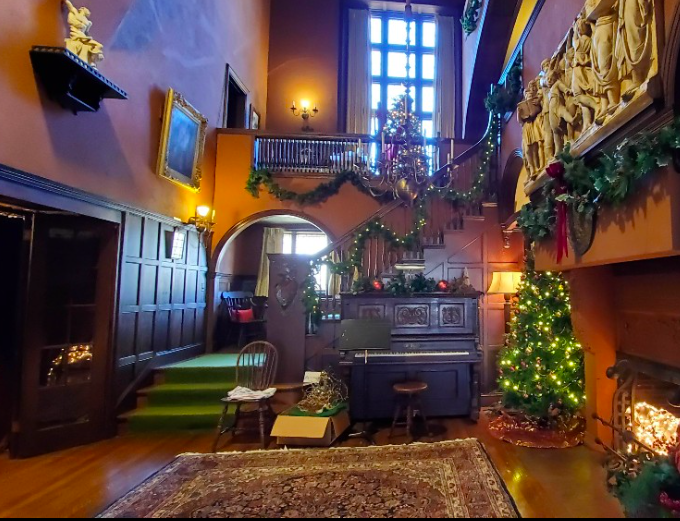
The Great Hall of the Norwood Historical Society’s home all decked out fro Christmas!
The Norwood Historical Society has a beautiful Victorian House as their headquarters. It contains a wonderful collection of papers and artifacts that help to tell the story of Norwood. But if you were to enter with a child, you might see the entire house as a giant “do not touch” zone. Trying to come up with ideas to make history inclusive for families and fun for children is the trick, especially in a grand old house.
Mustang Sally
In Norwood the resource officer has a dog, Mustang Sally, and all the children in town just love her. She is a rock star at every event she comes to. Finding a way to incorporate Mustang Sally in the Norwood Historical Society’s house seemed like an opportunity to make a fun game for the children who came to visit. If you think this is a fun idea for your historical society or museum, of course you should find an item that represents your town or museum or history. The possibilities are endless!
Mini Mustang Sallys
You will want to acquire several history icons. I found small golden retriever statutes that look a lot like Mustang Sally at a local craft store. To get the game going, you will have to first decide the places your little icon will hide. Think about hiding it at kid eye level. Also consider the history you want your little visitors to learn.
Next make clue cards that will give the seekers a hint as to where the little icon is hiding. That card can have little nuggets of historical information in it. Place the card just inside the room where you have hidden your icon. This way, children will know there is a little something to find in that particular room. That way they are not searching in rooms where nothing is hidden. You can provide a check-list for each child to write down the locations of the hidden objects. When children are done with the search, you can ask them questions about the game, what they found interesting, and so on.
Being creative with ways to present your museum to younger visitors or to families with children, can be a fun way to tell your museum’s history.
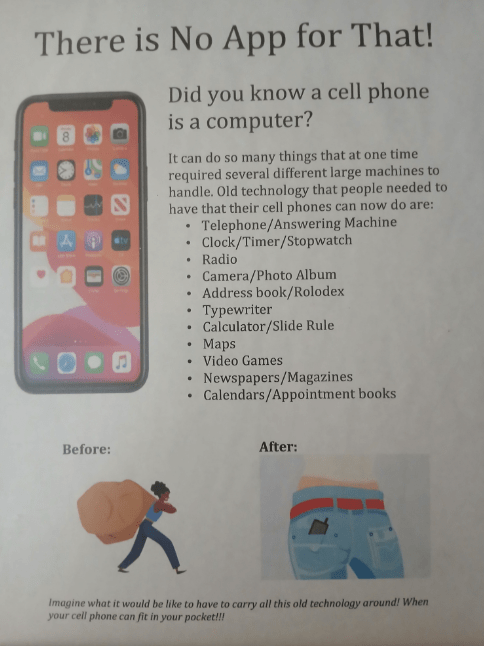
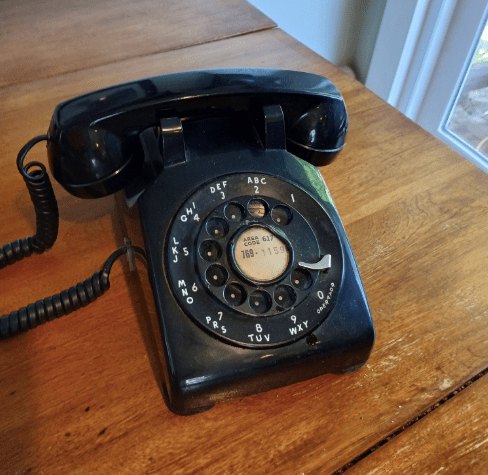
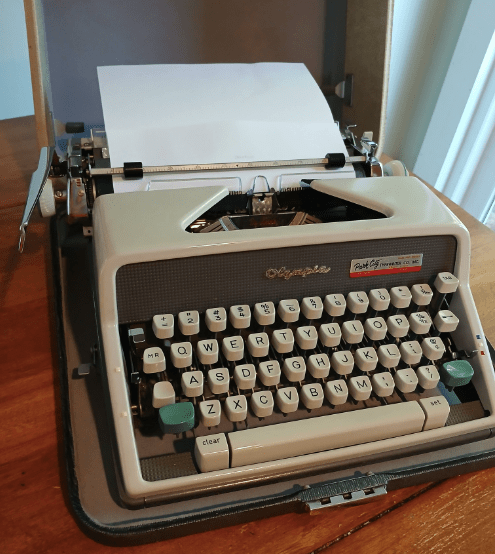
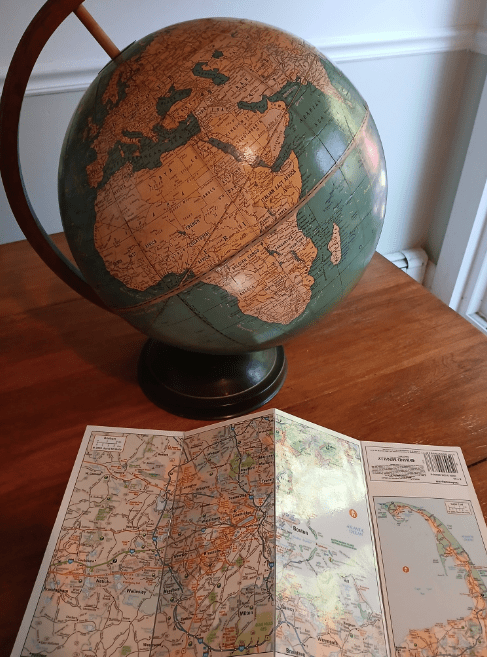
This is a super fun idea that is easy to do. I found adults love it as much as the children! I call it “There is No App For That.” The idea is simple, collect items that at one time were used, but that a cell phone can now do. Most of these items (if not all) can be handled. This gives children an opportunity to dial an old rotary phone. Something they find absolutely puzzling!
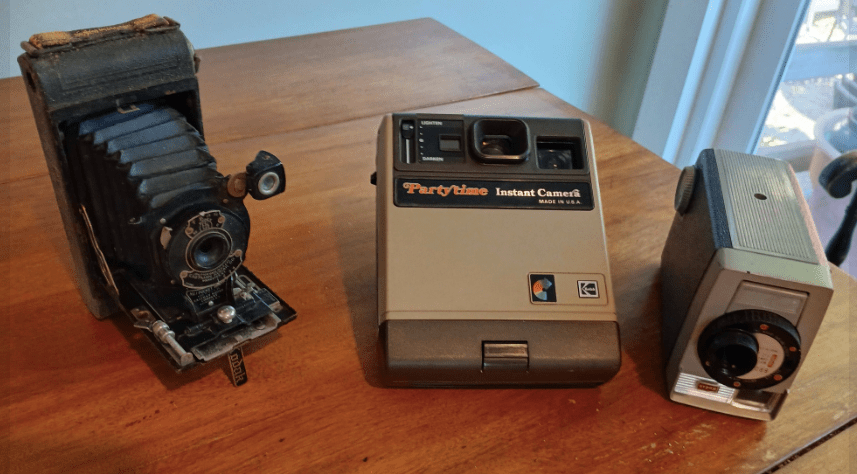
Some of the items I collected are — a rotary phone, calculator, Gameboy, abacus, transistor radio, a globe & maps, a calendar and camera. The possibilities are endless! Today’s cell phone does so much! Most of these items were donated, I asked in a local Facebook group for these things, and people were happy to gift me their old stuff.
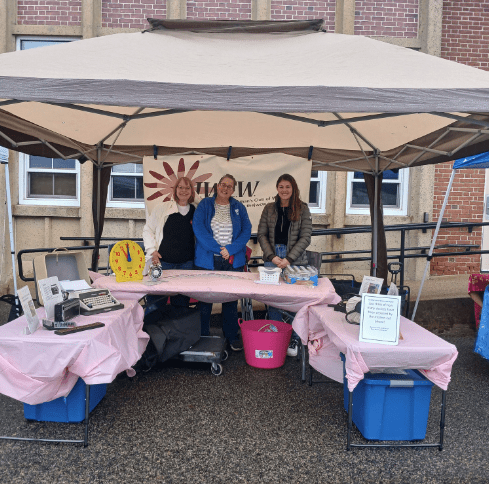
Currently my exhibit is in totes, which can be brought to a variety of venues. I have taken this hands-on exhibit to local historical society open houses, as well as town celebrations. People love to stop by the table and have a look. Although, one person stopped by to inquire how much the radio was…yikes! Now I feel I must keep an eye on my exhibit, as I don’t want anything to walk away!
This exhibit would also work well in an area of your museum, as a “Please Touch” table. The more things you collect, can give you an opportunity to have a rotating exhibit. One of the really nice things that I see happening when folks stop by, is the fond memories they elicit from the adults, who intern share their memories with their children.
I feel this is an excellent hands-on exhibit for children. When we make history accessible for everyone…everyone wins!
Many years ago, when I was visiting the New England Historic & Genealogical Society, I met a woman up on the sixth floor in the stacks. We got chatting about or various research projects, and in the course of our conversation, she mentioned how she strongly trusts marriage records. Her point was that people don’t remember their births and are therefore reliant on others to tell them their birthday. Likewise, they are not here to provide familial information when they die. However, at the time of their marriage they are alive to apply for their marriage certificate, and thus, know the answers to the questions the town clerk asks. This notion has been reiterated in many genealogy classes I have taken, and actually, it’s a pretty good rule of thumb! (and yes, I have indeed found incorrect information in marriage records!)
This rule of thumb applies to my grandmother. She was born in April of 1908, an only child, who was the apple of her parent’s eye. When she graduated from high school, her parents decided to take her on a tour of Europe. Passage was arranged, reservations were made, and passports were ordered. When to postman delivered her passport, my grandmother was shocked to find a terrible error on her passport. Instead of listing April 2nd as her birthday, the passport had April 1st listed instead. She told her mother about this error, and was worried it might somehow be problematic for the family’s impending trip. Her mother had to confess that April first was indeed correct, and that she had thought it best if my grandmother celebrated her birthday on the second of April, because she was concerned children would tease little Hope that she was an April Fool. My grandmother was indeed present at her birth, but she relyed on her parents to tell her the day she was born, but her parents did not tell her the correct day for over eighteen years!
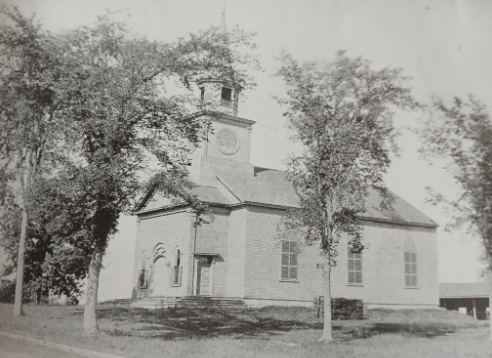
The 1828 South Dedham Church
Take the case of Stephen Fuller. He was born in 1754 in South Dedham (MA), he enlisted in Walpole’s town militia and marched to Lexington-Concord to chase the British back to Boston. He moved in the late 1700s to Francestown (NH), along with about thirty other South Dedham families. When he died in 1839, his family did not erect a gravestone. Now here’s where the problem begins. There is a second Stephen Fuller buried in Plainville (MA) and HIS gravestone has the other Stephen Fuller’s birthdate etched on it. So of course, genealogy database algorithms point us in the direction of the Plainville Stephen Fuller versus the Francestown Stephen Fuller. Untangling the information and proving which Stephen Fuller was which was what the historian/genealogist in me set out to prove.
Dedham vital records identified two Stephen Fullers being born in their town in the 1750s. Stephen Fuller, son of John and Anna (Fales) Fuller was born September 9, 1750 and Stephen Fuller, son of Benjamin and Sarah (Bullard) Fuller was born December 18, 1754. Turning to Attleboro, the town were Plainville Stephen Fuller grew up, their vital records provide two more possible Stephen Fullers to consider. Stephen Fuller, son of Stephen and Mary (Richardson) Fuller was born May 18, 1742 and Stephen Fuller, son of Stephen and Jemima (White) Fuller, was born January 4, 1764. Attleboro had a large Fuller family, their Fuller ancestors settled in Rehoboth (MA) in the 1600s, and by the early 1700s they drifted across the town borders into Attleboro. Trying to figure out if Stephen of Plainville was a Rehoboth Fuller was going to take a lot of work and time, so starting out in Dedham, was the easier place to start.
Believing Stephen, son of Benjamin was Francestown Stephen, only left one other Dedham Stephen to study. Stephen Fuller was born in 1750 in Dedham proper, he was the second Stephen born to John Fuller and his wife Anna Fales. Looking at this family we can confirm John was the son of John Fuller and Mary Guild, and Anna Fales was the daughter of Stephen Fales and Anna Sales (likely Fales). John and Anna became the parents of John, Stephen, Stephen, Anna and Molly (a nickname for Mary), it is clear that John and Anna did not look farther then their family to name their children. Now the question became did John Fuller move with his family to Attleboro? Not a usual migration pattern for Dedhamites. As luck would have it, Bristol County (MA) has a 1766 administration for a John Fuller. In this administration, John’s wife Anna is named as executrix, along with son Stephen, and a daughter Anna is named as one of the heirs. When the estate is finally closed in 1775, daughter Anna had married becoming Anna Healy. It appears that his family is indeed the John Fuller family of Dedham, and that their children John and Molly had died as they are not listed in the estate
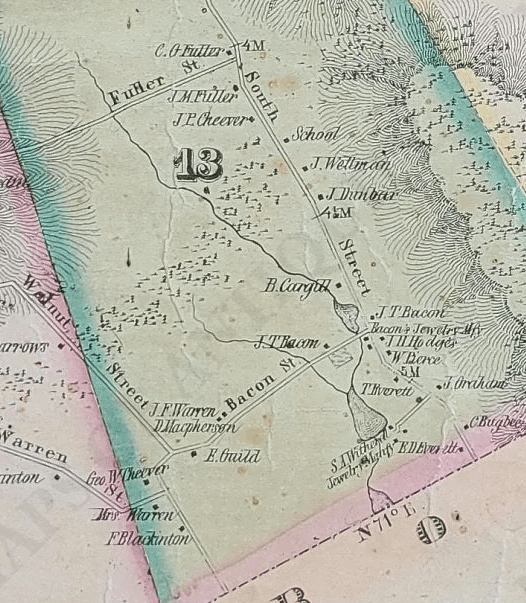
1851 Map of the part of Wrentham that became Plainville in 1905. Near the top, you can see the Fuller family homes
Stephen Fuller of Attleboro/Plainville married in 1773 to Mary Maxcy. Together they became the parents of six children – Stephen, John, Mary, Anna, John and Maxcy. Again this family naming pattern is strong. Looking at the family of Stephen Fuller of Francestown. He had siblings – Hannah, Samuel, Elizabeth, Lucy, Thaddeus and Rufus. Stephen married Hannah Felch and together they became the parents of Samuel, Rufus, Jared, Hannah, Lucy, Asenath, Sarah and “Betsey” (Elizabeth); another strong naming pattern!
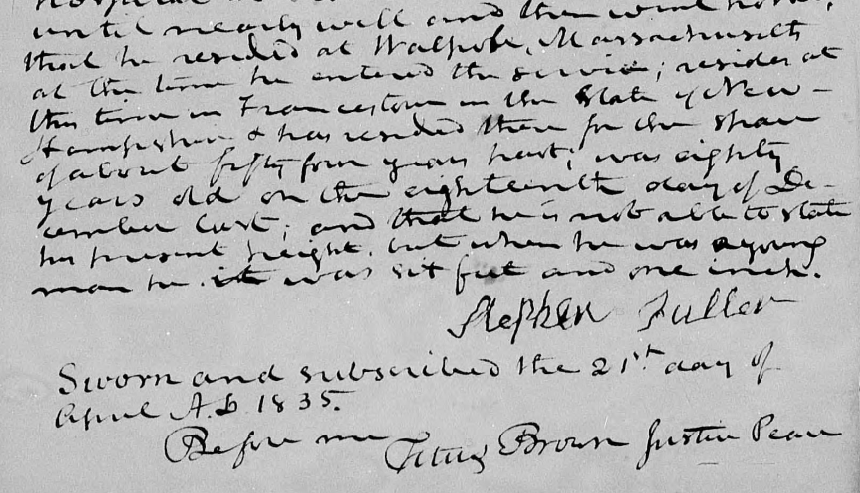
Checking to see if Stephen Fuller of Attleboro/Plainville ever received a pension for service in the Revolutionary War does not yield any new information, but Stephen Fuller of Francestown did receive a pension. He had initially applied for a pension in 1794 as he had received a serious injury – the loss of his right thumb in 1777. He had to submit more information in 1835, in this document he stated and swore that he had turned “eighty years old on the 18th day of December last,” making his birthdate December 18, 1754. This confirms that Stephen Fuller of Francestown was the son of Benjamin Fuller and Sarah Bullard, which certainly is reflected in the family’s naming pattern.
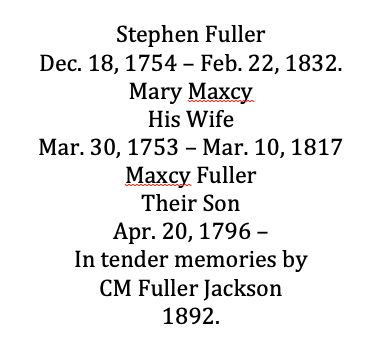
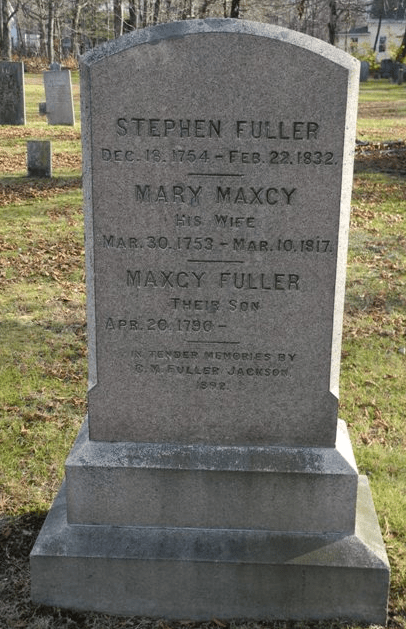
Now the question becomes, how did Stephen Fuller of Attleboro/Plainville end up with the wrong birthdate on his headstone? This puts his birth year at 1750, but indicates the death date may be wrong. A complete translation of his gravestone says:
The clue is at the bottom. CM Fuller Jackson, was Cornelia Maria (Fuller) Jackson, granddaughter of Stephen Fuller and Mary Maxcy. She erected this stone in 1892, some thirty years after Stephen had died. She knew where her grandfather was buried as he died when she as ten. She very likely attended his funeral, plus her parents are buried nearby. Census records show Stephen lived next door to her family in 1820 and was living in her childhood home in 1832. However, being a child it is highly likely she did not know the birth and death dates of an older generation, but she likely knew the towns they were born. She likely wrote to the town clerk of Attleboro and obtained the birth dates for her grandmother and Uncle Maxcy, and personally knowing her grandfather, she likely knew he came from Dedham, wrote to them for Stephen Fuller’s birth date, and it is likely the Dedham town clerk gave her the wrong date. At least that is my theory.
A portion of Stephen Fuller’s Revolutionary War pension application noting his age/birth date
So, looking at the facts, and not theories:
The DAR recognizes Stephen Fuller of Francestown as the son of Benjamin & Sarah (Bullard) Fuller
William Hyslop Fuller, a genealogist and author of several Fuller Genealogies recognizes Stephen Fuller of Francestown as the son of Benjamin & Sarah (Bullard) Fuller in his book Genealogy of Matther Fuller, John Fuller of Newton, John Fuller of Ipswich, Robert Fuller of Dorchester and Dedham (pub 1914), identifies Stephen Fuller of Francestown as a son of Benjamin & Sarah (Bullard) Fuller (p 249-250). In the same book, he outlines the family of John & Anna (Fales) Fuller, noting he could not find further information on this line, likely because they removed to Attleboro. However, when he published the Genealogy of Thomas Fuller of Woburn (pub 1917) he added a supplemental section to the book identifying Stephen Fuller of Attleboro/Plainville as a son of John & Anna (Fales) Fuller. This information came from a great-great-granddaughter, Anne (Wright) Whitney (p213).
Warren Cochrane, Francestown Historian and author of History of Francestown, NH, identifies Stephen Fuller as son of Benjamin & Sarah Bullard) Fuller, noting that he came to Francestown with his brothers Thaddeus and Rufus (p 714).
Familial naming patterns for both Stephen Fullers reflect family names.
The most important fact is the Stephen Fuller of Francestown, gave his birth date when applying for a pension. He swore to it in front of a judge. Proving he is the son of Benjamin & Sarah (Bullard) Fuller.
The moral of this story is to really dig into primary sources. Sometimes what you initially find in secondary resources may not be accurate, even if it is etched on a gravestone, and thus, may require deeper digging to discover the truth.
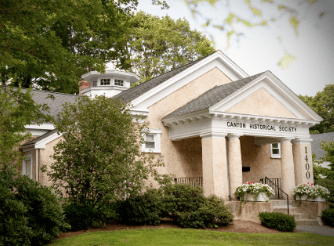
Recently the Canton Historical Society (MA), had the records of an early minister digitized and put online. I was very excited when the announcement of their project popped up on Facebook. I have been researching the lives of enslaved and formerly enslaved people in Norfolk County, Massachusetts. This is a rather tricky research project as people from the labor class left very little or no records behind. Very often one can find some records of enslaved/formerly enslaved in ministerial records.
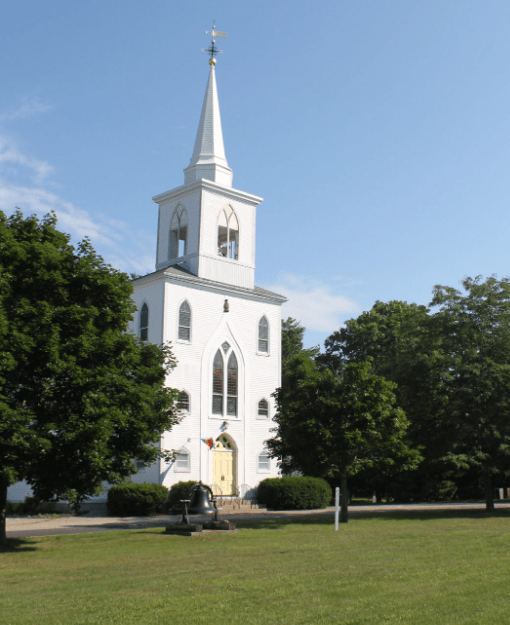
First Parish Unitarian-Universalist Church, Canton, MA
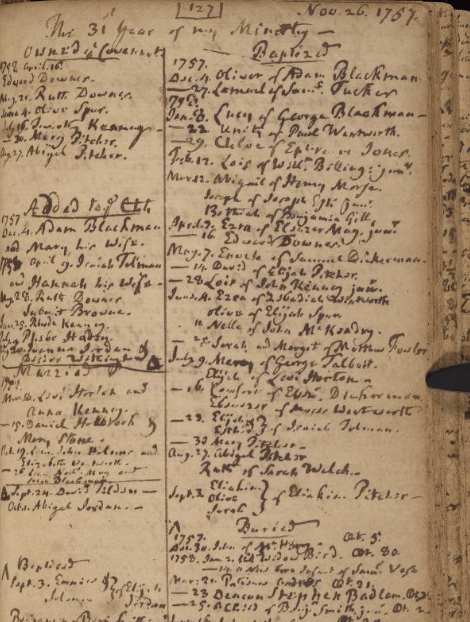
Samuel Dunbar (1704-1783) was the second minister to be called to the First Parish Church of Stoughton, the part that became Canton. As a young boy, Rev. Cotton Mather, took an interest in him, encouraging him to attend the Boston Latin School and then Harvard, graduating in 1723. In 1727, he was called to Stoughton to serve as their minister, a position he held until his death in 1783. In 1755, he served as chaplain in the expedition to Crown Point during the French and Indian War. Dunbar supported the Colonists cause long before the Revolutionary War broke out. In 1774 he participated in a “Congress” which met at the Doty Tavern near Blue Hills, he opened the meeting with a patriotic prayer and assisted with writing “The Suffolk Resolves,” a declaration of objection to English taxes, that resulted in the boycott of English goods. He is believed to be one of the first ministers to read the Declaration of Independence to his congregation. Dunbar’s record book starts recording baptism, deaths and marriages as soon as he arrived in 1727 and continues up to his death. It was only in this record book do I find a reference to Dunbar being an enslaver.
A page from Rev. Dunbar’s record book
However, a weird thing happened as I was reading Dunbar’s record book, page by page looking for some of the enslaved from Stoughton. I noticed the name “Jordan” kept popping up from time to time in the record book. At first I thought this was pretty cool, as my husband’s first cousin is a Jordan. Several years ago, she had asked me to take a look at her line to see if I could find documentary evidence to confirm her research. I love a good search, and was happy to see if I could find anything. Her Jordan family’s Massachusetts roots can be found in early Dorchester, Stoughton and Braintree. But she had yet to find records that would confirm all the children of Elijah & Joanna (Veazey) Jordan. She knew the family had removed to Gray, Maine, and records there were just as unhelpful. The best I could do was find a couple of land deeds where Elijah (Jr), Solomon and David Jordan shared in the sale of property. This, to me, indicated a familial connection. I even submitted a genealogical sketch to The Maine Families of 1790 project, volume 12. Much of the family I have listed as “likely,” meaning I did not find proof of the connection.
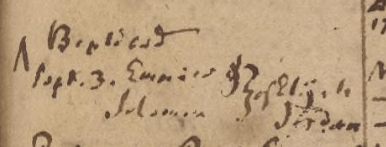
Entry from Rev. Dunbar’s book showing baptism for Elijah & Eunice children of Elijah Jordan
Fast forward to January 2026, and I am perusing Rev. Dunbar’s records. My initial thoughts of wow, Jordan, that’s cool, gave way to OMG! This IS documentary evidence of the Jordan family I had researched almost ten years ago! (Here is another Never-Give-Up story). Anyhow, I reached out to my husband’s cousin with the link, and also to another Jordan descendant whom I have communicated with in the past. Three of us, from the comforts of our living rooms began combing through Dunbar’s records, looking for pieces of information that will correctly assemble this branch of the Jordan family. Years ago, I believed that Solomon Jordan, who the Jordan cousins descended from, was the second Solomon born to Elijah & Joanna (Veazey) Jordan….and Dunbar’s records prove my theory! (Woohoo!)
I would like to present and amended genealogy sketch for your reading enjoyment!
Elijah3 Jordan, (Benjamin2, John1), was born 23 Sept 1723 in Stoughton (MA), the son of Benjamin Jordan and Elizabeth Wentworth. He married 1 Jan 1746 to Joanna Veazey in Braintree (the part that is now Randolph). She was born Braintree (now Randolph) 26 Mar 1726, the daughter of Samuel Veazey and Deborah Wales. Elijah and Joanna likely died in Gray (ME), but their death dates have yet to be found. The births of their first two children are recorded in the —- Church of Braintree (now Randolph). Until the digitizing of Rev. Dunbar’s records, the only confirmed children of Elijah & Joanna Jordan, were Solomon Veazey and Joanna. The Jordan’s started out their life together in Braintree, then they seem to have moved for a short time to Boston, before coming to the First Parish Church of Stoughton. In the 1770s they removed to Gray.
Children of Elijah Jordan and Joanna Veazey are:
Solomon Veazey Jordan, born 31 Aug 1746 Braintree; d bef 1757
Joanna Jordan, bpt 4 Jun 1749 Braintree; d 7 Jan 1826 Needham (MA); m Daniel Smith of South Dedham (now Norwood)
(likely) Elijah Jordan, b. abt 1751 possibly in Boston
John Jordan, b. 1755 Stoughton; d 4 Oct 1756 Stoughton
Eunice Jordan, bpt 3 Sept 1757 Stoughton (no further info)
Solomon Jordan, bpt 3 Sept 1757 Stoughton; d 4 Mar 1846 Garland (PA); m Lydia Russell
David Jordan, bpt 27 Jun 1761 Stoughton; d 30 May 1847 South Waterford (ME); m (#1) Ruth Cummings, (#2) Temperence Russell and (#3) Lucy Pratt.
Mary Jordan, bpt 6 May 1763 Stoughton. (no further info)
I have tried to use my page to highlight my historical and genealogical research and my hope was a visitor to my page would learn something new to help them with their research. I never thought that my postings would lead ME to new information. Such is the case with my genealogical posting “The Abel Prior Story.” I have had two messages from other Prior researchers, one who helped fill in a few blanks in Abel’s life.
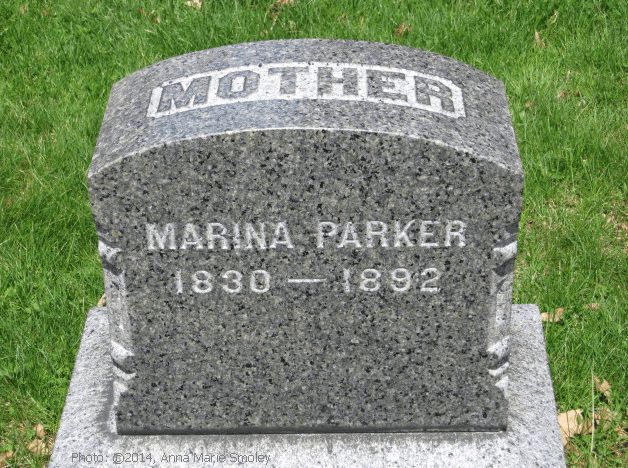
As I mentioned in that earlier posting I have been trying to find the parents for Marina (Prior) Bassett-Rich-Hall-Parker (yes, she married a lot!). Focusing on the theory that Abel Prior may potentially be Marina’s father, I began tracing his life. I managed to find a lot on him, including proving through documentation who his parents were. All this research on Abel has yet to lead me to discover if he is the father of Marina.
Marina (Prior) Parker’s headstone
But I am drawing closer to the answer.
In May of 2024, a gentleman who discovered my page and article on Abel Prior reached out to me. He had been researching the Shipman family and had found that the Shipmans intersected with Abel Prior’s family. We spent the next several months communicating via email, working together and bouncing research ideas off each other.
Through his research he was able to add details to Abel Prior’s life timeline, and his research cleared up the confusing census records….ages of wife/wives changed from decade to decade, as did the ages of children in the home. These inconsistencies made it difficult for me to develop a solid picture of the family. In 1800, Abel is living in Augusta (NY). In the home is Abel (m 26-44), a wife (f 26-44) and two teenagers (m 10-15) and (f 10-15), possibly siblings is my thought. Adding to this picture, my research buddy found that in 1801 Abel and his wife “Patty” signed a land deed in Augusta. Now I had a name for Abel’s first wife…Patty, which is a nickname for Martha. Adding to the story, the gentleman forwarded me an article that was published in the Fredonia Censor, January 13, 1869. The story was about Elijah Shipman who in 1813 had managed to kill a bobcat (but he thought it was a raccoon). It tells that Elijah was fostered/adopted by a childless couple — Abel Prior and his wife. It further notes that Abel Prior at one time owned a tavern in Sheridan (NY), which was a welcome stop for folks from Connecticut on their way to Northern Ohio. The history of Chautauqua notes that the “Prior’s Inn” tavern burned down around 1815.
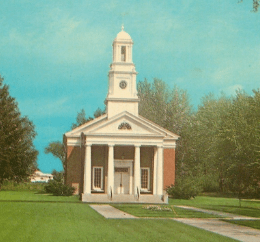
Fredonia Presbyterian Church, Fredonia, NY, circa 1966
This new piece of information clarifies who was living in Abel’s house in 1810, when the family was living in Pomfret (NY). He has himself (m 26-44); no wife; Elijah Shipman (m 0-10) and the two teenagers, now young adults (m 16-25) and (f 16-25) are still in the home. (I would love to discover who these two people are, although there is a notion that the woman could be another one of Abel’s wives). However, this census most certainly indicates Patty had died. Also during this decade, I surmise Abel’s father, Jedediah had died, and his mother appears to have moved from Augusta as she had asked to be dismissed from the Augusta (NY) Congregational Church in 1804.
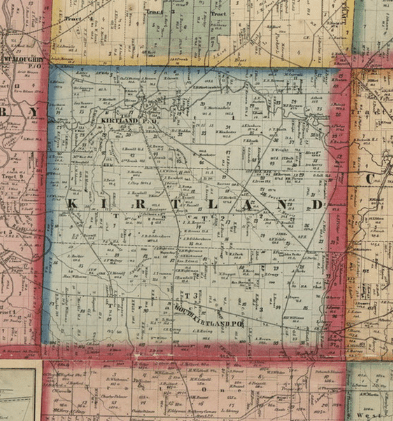
In 1820 Abel was living in Kirtland, OH. In the census he shows himself (m 26-44); a new wife (26-44); 2 males (m 0-10) & (m 10-15); and a teenage/young female (16-25). From my email correspondence, I learned that Elijah Shipman had remained in New York State, and that in 1817 Abel signed another land deed with his new wife “Marina.” In my records, I had referred to her as “the Widow Strong,” because Abel signed off on a 1829 marriage certificate for John Strong, as he was under age, and I believed Able was his guardian (no official guardian papers have been found). What I did find online was a transcribed document of records of the Fredonia Presbyterian Church. In those records, Theodore/Thomas (transcription uses both those names….would love to see originals myself!) and his wife, Marina had their two young sons, Stephen Barnes and John baptized on July 24, 1814. T Strong is enumerated in the 1810 census in Pomfret (NY) with himself, his wife and one little boy. It appears Theodore/Thomas had one son before 1810 and one son after 1810. Looking at Abel in the 1820 census, we can now identify the male 0-10 as Stephen Barnes Strong and the male 10-15 as John Strong. Who the young woman in the census (f 16-25) is not known. She is too young to be the teen/young women in the earlier two censuses.
In 1830, the family is still in Kirtland and in their home the census reflects Abel (m 50-59); Marina (f 30-39); Stephen B Strong (m 15-19) and a little girl (f 5-10). The presence of this little girl may indicate Abel and Marina had a daughter. ….perhaps MY Marina? It is at this point my earlier research in “The Abel Prior Story” dove tails up with this new information.
Getting this information, lead me to finally reaching out to the Weathersfield (VT) Historical Society and to the Weathersfield Congregational Church, unfortunately the only information they had on the Prior family was a 1793 tax record listing Jedediah and Abel Prior. I reached out to the Augusta (NY) historian, who was unable to find any information on the Prior family. An online search for Augusta (NY) history, I found the records of the Augusta Congregational Church on familysearch, and from going through that, page by page, I found Desire (Hatch) Prior’s request for a dismissal hiding in the pages, but sadly no other Priors. I also reached out to the Probate Court of Lake County (OH), who forwarded me a copy of Marina (Prior) Bassett-Rich-Hall-Parker’s will, which had the names of her three children Oliver, Mary and Sarah, and her death certificate, which did not name parents. (Rats!)
Every little piece of information helps to flesh out the lives of Abel Prior and his family, drawing me closer to finding something that will document who the parents of Marina (Prior) Bassett-Rich-Hall-Parker. I remain firm with the notion of never giving up on your search….and maybe start a blog!
Ruth Batson was involved with METCO (Metropolitan Council for Educational Opportunity) a voluntary urban-suburban busing program, from its very beginning. As early as January 18, 1965, a steering committee formed to explore how to organize and establish the METCO program. At that meeting, Batson was elected to serve on the Permanent Executive Board (link). The steering committee launched METCO’s program by enlisting suburban towns to participate in the program, seeking out an executive director, applying for funding and grants, organizing busing contracts, and reaching out to the communities to create a positive interest in this new program.
“The Organizing Committee moved swiftly. Soon more concrete plans were made for the transporting of Boston students to a better educational opportunity. I had no qualms whatsoever about taking this step. I thought if I had had this opportunity for my children, faced with the open hostility that we had encountered, I would have bused my kids to California.” Ruth Batson (1)
The Organizing Committee had indeed moved swiftly; within thirteen months they had submitted a plan to the US Office of Education outlining the METCO program, had applied for funding from the Carnegie Foundation, and had four suburban communities agreeing to participate. A few months later the funding came through and two more communities had signed up. In May of 1966 the Boston School Committee voted to support the METCO program. The Organizing committee had also hired a new assistant director, Ruth M. Batson.
By the spring of 1966 Batson knew she had to act fast since seven suburban communities were ready to accept students in September. Batson reached out to Boston’s many black community organizations to explain the application process. Batson was in charge of interviewing and selecting the first students to participate in this new program, as well as speaking at informational meetings to discuss METCO and to address questions and concerns. Often she had to assure parents they was looking for a cross section of students, and not “the cream of the crop” or children of friends and family who were on METCO’s board of directors. Once the board of directors created a list of criteria for student selection the interview process could begin. The goal was to have the majority of students fall in an average range academically. They wanted all students to be at grade level, which was tricky because Batson found average grades in Boston schools translated to being academically behind compared to suburban schools. METCO staff interviewed applicants and their parents, their grades were scrutinized, and hypothetical situations were discussed. As the process continued, the suburban community interviewed students where they wished to attend school. Out of six hundred applicants, two hundred twenty students were selected to attend one of the seven suburban host schools. The following year Batson placed four hundred twenty-five students in sixteen suburban communities.
In January 1968, Batson became the Executive Director of METCO, and she served in this capacity until the spring of 1970. In this new position, Batson’s responsibilities included fund raising and grant writing; she also worked developing and maintaining relationships with superintendents of the suburban school districts. During her tenure as the executive director, METCO continued to grow, not only in number of students and suburban communities, but they also began provided a variety educational and support of services. Under Batson’s leadership, programs were established which further assisted inner-city children with educational opportunities; in conjunction with a local college, METCO organized a tutoring program for its students. They also created a job-training program “New Careers,” which worked with local businesses to train and place students in jobs and provided these students an opportunity to enroll in a basic education program or into a college. By the fall of Batson’s first year as executive director METCO’s program had doubled, with over nine hundred students attending twenty-eight suburban schools. In June 1969, Batson informed the board of directors she would be stepping down by the end of the year. The position of Executive Director was extremely demanding and she felt it was important to keep leadership fresh.
“At the end of four years with METCO, I wanted to move onto another job. An action job like METCO, in my opinion, required a change in leadership…” (2)
(pictures & documents: letters from grateful parents, pages 9-10, 14 from story of metco, link to stark & sub’s metco exhibit,
footnotes:
Ruth M. Batson. The METCO Story. An unpublished paper written for The Association for the Study of Afro-American Life and History, October 11, 1985. (The Papers of Ruth Batson, 1919-2003 inclusive, (1951-2003 bulk); The Schlesinger Library, Radcliffe Institute, Harvard University, Cambridge, MA.) Page 7
Ruth M. Batson. Ruth Batson: Personal Statement. An interview for Boston University Community Mental Health Center Consultation and Education Program. (The Papers of Ruth Batson, 1919-2003 inclusive, (1951-2003 bulk); The Schlesinger Library, Radcliffe Institute, Harvard University, Cambridge, MA.) MC590 Box 2, folder 9
Sources:
Ruth M. Batson. The METCO Story and unpublished paper written for The Association for the Study of Afro-American Life and History, October 11, 1985 The Papers of Ruth Batson, 1919-2003 inclusive, (1951-2003 bulk). The Schlesinger Library, Radcliffe Institute, Harvard University, Cambridge, MA)
Ruth M. Batson. Ruth Batson: Personal Statement. An interview for Boston University Community Mental Health Center Consultation and Education Program. The Papers of Ruth Batson, 1919-2003 inclusive, (1951-2003 bulk). The Schlesinger Library, Radcliffe Institute, Harvard University, Cambridge, MA. MC590 Box 2, folder 9
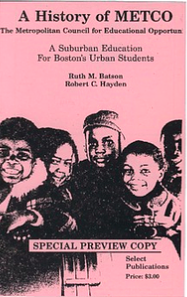
Ruth M. Batson and Robert C. Hayden. A History of METCO: The Metropolitan Council for Educational Opportunity; A Suburban Education for Boston Urban Students. Boston, MA: 1986
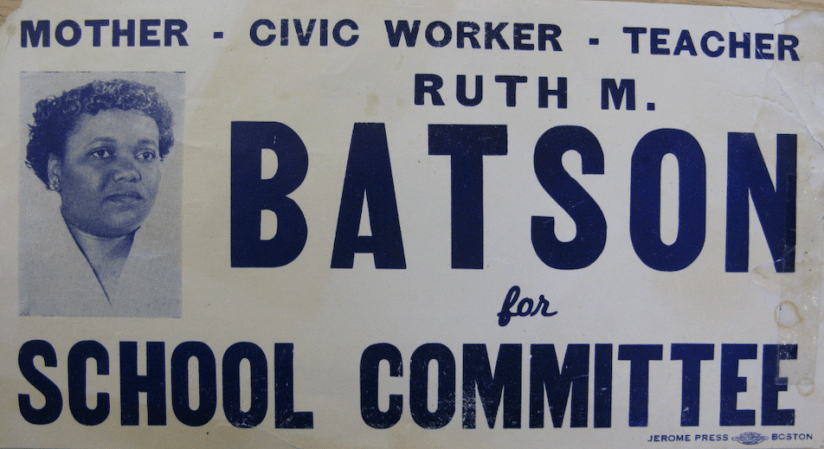
Ruth M. Batson remained active in the community of Boston advocating for children and for African Americans her whole life. In 1951, she highlighted her attributes for a School Committee campaign as “Mother – Educator – Civil Worker” and these are attributes she always retained. She may not have known it at the time, but these characteristics became her driving force to make changes in Education and demand equal treatment for Boston’s African-American population.
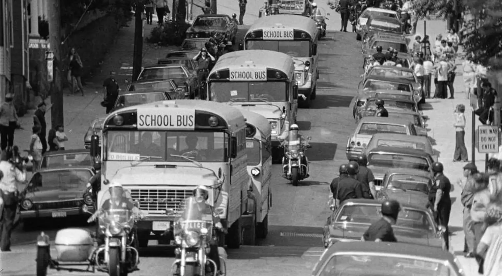
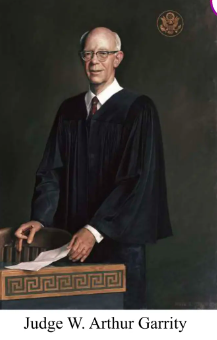
It is important to note, in June of 1963 when Batson, as chairman of the Public Education Committee of the NAACP Boston Branch presented the list of fourteen demands, busing students to desegregate the schools was not one of them. In fact, there was no mention of desegregating the schools. It was not until September of 1963 that the Public Education Committee began to mention an integration plan, which was to build new schools on the edges of neighborhoods, and to redraw the school boundary lines for better integration. After eleven years of filibustering, Judge Garrity had reached the end of his patience with the Boston School Committee. During these years the school committee had filed appeal after appeal, they created programs and policies that would appear to address the NAACP’s concerns, but these programs and policies never amounted to anything. But mostly, this committee seemed to fan the flames of anger. Busing was Judge Garrity’s best plan to desegregate the schools. People like Ruth Batson, who worked for almost thirty years to achieve integration of the Boston school system, inherited the fallout from the Judge’s court order, but it was mostly the children of Boston who got stuck having to deal with this situation. Ruth Batson was there all along the way.
“Twenty years later, six years before the 21st century, the citizens of Boston must turn their sights on restoring Boston’s tarnished image. We must ask ourselves: How do we want history to record us?” Ruth M. Batson, (Boston Globe; May 1, 1994)
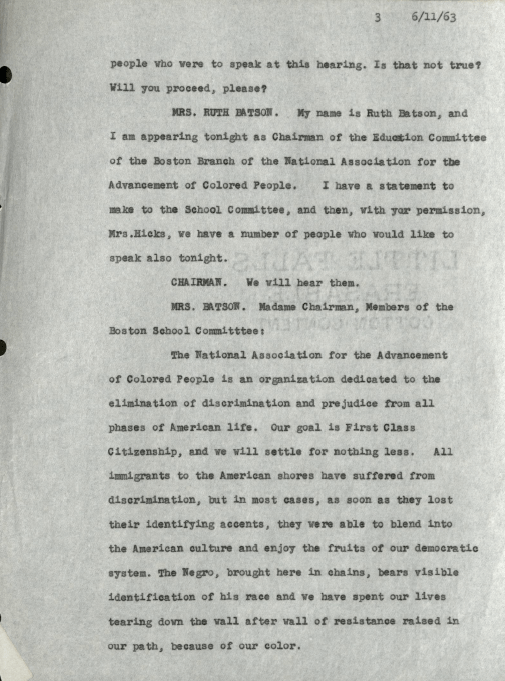
By June of 1963, The Public Education Committee of the NAACP Boston Branch was finished meeting with officials to discuss their concerns. They requested to meet (Tuesday, June 11, 1963) with the Boston School Committee so they could air a list of demands to improve Boston Schools. Ruth Batson, as chair, read a long statement her committee carefully composed specifically to call attention to their concerns. In this statement was a list of fourteen demands the group wanted addressed immediately. Minutes of this meeting show all parties involved were polite and restrained. The Boston School Committee promised to look into the NAACP’s concerns. The next day, (Wednesday, June 12, 1963) the Boston School Committee held another meeting. They questioned principals and other officials regarding the concerns and demands of the NAACP. School officials reported, for the most part, the problems were due to bad parenting, difficult students, and lack of support from the families. It was apparent to the NAACP, from the tone of this meeting and from the prior ten years of meetings with city officials, the Boston School Committee did not plan to move quickly on their concerns. It was decided by several Boston African American leaders that a peaceful protest should be organized.
The following day (Thursday, June 13, 1963) a school boycott and a march to the Public Gardens were held. The school boycott continued into the next day (Friday, June 14, 1963). On Saturday, June 15, 1963, a special meeting between the NAACP and the Boston School Committee took place at to discuss the boycott and the list of fourteen demands. The majority of the minutes from that meeting show a very long discussion regarding de facto segregation. The NAACP wanted the Boston School Committee to acknowledge that it was a real issue. The Boston School Committee did not want to acknowledge de facto segregation because they were concerned the segregation would appear to be a conscious effort by the city of Boston rather than a situation of happenstance. Eventually the school committee was willing to refer to this the situation as “residential groupings,” but little else was settled that day.
On July 15, 1963, the Public Education Committee of the NAACP Boston Branch requested yet another meeting with the Boston School Committee. They also met with the National NAACP officer to discuss the issues previously raised with the Boston School Committee. They planned out potential actions they may have to undertake in order to get the School Committee to address their concerns, including the possibility of suing the school committee. They also discussed their trepidations regarding the seven candidates to replace Frederick Gillis as superintendent. A week later, the School Committee stated that they would not meet with the NAACP. The following week, the Executive Committee of the NAACP unanimously voted to support public demonstrations. They also issued an ultimatum:
“If by Friday, August second, the school committee has not agreed to honor the request on July 15 for a continuation of negotiations between that body and the Education Committee for the NAACP, the Boston Branch NAACP with the support of every other Major civil rights organization will hold mass demonstrations at the school committee’s 15 Beacon Street offices. To begin on the next Monday, August 5th…..we are herein asking the school committee to reverse its decision of a week ago for the sake of the national image of the “All-American City;” for the sake of the neglected children of our community; and most important, for the sake of moral rectitude.” (1)
This message was sent to the Mayor of Boston and the Governor of Massachusetts. A similar message was sent to President Kennedy. Each of these politicians sent responses supporting the NAACP’s position and urging the school committee to continue discussions with concerned citizens. The school committee bowed to pressure and agreed to a meeting, but Louise Day Hicks, the school committee’s chairman, had conditions for this meeting: it could last no longer then an hour and the term “de facto segregation” could not be discussed. The meeting was held August 15, 1963, but it only lasted a few minutes. Batson read a statement and uttered the words “de facto segregation.” Louise Day Hicks banged the gavel ending the meeting. As a result, demonstrations were held throughout the month of August by organizations that supported desegregation. In September the NAACP held a sit-in at the Beacon Street offices of the Boston School Committee in hopes they would admit the problem of de facto segregation. In a statement released to the press, and published in the Sept 6, 1963 edition of the Boston Herald, the NAACP had five key issues they wanted the committee to address;
“Open enrollment for school children
Full consideration in locating new schools for maximum integration
The rezoning of school districts to achieve maximum integration.
Consultation with educational experts regarding the desegregation of the de facto schools
A meeting with the NAACP Public School Committee to discuss further ways and means to achieve desegregation.” (2)
By September, the School Committee was once again holding meetings with the Public Education Committee of the NAACP. These meetings would continue for another ten years, as the Boston School Committee refused to acknowledge de facto segregation or that there was any unfair or unequal treatment regarding the students in Boston Public Schools. In February of 1964, Batson stepped down from her duties as the Chairman of the Public Education Committee of the NAACP because she had accepted a position at the Massachusetts Coalition Against Discrimination, but she remained on its board.
footnotes:
Ruth M. Batson, The Black Educational Movement in Boston: A Sequence of Historical Events; A Chronology. (Boston, MA: Northeastern University, School of Education, 2001) pg 101
“Mrs. Hicks ‘Tragic’ Event: NAACP Leader Blasts Committee,” The Boston Herald, September 6, 1963; page 18
Sources:
Ruth M. Batson, “The METCO Story” and unpublished paper written for The Association for the Study of Afro-American Life and History, October 11, 1985. The Papers of Ruth Batson, 1919-2003 inclusive, (1951-2003 bulk). The Schlesinger Library, Radcliffe Insutitute, Harvard University, Cambridge, MA
Ruth M. Batson, The Black Educational Movement in Boston: A Sequence of Historical Events; A Chronology. Boston, MA: Northeastern University, School of Education, 2001
Jackie Shearer (interviewer) “Eyes on the Prize II Interviews: Interview with Ruth Batson,” Washington University Digital Gateway Texts, conducted by Blackside, Inc., for Washington University Libraries, Film and Media Archive, Henry Hampton Collection, Seattle, WA. November 8, 1988
Minutes of the Boston School Committee, June 11, 12, 15, 1963
“Hynes to Run for Mayor Again: City Head Tips Hand in Seeking to Calm Group Irate Over Schools,” The Boston Herald Traveler, Boston, MA; December 28, 1950; page 1 and 32
“Mrs. Hicks ‘Tragic’ Event: NAACP Leader Blasts Committee,” The Boston Herald, September 6, 1963; page 18
George D. Strayer, A Survey of the Boston Public Schools, for The Boston Finance Committee 1944
Cyrus Sargent, The Sargent Report, for the Superintendent of the Boston Public Schools, May 1962
The Harvard Report on the Schools in Boston, for the Boston Redevelopment Authority, 1962
A Progress Report, by The League of Women Voters of Boston, Education Committee, 1963
Ruth Batson’s interest in education started well before the night of June 11th 1963 when she stood before the Boston School Committee and read a list of demands. Being a mother, she was involved with her children’s education. She taken several classes on nursery school education in the late 1940s and joined The Parent’s Federation of Greater Boston, a parent group that supported the public schools. It was here she learned about The Strayer Report, which was a survey of the Boston Public Schools commissioned by the Boston Finance committee in 1944. This report highlighted the crumbling schools and over crowding especially in Roxbury and the South End. On December 28 1950, The Boston Traveler reported The Parent’s Federation of Greater Boston, under the leadership of Mrs. Ruth Batson, held a protest at Boston City Hall to discuss its recommendations with Boston’s mayor. They were especially concerned because nothing had been done since the report had been written. Mayor John Hynes told the protestors, “nothing could be done until the school committee resurveys the school population and arranges for maximum use of existing school buildings.” (1) Within a few short months, Ruth Batson threw her hat into the political arena when she decided to run for Boston School Committee member. Her campaign slogan was “Mother, Educator, Civil Worker.” Unfortunately she lost her bid, but that did not stop her from advocating for the children of Boston.
In 1953 Ruth read the NAACP was opening a Boston office, and she decided to pay them a visit to discuss her concerns regarding the physical condition of the Boston Public Schools, the lack of supplies, and poor curriculum in the black schools vs. the white schools. She was disappointed to learn the NAACP did not have a committee to deal with public schools, and they could therefore not help her. However, shortly after this visit Lionel Lindsay, the head of the NAACP Boston Branch, called Mrs. Batson and asked her if she would consider being the Chairman of the newly formed NAACP Public Education Sub-Committee. It was a role Batson quickly accepted. Little did she know that this new position would thrust her into the limelight in a few short years. Later in life, Batson reflected, “From that day on, my life changed profoundly. I learned how to sharpen my observation skills. I learned how to write reports. I learned how to stand before a legislative body and state the NAACP’s case. I lost all fear of ‘important’ people or organizations.” (2)
The first thing Batson did was to form her committee and together they outlined their objectives. One of their early goals was to meet with the principals in the predominately black schools. “And we did what we called a survey. Of course we didn’t even know we were doing a survey. We just thought we’d go around and ask these principals these questions about education and black students.” (3). The committee soon became a source for parents to voice their concerns regarding the conditions of the schools their children attended. Issues parents raised varied from the lack of fire escapes and bathroom plumbing problems, to no school libraries and few supplies for teachers and students. Committee members met with local politicians as well as city and school officials to discuss these problems. In an effort to improve Boston schools, the committee organized parent groups to help advocate for their children. More and more parents turned to the Public Education sub-committee to report concerns and to seek help in advocating for their children, the work of this standing sub-committee continually expanded, until the NAACP decided to make them a full committee.
In June of 1961 the NAACP Public Education Committee met with members from the Massachusetts Commission Against Discrimination (MCAD) to discuss de facto segregation in the Boston schools and to urge them to conduct a survey of the Boston schools taking into account racial demographics and quality of education. It was decided MCAD would do preliminary research over the summer then go over the findings with the Public Education Committee in the fall. After that meeting MCAD met with Frederick J. Gillis, Superintendent of Boston Public Schools, to discuss their findings. When asked questions about racial demographics, Mr. Gillis always answered that there were no numbers on that issue. On questions regarding quality of education, Mr. Gillis would answer that the school system upheld the highest standards of education in all of their schools.
footnotes:
“Hynes to Run for Mayor Again: City Head Tips Hand in Seeking to Calm Group Irate Over Schools,” The Boston Herald Traveler, Boston, MA; December 28, 1950; page 32
Ruth M. Batson, The Black Educational Movement in Boston: A Sequence of Historical Events; A Chronology. (Boston, MA: Northeastern University, School of Education, 2001) pg 9
Jackie Shearer (interviewer) “Eyes on the Prize II Interviews: Interview with Ruth Batson,” Washington University Digital Gateway Texts, conducted by Blackside, Inc., for Washington University Libraries, Film and Media Archive, Henry Hampton Collection, Seattle, WA. November 8, 1988
Sources:
Ruth M. Batson, “The METCO Story” and unpublished paper written for The Association for the Study of Afro-American Life and History, October 11, 1985. The Papers of Ruth Batson, 1919-2003 inclusive, (1951-2003 bulk). The Schlesinger Library, Radcliffe Insutitute, Harvard University, Cambridge, MA
Ruth M. Batson, The Black Educational Movement in Boston: A Sequence of Historical Events; A Chronology. Boston, MA: Northeastern University, School of Education, 2001
Jackie Shearer (interviewer) “Eyes on the Prize II Interviews: Interview with Ruth Batson,” Washington University Digital Gateway Texts, conducted by Blackside, Inc., for Washington University Libraries, Film and Media Archive, Henry Hampton Collection, Seattle, WA. November 8, 1988
Minutes of the Boston School Committee, June 11, 12, 15, 1963
“Hynes to Run for Mayor Again: City Head Tips Hand in Seeking to Calm Group Irate Over Schools,” The Boston Herald Traveler, Boston, MA; December 28, 1950; page 1 and 32
“Mrs. Hicks ‘Tragic’ Event: NAACP Leader Blasts Committee,” The Boston Herald, September 6, 1963; page 18
George D. Strayer, A Survey of the Boston Public Schools, for The Boston Finance Committee 1944
Cyrus Sargent, The Sargent Report, for the Superintendent of the Boston Public Schools, May 1962
The Harvard Report on the Schools in Boston, for the Boston Redevelopment Authority, 1962
A Progress Report, by The League of Women Voters of Boston, Education Committee, 1963
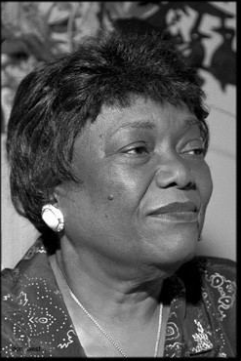
Ruth Marion (Watson) Batson was a lifelong resident of Boston was born August 3, 1921 in Roxbury, to Jamaican immigrants, Joel R. Watson and Cassandra D. Buchanan. Her beginnings were rather humble. Ruth and her brother were raised by their single mother, who struggled to make ends meet for her family. In spite of their circumstances, Mrs. Watson managed to provide a stable home and laid the foundation of lifelong values regarding education and civil rights, which became the springboard for Batson’s accomplishments. At age nineteen Ruth Watson married John C. Batson, and together they became the parents of three daughters; Cassandra, Susan and Dorothy. When Batson’s daughters were in elementary school she noticed stark differences in their assignments as compared to the children of her white friends. An unfruitful meeting with her daughters’ principal started Ruth down a path of activism. Batson’s family supported her endeavors, even though her work sometimes took her away from home, required long hours, or provoked anger that was hurled her way. John Batson was founder and co-director of the Ruth M. Batson Educational Foundation, a scholarship foundation that supports needy students, and Batson’s daughters assisted her on several projects documenting the desegregation era.
Early Years: Laying a Foundation.
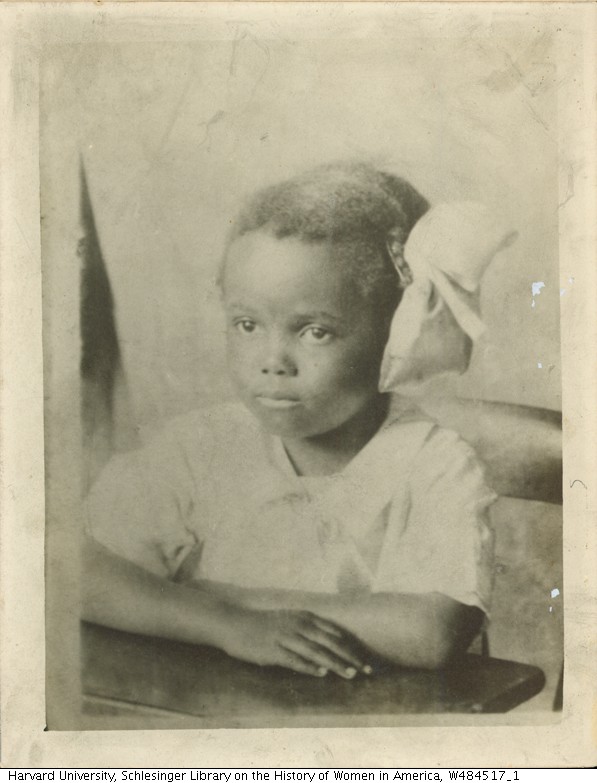
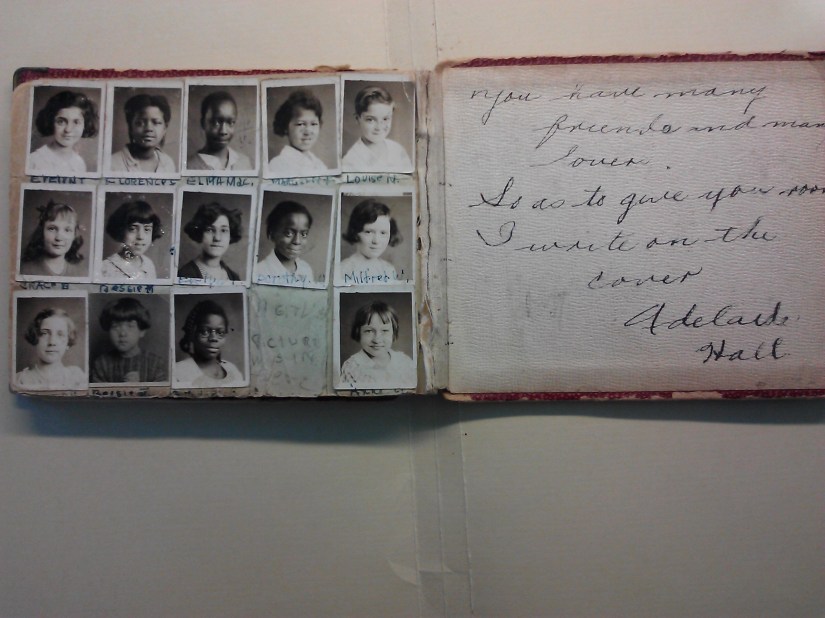
Batson was exposed to civil rights issues at a young age (although the phrase ‘civil rights’ was not in common use at the time). Batson’s mother became involved with a group who followed the teachings of Marcus Garvey, an international Pan-African movement leader and a fellow Jamaican, who espoused the idea that all people of African descent should demand their rights to dignity and equal treatment. On Sundays Batson’s mother took her to “Garveyite” meetings where these issues were discussed. At these meetings, young Ruth became acutely aware of how unfairly black people were treated. Growing up in Boston, Batson was exposed to discrimination. During the interviewing process for a PBS series called Eyes on the Prize, Batson recalled a day she and her girlfriends stopped into a diner for a hotdog and a drink. The man at the counter served them uncooked hotdogs, which surprised and shocked the young girls. Instead of complaining, young Batson ate her hotdog saying she liked her hotdogs raw, but she recalled feeling ashamed. As a girl, Batson was also exposed to integration; Photos she collected coupled with the kind words written by friends in her autograph book from the Everett school, and from her high school yearbook, it appears she had many culturally diverse friendships and that the schools she attended were integrated. Her early negative and positive experiences with the rhetoric of the Garveyites, racial discrimination, and years in integrated schools helped to provide the foundation upon which Batson built a career fighting for basic civil rights for all.
Politics: Learning to Lobby
In the 1950s Ruth Batson began to take an active interest in politics. Following an unsuccessful run for the Boston School Committee in 1951, she worked behind the scenes for John Kennedy’s 1952 senatorial election campaign. Shortly thereafter, she was encouraged to run as a Delegate to the Democratic State Committee. She ran in Ward 12; her election in 1956 made her the first black woman to serve in this capacity. Batson attended the National Democratic Convention in 1960 to work behind the scenes in JFK’s civil rights office. She went on to become a delegate for the 1964 and 1972 conventions. She worked tirelessly for many campaigns on both local and national levels. Some of the high profile campaigns she supported included Mel King’s run for the Boston School Committee, Edward Kennedy’s senatorial campaign, and the presidential campaigns of John F. Kennedy, Lyndon B. Johnson and George McGovern. Batson worked behind the scenes of many of these campaigns, she learned valuable skills in lobbying and campaigning; set a solid base for her future work advocating for education and civil rights.
Education: life’s most important lessons.
Batson grew up in Roxbury and attended the Everett School in Dorchester, graduating in 1935. Knowing that the future success of her children depended upon a good education, Batson’s mother stressed the significance of education and reportedly often quipped, “no one can take your education away from you.”[1] To prove her point, when Batson was eleven years old her mother returned to Elementary School (Ruth’s school) to complete her own grammar school education. Batson attended the Girl’s Latin School in Roxbury, graduating in 1940. When her youngest child was about three years old, Batson attended The Nursery Training School of Boston (ca. 1948) for two years; but it was not until Batson was in her late forties that she sought out a formal college education. She eventually earned a Master’s in Education in 1976 from Boston University.
A Career: volunteer to paid professional
Ruth Batson’s lifelong interest in education guided her career both as a volunteer and as a salaried professional. This interest led her to take classes at The Nursery Training School of Boston. As a young mother, she also joined The Parent’s Federation of Greater Boston, a parent group dedicated to improving the public schools in Boston. It was there she learned about the Strayer Report’s 1944 recommendations, and she took the issues it raised to Mayor of Boston John Hynes in 1950. In 1953 she became the chairman of the Public Education Sub-Committee of the NAACP Boston Branch. In April 1957 she became the chairwoman of the New England Regional Conference of the NAACP, where she worked as a Civil Rights lobbyist. She served in this capacity for three years, stepping down in 1960.
Because of her work at the NAACP, in December of 1963 Governor Peabody appointed Batson to a paid position at the Massachusetts Commission Against Discrimination. In this position, Batson championed better employment opportunities for African Americans. She traveled to Mississippi and Washington DC to join non-violent protests for civil rights; additionally, she participated in demonstrations in Boston. By 1966 Batson took a job helping to establish METCO. Here she was once again advocated for education for Boston’s African-American children. In 1970, Batson accepted a position at Boston University School of Medicine. Serving as a director of the “Consultation and Education” program in the division of Mental Health, she ran a community counseling outreach and education program. She educated people regarding their rights within the mental health system and worked to eliminate fears and stereotypes that surrounded mental health. In 1975 she became the coordinator of Boston University’s Clinical Task Force as well as an Associate Professor at the School of Medicine’s Division of Psychiatry. From 1987 to 1990 she served as President & Director of the Museum of Afro American history where she promoted African American History programs and oversaw the renovation and rededication of the African Meeting House on Beacon Hill.
Golden Years: After the Crisis, Still in the Game
Ruth never fully retired. She did enjoy spending more free time with her family and took many trips abroad, but she remained a visible force in the civil rights movement. She was frequently asked for interviews from local media outlets about the desegregation era, and she obliged happily. She wrote several articles for Boston Newspapers about the desegregation struggle. Ruth M. Batson died October 28, 2003 in her Beacon Hill Home. Through out her life, Batson championed her beliefs, spoke out against social injustice, and refused to back down in the face of inequity. Batson’s tireless efforts over decades helped improve the Boston School system for all of Boston’s children.
Footnotes:
[1] Ruth M. Batson, The Black Educational Movement in Boston: A Sequence of Historical Events; A Chronology, Batson, Ruth M. (Boston: Northeastern University, School of Education, 2001) page 2
Sources:
Social Security Death Index
Ruth M. Batson, The Black Educational Movement in Boston: A Sequence of Historical Events; A Chronology. Boston, MA: Northeastern University, School of Education, 2001
“Peabody Fails Again to Name New DPW Heads,” The Boston Traveler, Boston, MA; December 4, 1963; page 42.
Sheldon Stern (interviewer), “Oral Interview with Ruth M. Batson” for the John F Kennedy Library, Boston, MA. January 24, 1979
Jackie Shearer (interviewer) “Eyes on the Prize II Interviews: Interview with Ruth Batson,” Washington University Digital Gateway Texts, conducted by Blackside, Inc., for Washington University Libraries, Film and Media Archive, Henry Hampton Collection, Seattle, WA. November 8, 1988
Katherine M. Shannon (interviewer), “Transcript of a Recorded Interview with Mrs. Ruth Batson; Executive Director of the Metropolitan Council for Education Opportunities, Boston, MA,” The Civil Rights Documentation Project, Washington, DC; December 27, 1967
[1] Ruth M. Batson, The Black Educational Movement in Boston: A Sequence of Historical Events; A Chronology, Batson, Ruth M. (Boston: Northeastern University, School of Education, 2001) page 2
Sources:
Social Security Death Index
Ruth M. Batson, The Black Educational Movement in Boston: A Sequence of Historical Events; A Chronology. Boston, MA: Northeastern University, School of Education, 2001
“Peabody Fails Again to Name New DPW Heads,” The Boston Traveler, Boston, MA; December 4, 1963; page 42.
Sheldon Stern (interviewer), “Oral Interview with Ruth M. Batson” for the John F Kennedy Library, Boston, MA. January 24, 1979
Jackie Shearer (interviewer) “Eyes on the Prize II Interviews: Interview with Ruth Batson,” Washington University Digital Gateway Texts, conducted by Blackside, Inc., for Washington University Libraries, Film and Media Archive, Henry Hampton Collection, Seattle, WA. November 8, 1988
Katherine M. Shannon (interviewer), “Transcript of a Recorded Interview with Mrs. Ruth Batson; Executive Director of the Metropolitan Council for Education Opportunities, Boston, MA,” The Civil Rights Documentation Project, Washington, DC; December 27, 1967
Ruth Batson started out as a volunteer fighting for a fair and equal education. Her grace and tenacity led to several high-profile paid positions, but she always remained passionate about improving the education of Boston’s children and the civil rights of Boston’s African American community. She may not have always led the charge, but she always maintained a presence in this fight. In the 1970s, Batson worked for Boston University School of Medicine in the division of Mental Health as a director of the “Consultation and Education” program, she was also involved with Freedom House’s Coordinated Social Services Committee, and Judge Garrity appointed her to the Citywide Coordinating Council. Due to her associations with these organizations, Batson developed several programs supporting families and children when Garrity’s busing plan (“Phase I”) began in Boston. Batson wrote articles for local newspapers, authored several books, and was often sought out by the press for an interview or a sound byte regarding her thoughts and memories of the desegregation fight.
In June 1974, Judge W. Arthur Garrity ordered the Boston School Committee to desegregate the schools. He believed that busing students away from their neighborhood schools into other Boston area schools would effectively desegregate Boston schools. Many people and organizations in Boston believed there were problems with this plan and they formed committees to try to help make this transition as peaceful as possible.
Freedom House: Working for a Smooth Transition
In early summer 1974, Freedom House, Inc. invited several community leaders and organizations that had supported of the fight to desegregate Boston’s schools to meet to share information, and to figure out how to help the community deal with forced busing. By the fall, they decided to meet on a regular basis at Freedom House to discuss what was happening and how to handle any potential emergencies. They called this newly formed committee the “Coordinated Social Services Committee” (or sometimes “Group”). Batson became the co-chairperson of this newly formed committee with her friend Ellen Johnson. “…we would meet to get legal updates, findings out what was happening, where it was going. And there were all kinds of appeals coming in from the school systems so we needed to have an understanding.(1)” This Freedom House committee pulled together many service providers in the community of Boston to help students with the transition into their new schools and other issues that may arise from forced busing. They provided a hotline, bus monitors, published a “question and answer” brochure and provided assistance to a black citizen’s group who was also trying to help with the transition.
Consultation and Education Program: Working for a (Mental) Healthy Transition
Batson felt her involvement in the community and in her position as director of the Consultation and Education program at Boston University School of Medicine, Division of Psychiatry, she was best prepared to provide help for those who were struggling with the stresses forced busing may bring to individuals. Batson and a co-worker, Lyda Peters, came up with a plan to help parents and students with any mental health issues that would arise from this transition. They went to Washington, DC and met with officials from the National Institute of Mental Health. They secured funds to train people to work with the students during this period. They set up a program in the summer of 1975 where there were teams of people to ride on buses and work in schools to help the children feel safe. They created a counseling program, that trained professionals and provided places for students and parents to discuss their worries and concerns with forced busing. Out of their efforts came a booklet titled Community Crisis Intervention and Boston’s Desegregation Effort: A Case Study of a Training Program, which outlined their program, what worked and what didn’t work, as an informational guide for other professionals who may be interested in starting a similar program.
Riding the Buses: Working to Keep Children Safe
In October of 1974 Batson took her turn riding the school buses, as a monitor, to escort children from Roxbury to their new school in South Boston. For the interview for a PBS documentary called Eyes on the Prize, Batson tells of her experience as a bus monitor. She describes how the children were loud and boisterous early in the ride, but as the bus began its approach to the school, the children became quiet. The street to the school was lined with signs and there were protesters at the school. “The other thing that shocked me, as we pulled up to the school, was the large number of women standing there making noises and making gestures at these children. And you know, it really bothered me because somehow I felt that women would be more understanding, and even if they didn’t agree with what was happening, they would at least have this motherly feeling….or some kind of feeling for these children.(2)” For safety, the children would stay on the bus until the police could provide a safe escort past the protestors and into the school. Once in the school the children passed through metal detectors. “It killed me to see our Black students go through that procedure.(3)”
Citywide Coordinating Council: Working to Bridge the Gap
Judge W. Arthur Garrity, in May of 1975, ordered the creation of the Citywide Coordinating Council (CCC). Ruth Batson was one of those members. The purpose of this group was to monitor and to promote public awareness during the process of implementing the desegregation of the schools. Forty-two people were appointed to this council. The council was made up of people of different ages, ethnicities, religions, and levels of education. They came from different neighborhoods and were a mix of professions; they were parents, students, and teachers. The committee had a wide range of responsibilities, but the group was so large, had a difficult time being effective. Judge Garrity had planned that the group would establish smaller functional sub-committees as part of the CCC’s structure, these sub-committees would report to each other before they finally reported to him. Boston newspapers covered their activities for the two and a half years they existed. Very often they were viewed in a contentious light. In August of 1977 Judge Garrity ordered the disbandment of the Citywide Coordinating Council and he split their responsibilities between several other councils.
Story Teller-Record Keeper: Working to Keep the Memory Alive (and Accurate)
Ruth Batson willingly became a voice for the era. She was deeply concerned that the history of this era should be recorded accurately. She was often sought out for interviews in Newspapers, Magazines and Books. Sometime she was the interviewee and sometimes she was the author of the articles. Batson participated in several oral history projects and television documentaries on the subject. She wrote several books on the subject; The Black Educational Movement in Boston: A Sequence of Historical Events; A Chronology (1995), A History of METCO: Suburban Education for Boston’s Urban Students (1986)and Community Crisis Intervention and the Boston Segregation Effort: Case Study of a Training Program (1976). When J. Anthony Lukas’ book Common Ground was published in 1985, Batson was extremely upset as the civil rights movement barely got a mention in the book. When it won the Pulitzer Prize, Batson became very concerned that Lukas’ story would become THE story of the desegregation era in Boston. Her concern for this potential outcome, along with her fundamental belief in accurately portraying the events of this era was a driving force for her willingness to tell the story in the public forum.
footnotes:
Jackie Shearer (interviewer) “Eyes on the Prize II Interviews: Interview with Ruth Batson,” Washington University Digital Gateway Texts, conducted by Blackside, Inc., for Washington University Libraries, Film and Media Archive, Henry Hampton Collection, Seattle, WA. November 8, 1988. Question 8
Jackie Shearer (interviewer) “Eyes on the Prize II Interviews: Interview with Ruth Batson,” Washington University Digital Gateway Texts, conducted by Blackside, Inc., for Washington University Libraries, Film and Media Archive, Henry Hampton Collection, Seattle, WA. November 8, 1988. Question 9
Jackie Shearer (interviewer) “Eyes on the Prize II Interviews: Interview with Ruth Batson,” Washington University Digital Gateway Texts, conducted by Blackside, Inc., for Washington University Libraries, Film and Media Archive, Henry Hampton Collection, Seattle, WA. November 8, 1988. Question 9
Sources:
Ruth M. Batson, “The METCO Story” and unpublished paper written for The Association for the Study of Afro-American Life and History, October 11, 1985 (held with Ruth Batson Papers @ the Schlesinger)
Ruth M. Batson, The Black Educational Movement in Boston: A Sequence of Historical Events; A Chronology, Batson, Ruth M. (Boston: Northeastern University, School of Education, 2001)
Jackie Shearer (interviewer) “Eyes on the Prize II Interviews: Interview with Ruth Batson,” Washington University Digital Gateway Texts, conducted by Blackside, Inc., for Washington University Libraries, Film and Media Archive, Henry Hampton Collection, Seattle, WA. November 8, 1988
Alan Eisner and Frank Thompson “The Anatomy of Boston’s School Crisis,” The Sunday Boston Herald Advertiser, Boston, MA; August 10, 1975; section 5, page 1.
In a telegram to The Women’s Business and Professional Club, Florence and Sam Castleman regretfully declined an invitation to a luncheon honoring Ruth Batson. They closed the telegram saying:
“…you are paying tribute to a woman who has given her heart, her strength and her militant spirit in the true tradition of Harriet Tubman.”
Ruth M. Batson (1921-2003) was an African American woman and a lifelong Bostonian who stood up for her beliefs. For more than thirty years she championed fair and equal education for Boston’s school children and for the civil rights of African Americans. On printed flyers and in newspaper advertisements for her 1951 Boston School Committee campaign, Batson lists “Mother – Educator – Civil Worker” as her three most important qualifications for this committee. These characteristics propelled her into a life of public service where she fought for a better education for children and for the African American population of Boston. The core values she learned as a young child would became a motivation for her tireless work for justice.
In order to bring Ruth Batson’s story forward, we must start by looking backward. In 1975, a series of articles in The Sunday Boston Herald Advertiser appeared regarding the desegregation of the Boston Public Schools. The reporters, Alan Eisner and Frank Thompson, credit Ruth Batson as the person who initially championed changes in Boston’s School system. Batson, indeed, stood before the Boston School Committee in June of 1963 to read a statement from the NAACP demanding changes to be made to the Boston Public School system (2). A cohesive fight to attain Civil Rights spread through out the nation movement a decade earlier, so what was Batson doing before she stepped onto the public stage in 1963?
The December 28th, 1950 edition of The Boston Traveler (3) reported that members from a group called “The Parents Federation of Greater Boston,” headed by Ruth Batson, held a protest at Boston’s City Hall attempting to talk to Mayor John Hynes regarding the deplorable conditions in the city’s schools. With in a few short months, Batson ran an unsuccessful campaign for a seat on the Boston School Committee. By 1953 Batson had approached the NAACP for help with this issue and found herself the chairman of the Public Education Sub-Committee of the NAACP Boston Branch. At a time when most American women were content to be a wife, mother and homemaker, Batson stepped out of this traditional female role to speak out and advocate for much needed changes to Boston’s public schools and for civil rights long before there was a “movement” to speak of in Boston.
Ruth M. Batson continuously worked in some capacity for almost thirty years to bring about changes to the Boston Public School system. She started out a young mother trying to improve her children’s neighborhood school and ended up improving all the schools of Boston. This exhibit focuses on Batson’s work regarding the desegregation of Boston Public Schools. A brief biography establishes the foundation of Batson’s belief system and demonstrates her motivation to fight for change in Boston’s public school system. This biography reveals the many components of her life and put into perspective her family, interests, and a varied career fighting for education and civil rights.
The remaining three parts of this exhibit explore Batson’s direct work regarding the desegregation of Boston’s schools. The first explores her work on the Public Education Committee of the NAACP Boston Branch. Her work included gathering information on the condition of Boston schools, advocating for parents and children, and finally becoming a spokesperson to call for necessary changes in the schools. The second focuses on Batson’s career at the Metropolitan Council for Educational Opportunity (METCO). She was involved with this program from its inception, helping to develop it from an idea to a thriving program. She started out on a steering committee and went on to become its executive director. The last looks at Batson’s involvement working behind the scenes during the early days of forced busing. From her job at Boston University and as a committee member at Freedom House, she worked to support children and families during this turbulent time.
Ruth M. Batson, The Black Educational Movement in Boston: A Sequence of Historical Events; A Chronology, Batson, Ruth M. (Boston: Northeastern University, School of Education, 2001)
Alan Eisner and Frank Thompson “The Anatomy of Boston’s School Crisis,” The Sunday Boston Herald Advertiser, Boston, MA; August 10, 1975; section 5, page 1.
“Hynes to Run for Mayor Again: City Head Tips Hand in Seeking to Calm Group Irate Over Schools,” The Boston Herald Traveler, Boston, MA; December 28, 1950; page 1 and 32.