

I apologize if now you have the Doobie Brothers stuck in your head, and well this discussion has nothing to do with the Doobie Brothers, and everything to do with developing walking tours. Finding and creating an informal ways to share local history can and will attract participants and draw attention to you local historical society can be challenging. One program that many people seem to enjoy are walking tours. I have been lucky enough to research, write and offer several walking tours for a local church and a couple of local historical societies. All tours were well received and many people have asked if they will be run again as they either want an encore presentation or were unable to make the scheduled tour.
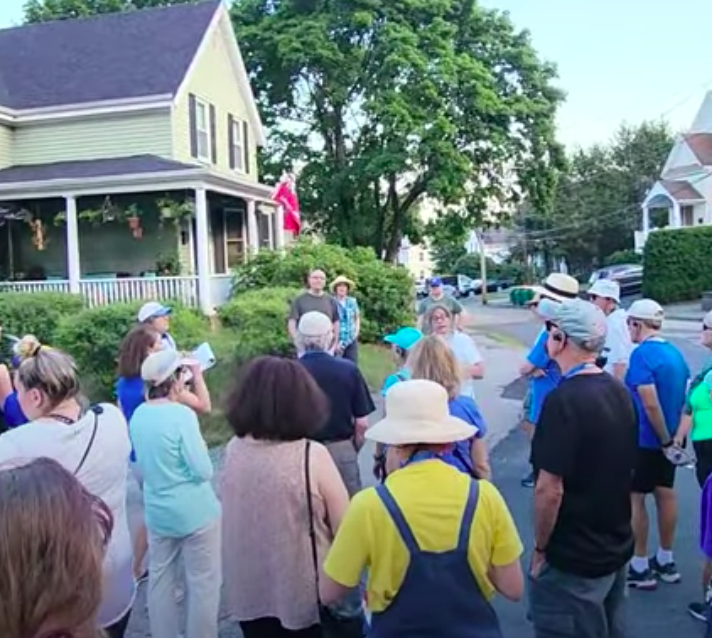
In the summer of 2022, the town of Norwood celebrated their 150th anniversary. A celebration committee was formed a couple of years in advance, and had planned some amazing year-long activities. Our historical society also wanted to offer opportunities to celebrate this anniversary, and we decided to offer several walking tours focusing on some of the ethnic neighborhoods that helped the town grow. These neighborhoods were established around 1900, and were home to so many people who came to Norwood in search is good jobs. A sort of chain migration occurred, as they told friends and family members of the wonderful opportunities Norwood had to offer. As I was researching these neighborhoods, I found it so fascinating how these new Americans shared their culture with their children in a variety of social organizations, churches, and celebrations. We offered seven tours over seven weeks over the summer on Tuesday nights. Every Tuesday, the number of attendees grew as people began talking about our tours. The last tours we gave had 50 to 60 participants!

A couple of years ago a local church began to explore the history of slavery in their church, with an eye towards reparations. I was asked to research a man who was enslaved in their town. This research led me to ask myself who else was enslaved there and what did their lives looks like during their enslavement and after (assuming they experienced freedom). First I had to identify people who had been enslaved in town, but the enslaved traditionally do not leave a lot of records behind. So I started with looking for wealthly residents and pulled wills, deeds and local published histories. As I was finding these people and the people they enslaved, I realized they all lived in walking distance of one another. I automatically thought writing and giving a walking tour about this history might be well received by the church and other interested people, but more importantly, I thought it was a wonderful way for people to learn about this history.
Currently, my hometown is celebrating its 300th anniversary. A friend, who is a member the Board of Directors of our historical society, and I are planning to present six walking tours of our local cemeteries over the course of the year. I’ve been working on the research part and I think we have selected several great topics. So instead of giving a similar tour of each cemetery, we have selected an over arching theme for each tour. Some themes we will be discussing are founding families, early industries and wars that have affected Americans. By taking these themes and tying them into people who are buried in the cemetery we will create a walking tour that is more than “here is a grave of a person….AND here is another grave of a person,” hopefully it will be a tour that presents local history in a unique way.

Some of my take-ways from the tours I have given, is to try to keep it around 1 hour to 1½ hours long. If they are too long, you will loose people. I have a couple of tours I know if are offered again, need to be edited. Also, have an idea regarding the physical length of the tour. If you cover a lot of area, let people know, that way they can judge if it is the right tour for them. It is also important to do a dry run of your tour, think of it as a dress rehearsal. On my slavery tour I just walked it, and I found the non-stop walk was about 55 minutes. I lopped off one stop on the tour, which gained be 15 minutes, and I shorten my talks at a couple of stops and hoped I was in the 1½ hour range. The other part I think is important is to share the presentation with another presenter. With the neighborhood tours, I had someone else helping me. One tour was of a swanky neighborhood filled with beautiful Victorian homes, my co-presenter was an architectural historian who offered a perspective that was not in my wheelhouse. In another neighborhood tour my co-presenter was someone who’s grandparents came to Norwood and helped established this neighborhood, her parents grew up there and she did too! She offered personal stories about the lives of the neighborhood residents, which sparked a great deal of conversation among our attendees.
Walking tours are a wonderful casual way to share local history. It is through this kinds of low-key presentations, that will engage participants. They often feel free to ask questions or share memories. Walking tours are really an enjoyable way to teach local history!
 Laurie L. Kearney