
Creating A Online Presence – How To Attract Visitors

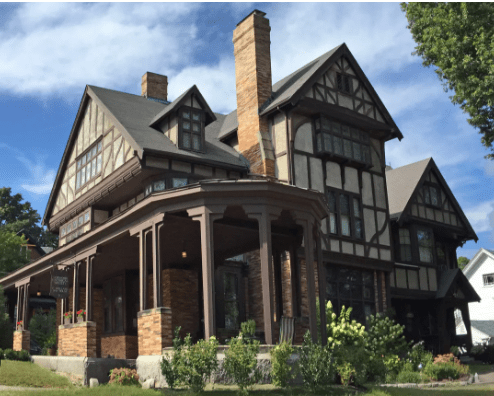
The beautiful Fred Holland Day House, the home of the Norwood Historical Society

            A few years ago, I was asked if I would join the Board of Directors of a local Historical Society. I became part of a dynamic group of people, each who bring a special interest or ability to the table, and together, I think we make a pretty good team. We have a beautiful old Victorian House that is our society’s headquarters, and we are always trying to come up with novel and interesting ways to physically bring people in our doors. Those that come to visit often say, “I grew up in this town and this is the first time I have been here.” Honestly, from being an active member of a couple of other local historical societies, I know this is a refrain heard over and over again. It seems our culture values the places and people who keep history alive in town, but they rarely have anything to do with that local history. When COVID hit, we, like everyone else, had to shutter our doors to guests. Although our physical home was closed, we still wanted visitors, so we went virtual.

This Day in Norwood History. A fun graphic created by George Curtis.

            One member of our Board of Directors created a daily posting he called “This Day in Norwood History.” Part of our collection contains bound copies of our local newspapers, going back for several decades. Taking a cue from today’s date, he looked through our collection for interesting newspaper articles with the same date. He usually selected a short article that may have featured a business or a person or a location. He transcribed it and posted it to our home page, then linked that posting to our Facebook page….of course he included a picture to catch someone’s eye. The response was incredible! Our Facebook post was shared and shared again. People often started threads discussing their memories of topic posted, and the traffic to our home page increased tremendously! We were reaching not only local folks, but those who had moved out of town settling in far way communities.

            Another local historical society where I volunteer did something similar. They thought it might be fun to photograph items from their collection, and post them on their Facebook account asking people if they can identify what the item was and/or what it was used for. This was an excellent way to not only show off their collection, and to spark conversations, but an even better way to attract virtual visitors. Another take on this is posting local places long gone, and asking visitors if they know where this place was…and what is there now.  Sparking a memory often will engage people, and bring you virtual visitors, who if in the area may physically walk though your doors someday.
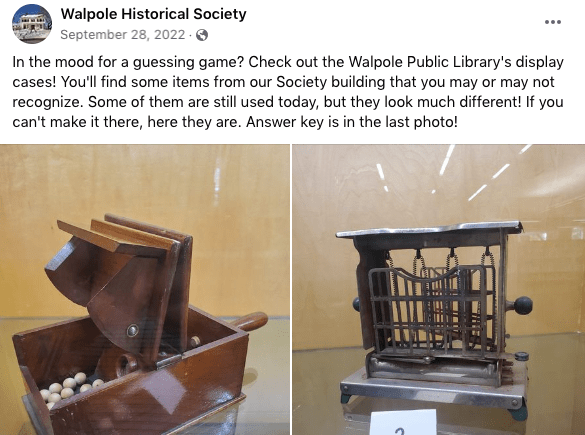
A fun Game from the Walpole Historical Society’s Facebook page.

            Today, so many historical societies struggle finding ways to share a their history and trying to engage people. Using the internet effectively a small society can potentially reach millions of people. Yes, using social media like Facebook, Tik Tok and Twitter (now X), can reach a large amount of people, but your society wants to have their robust own home page. One that offers visitors online exhibits to peruse, history article to read, and a place to join or buy society swag. Using social media will catch the attention of interested people, but linking those posts to your society’s home page will bring in virtual foot traffic and educate the public on your unique history.

            Initially “This Day in Norwood History,” was planned to be a program we were going to run during COVID, it has been wildly successful, and is still going today! The “What is this Item” the other historical society was doing, continues but at a more sporadically. Mostly because they are fun and engaging…which I think is exactly what history should be!
1775 Small Pox Epidemic in Norwood

Recently I was assisting a local group with their cemetery database. They have some interesting notes left by a local historian regarding who is buried in the oldest cemetery in town, and do not have headstones to prove burial…and, by golly his notes are pretty accurate! Anyhow, I was cross-referencing these notes with a transcription of records from the local church, which I photographed and transcribed some fifteen years ago. I noticed in the record book of Rev. Thomas Balch, the deaths of 18 people from the village of South Dedham in September and October of 1775 had been recorded. This is a sharp contrast to the 8 to 10 deaths Balch recorded annually.

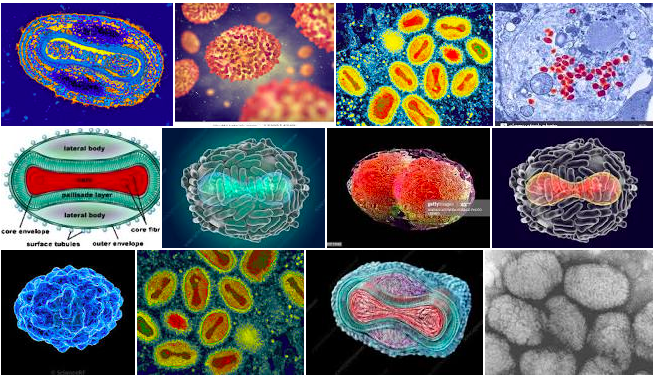
a collection of images of CIVID-19

Currently we are dealing with a pandemic, the likes of which we have not seen in over one hundred years, so these recordings caught my eye. In the 1770s the village of South Dedham was a sparsely inhabited agricultural community, and 18 deaths in a two-month span must have been devastating for this little village. These entries made me want to figure out what was happening in the fall of 1775 in the Boston area. I found that the illness Bostonians were dealing with was a small pox epidemic. In fact, one article I found online noted Bostonians were so focused on the illness that it took away their worries about the war.

Entries from my transcription of the First Book of Records for the First Church of Norwood.

Small pox is a virus, the CDC says “it was a serious infectious disease caused by the variola virus. It was contagious—meaning, it spreads from one person to another. People who had smallpox had a fever and a distinctive, progressive skin rash. Most people with smallpox recovered, but about 3 out of every 10 people with the disease died.” Bostonians were not unfamiliar with small pox. Over the 150 years since the Winthrop Fleet landed in the Massachusetts Bay Colony, they had experienced waves of this illness. The English, who had taken over the city of Boston in 1775, were not concerned about catching the virus, as many had either been previously exposed or inoculated against it. But the citizens of Boston struggled with the virus, some were sent to the countryside, by the British General Gage, some say to free up space in the city for British soldiers, others believe Gage wanted to spread the illness to the Boston countryside.

Like today, as we grapple with this strange novel virus, the American colonists, in the 1700s, recognized the importance of quarantining those with the contagious disease. Sometimes by setting an individual off by themselves or sometimes closing off an entire community until the virus had run its course. Often businesses were forced to close during these times, and farmers found they were either too sick to tend their crops or that others were too sick to help them. Even in the 1700s, there were economic consequences to these epidemics.

Back in Dedham in the fall of 1775, those that were the most effected were the children. Nathan Morse lost three children, while the families of Silas Morse, Jeremiah Kingsbury, and Benjamin Fuller each lost two children. After October, Rev. Thomas Balch’s record book does not record any deaths until Sarah Farrington and Liberty Thorp both died in January 1776. Indicating the smallpox virus had run it course for the good people of South Dedham, and likewise, today the Covid-19 virus will run its course for the people of today.

Tony Williams, an author who has written and lectured extensively on the 1721 smallpox epidemic in Boston, notes in an online article he wrote for the St. Luke’s Historic Church and Museum, in Smithfield, Virginia, “That winter, businesses opened again, ships returned to the harbor, social relations returned to normal, people walked freely through the streets without fear, believers went back to church. While their lives may have been forever changed in large and small ways, the people endured, and normal life returned again. “

I find this statement very hopeful for our own future.

Sources:

  • Thomas Balch, “The First Church Record Book” The First Church of Norwood, transcribed by Laurie L. Kearney
  • Laurie L. Kearney, “The Second Parish Cemetery List,” Census Notes, Norwood, Massachusetts
  • “What is Small Pox?” The Center for Disease Control, The US Department of Health & Human Services (cdc.gov: accessed May 10, 2020)
  • Elizabeth Fenn, The Great Small Pox Epidemic, History Today, Vol 53, issue 8 August 2003
  • Tony Williams, “A Pox and the Social Covenant:1721 and 2020” St. Luke’s Historic Church and Museum, stlukesmuseum.org