
Making Timelines and Charts and Dive Deeper into History –

            I am a visual person. Sometimes when I am researching someone, whether it is a genealogical search or a historical search, I find it can be extremely helpful to make a timeline or some sort of chart to help me with my search. When you lay out the events and facts of someone’s life, without the clutter of your writing or notation of your sources, you can see the simplicity of someone’s life, and that may lead you to finding more information on that person.
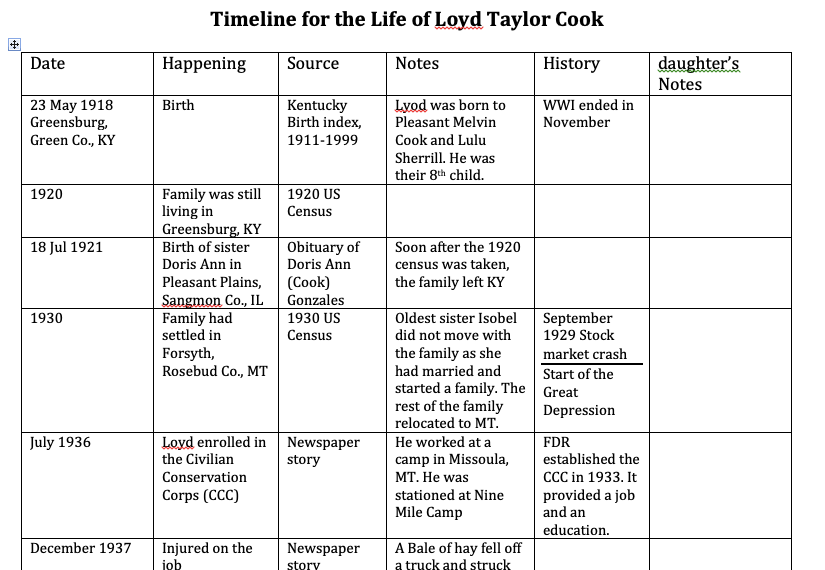
This chart incucludes events for Loyd’s life as well as historical event and a spot for his daughter to add memories

            Recently, I went to the movies with a bunch of friends to see The Boys in the Boat, which was about the University of Washington’s rowing team during the depression. So many of these young men came from families that were especially struggling during this era. Some came on scholarships, some worked to pay for their education, but through their participation in the crew, they found themselves on an equal playing field…or river in there case! This story really got me thinking about my friend’s father Loyd. During the depression, his family also struggled, he went on to work in the CCC, and eventually took those skills to Washington, where he put them to use. I thought Loyd might be a good subject to write about. I filled out the tree I had on my friend’s family, paying careful attention to her dad, trying to find as much documentation as I could on his life. As you build a tree on Ancestry, a timeline is created on the profile page, but as I looked at it, I could not clearly see the story I was hoping to tell. So I opened a new Microsoft word document, and began to create my own timeline on Loyd. By considering some to the events that happened in his parents and sibling’s lives and knowing Loyd was living with his family, I was able to add new events to his life. One of the things I see missing was his voice. I sent my timeline to my friend, leaving a column for my friend to enter her dad’s stories.

A section of Mrs. Simons’ obituary, naming her children (who I knew) and her brother (his name here proved this line)

            Another time I found making charts helpful was trying to work out the life of my husband’s great-great-grandmother, Mary Ellen. She was someone who had been a brick wall in my family research for almost twenty years. This was a woman who came to California as a new bride, leaving her history (and family) behind in Ohio. My husband’s Granny knew more about her grandmother’s life in California, but did not know anything about the family she left behind. She had a few stories to tell that I thought might lead to a familial find. The turning point for this search occurred with a distant cousin posted images of the family bible on line. This posting started to pull the pieces of Granny’s stories together with primary sources I had found. I made several charts that compared and contrasted the information I had. Through this process I could clearly see the family connections and was able to draft, I thought, a rather compelling argument as to who was Mary Ellen’s Ohio family. Approximately two years after I felt I found Mary Ellen’s family. One of the historical newspapers I subscribe to, digitized a newspaper with Mary Ellen’s obituary, which named her siblings….and by golly, I was right!

Time line for Hannah, a free woman of color who lived in Walpole a long time ago.

            Recently, I was looking for information on how my town handled their indigent population around 1800. As I was going through town records, and recording my findings in a chart, which I intend to use for comparing and contrasting the towns management of their poor, I found information regarding a person I had previously studied. She was a free person of color who married a formerly enslaved man and lived in my town. Church records and town records mention her from time to time, and local history books give her a passing mention. I decided to put all the primary sources into a chart (town and church), and what that chart showed me was that this woman lived here for many years and was frequently harassed by the town fathers. Shameful.

            Graphing the fact you find on your ancestors can be extremely helpful with your genealogical researching. Give it a try. I think you will like it!
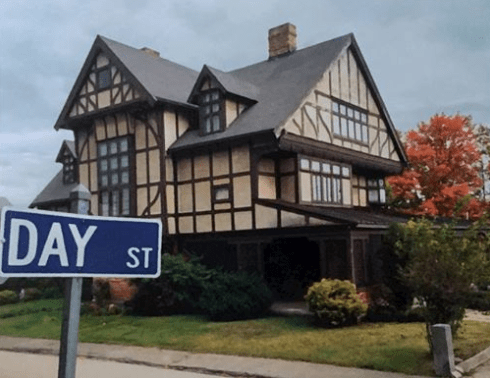
Know How a Large Victorian Homes Ran?… Like a Well Oiled Machine

I have had the pleasure of helping with tours at my local historical society. The society owns a lovely Victorian house, filled with beautiful things from an era gone by. Very often people ask if the family who owned the house had live-in help, and sometimes people inquire if they can see areas of the house that are not on the regular tour, like the basement and the attic. It is clear people are intrigued with the inner workings of a Victorian home.

The Norwood Historical Society.

These questions spurred me on to researching how Victorian homes were run. Although I had a pretty good idea, as my grandmother lived in a home her grandfather built, (she still cooked on a coal stove because she never liked those new fangled electric ones!). Both my mother and my grandmother told me stories about how my great-great-grandmother ran her home.

When one thinks of a grand Victorian house, one must consider how the house was laid out: there were public reception spaces, private family spaces and working spaces. My grandmother’s house and the historical society’s house were no different. Each had a formal staircase and a back staircase for the servants to use. Butler’s pantries were for storing table linens, dishes, glassware, and silverware, and it was also a space for servants to prepare before serving food. In the historical society’s house the door to the butler’s pantry from the dining room, when closed, blends into the paneling and cannot been seen. The way this house is laid out, the kitchen is the hub for all behind the scenes work. It has five doorways leading to the various working areas of the home, making those who worked there as invisible as the butler’s pantry door.

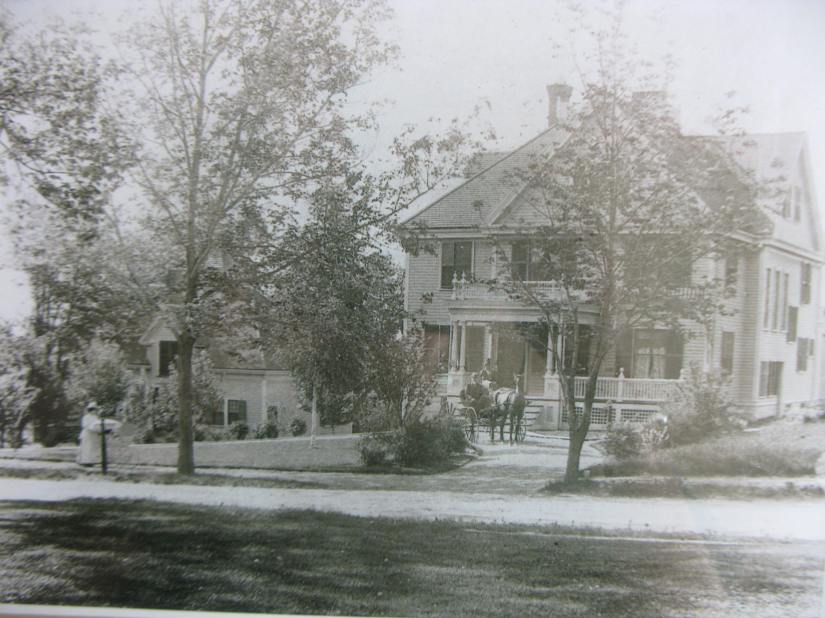
My Grandmother’s house in West Newton, (MA)

According to census records, the family who originally owned the historical society’s house, usually had two domestic servants living in the home. This gave me names of some of the people the family relied on to help run the home over a period of seventy years. The genealogist in me just had to research these people! I wanted to write little biographies of some of these workers to tell their stories….and all I could come up with was little biographies. Yes I know, there is a dearth of information out there about working class people. I had a much easier time writing about the owners of the home.

Next I researched the kind of people who were willing to do the jobs most were not interested in, what were the jobs, and the tasks involved in performing each job. I learned the working class people hired to perform these jobs tended to be recent immigrants and after the Civil War ex-enslaved people. A small home, may have had a cook, a maid, a gardener, and nanny, while larger estates may have had several people to perform one job. For instance, the cook in a large home would need two or three people to help prepare a meal, and a scullery maid to wash the dishes, and several butlers to serve the food versus the cook in a small home would perform all of those tasks.

The old coal stove in my grandmother’s kitchen. The kitties are resting near the stove as it is only warm. If my grandmother was heating it up….those kitties would be else where! (did I forget to mention my grandmother also raised siamese cats?)

I already had a working knowledge of how a Victorian home operated. I knew fresh food was kept in an icebox and ice delivery occurred when an “Ice” sign was put in a window for the iceman to see. Coal was delivered, probably on a schedule, through a chute to the basement. Laundry was an all day process and before there was indoor plumbing people used an out house, and someone had to empty the chamber pots in the morning, not to mention heating was a room by room project, as someone had to lay a fire in the fireplace in the rooms which were to be occupied. As one can image, days were long for domestic servants. They often rose before the sun, as the coal stove had to be heated up enough to do the morning baking. They would have gone to bed, up the back staircase, to bedrooms in the attic, after the evening chores were done and most likely the mistress of the home had gone to bed.

This was actually a fun little research project to do, as it required a little genealogy, and little bit of knowledge about the workings of a Victorian homes, and I enjoy doing a historical research too!

Sources:

  • Daniel A. Graff, “Domestic Work and Workers,” Encyclopedia of Chicago, (encyclopedia.chicagohistory.org/pages/386: accessed March 20, 2020)
  • “The Backstairs at Brucemore: Life as Servants in Early 20th Century America,” Teaching With Historic Places, The National Park Service; U. S. Department of the Interior (nps.gov: accessed March 20, 2020)