FamilySearch FamilyTrees

            FamilySearch is one of the best sites out there for researching genealogy. They came online almost twenty-five years ago, with a simple format that basically coughed up lists. Originally this included some census records, a couple of databases and their International Genealogy Index (IGI), which is a database that included many primary records as well as many undocumented sources. Over the years, they have continued to update and improve their website eventually doing away with the IGI and now offering digitized records. About eleven years ago, they added a family tree component to their page, which is basically a crowd-sourced tree. So if you realize that the tree you are adding to is NOT your tree and that anyone can add whatever they like to the tree….even if it is not accurate information about your grandfather – Then go ahead and add to it!
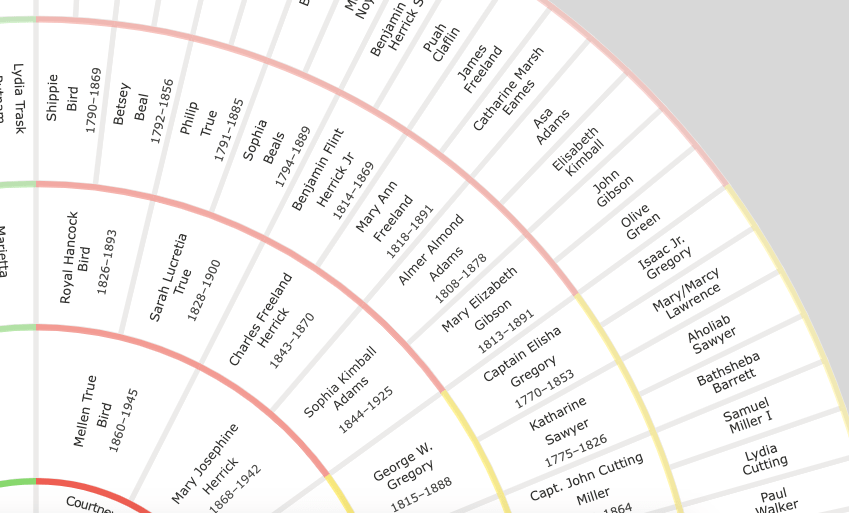
A section of my family tree fan chart on FamilySearch

            I initially was apprehensive about contributing to the tree. So apprehensive in fact, that I did not even look at it for almost ten years, mostly because wrong information drives me wacky! I can fix it of course…but someone can fix it back too. But eventually I thought why not. At least I could enter the information that pertains directly to me. I’ve added picture of ancestors, and some stories too, I have even added to branches of family lines to the tree that I am researching.
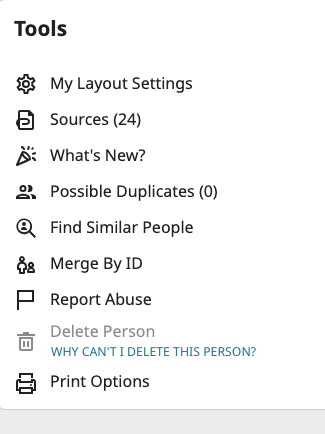
The tools FamilySearch has to help edit, merge and attach sources to your tree

            If you do not want to buy an Ancestry membership, then I would recommend keeping your tree on your computer, so do not rely on the FamilySearch tree to keep your research; mostly because someone can change it. Consider the FamilySearch tree as a clue and not fact. Do your own research and find your own documents (proof). The FamilySearch tree initially seems easy to use, first you will have to sign up for a membership. It’s free (I love free!), and therefore, they will not ask you for a credit card. The tree also has ways of attaching sources to it, which is nice as it helps prove the line. There is also a way to change information, delete people (or move them to another branch), and merge duplicate records, but I admit it is tricky to do. The learning curve is huge, and you will make mistakes. When I get stuck, I stop trying to fix it and hope someone will come along who knows how to fix my errors…I also imagine them cursing me out!

            I think the FamilySearch tree is worth a try. It is a great source that can point you in a new direction…or confirm you are on the right track. But keep in mind just as easily it can be right…it can be wrong! Think of it as a clue and not fact…it is just another tool in you toolkit.
Genealogy Conferences – a Gift you Give Yourself

         I think as learners we all get to a place where we need to turn to someone for help. There are plenty of online sites that have information that may hold the key to your questions – Facebook, YouTube, and blog posts are just a few that come to mind, and they may indeed have the answer you are looking for….but they can just as easily give you what you think is the answer, but it only confuses you more. As genealogical researcher, your questions may go from what does this word mean? To how do I break down a brick wall? And pretty much everything in between. The very best thing for you to do is to consider attending a genealogical club or conference to teach YOU how to do something new, instead of relying on input from a stranger. Over the years I have attended many genealogical conferences that not only simply educated me on a new technique or showed me a better way to find records, but these conference presentations fortified my research skills and has continued to assist me as a researcher, because I know what I am looking at.

            When DNA first came on the scene as a way to find wayward ancestors, I was not interested. I had a friend who was lovin’ it! And even she could not convince me to give it a whirl. Then one weekend I found my schedule was free AND my husband was willing to hang out with the kids, so I went to nearby Genealogy Conference….it was being held at a facility less then an hour from my home. I showed up as a walk in. There were booths to peruse, and books for sale, but best of all there were programs to attend. I decided to take in the DNA presentation, which was a two-part presentation.

            The presenter really started with the basics, starting with the vocabulary and then moved into using that vocabulary to explain what a DNA report was showing, and how to use that information to find family connections. She had a family mystery she was hoping to solve. She took us through her search step by step, showing us the breadcrumbs she discovered along the way. As her presentation progressed, she began to show us how she then put these pieces together to find her answer. I walked away with a new appreciation of DNA and how it can be used to break down a brick wall. I played with it for a couple of years, before I decided I needed to attend another conference. This was a week long one, and sadly because of COVID, I ended up attending it from the comfort of my own couch. We had presentations from several genealogical DNA rock stars. Their information added to my DNA tool kit, giving me a deeper understanding, as well as some new techniques that strengthened my skills.

            These conferences have been very helpful to me! Plus, hanging out with a bunch of Genealogists for a couple of days is fun! Imagine talking to someone who shares your enthusiasm! My poor husband has listened me, trying to be excited for my discoveries, but I know he is not. The conference that kicked off my DNA journey is only one of many conferences I have attended. I have taken in an all day “how to search and find Irish records,” a program I though would be helpful finding my husband’s Kearney ancestors. Another presentation I took in was “how to use ArkivDigital” Sweden’s Archives, which I figured would be helpful researching my grandmother’s line.

            As genealogists, we need to think of ourselves as life long learners. The more you learn….the better genealogist you will become!

(NOTE: All pictures are from RootsTech. A large in person/virtual Genealogy Conference. It happens every year in Frebrary. Some day I plan to go!)

Where to Start, Where to Start?

So, you think you would like to discover your roots and you don’t know where to start? Well that is easy! Start with yourself, your parents and your grandparents!  Jot down birthdates, marriage dates and death dates (if you know them!). Then have a conversation with the older generations in your family. Having all this personal first hand knowledge is a great place to start.

With your notes firmly in hand, you are ready to begin to search in earnest! I recommend starting the FamilySearch.org site. They will want you to sign up for a free account. They do not ask for any payment information (i.e. your credit card), and they do not flood your email account with unwanted emails. FamilySearch is owned and operated by the Latter Day Saints (the Mormons). Part of their belief system is that families are very important in this life as well as in the after life, and by finding (and baptizing them as Mormons) long dead relatives, they all will be reunited in heaven. The nice thing about their website is that they have imaged thousands of original documents (primary sources). It is these primary sources that prove your line, some secondary sources or a story passed down for a few generations may be false! My great-grandmother told my dad and his brothers we were related to Pocahontas. When I was little, I thought that was pretty cool, and indeed it was one of those facts I went searching for when I first started researching my family. It took a while, but I found my great-grandmother’s grandmother maiden name was “Rolfe.” That was clearly where the story came from, but my Rolfes were in no way related to the family into which Pocahontas married.

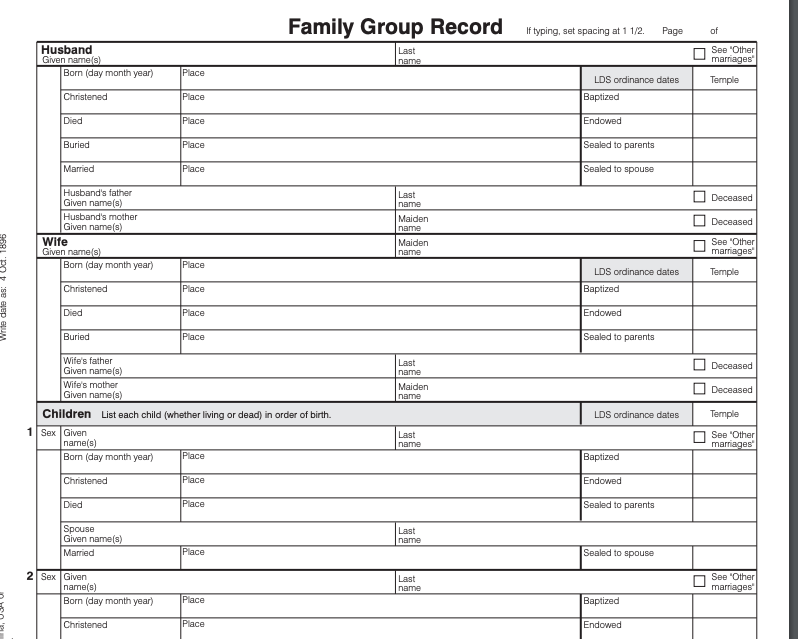
One of the most important things you can do is to keep accurate records. Notes of your conversations, family group sheets, pedigree charts, when and where you researched (so you do not repeat your searches!). You can keep these records in a binder or invest is some genealogy software. (There is free software out there, but I would research it before you download it!). I often start a new search by opening a Microsoft Word document, and take my notes there before I start making a tree. I can also cut and paste links in this document, so if I go back and revisit this family, I can re-visit the links!

It is very important to Document, Document, Document! Keep track of all your sources. By doing so you can show your proof, you can return to your searches if you need to re-evaluate the accuracy of your source, and it will also prevent you from doing the same searches over and over again. Once on a genealogy Facebook page (consider joining one!), I came across a fellow who posted that he had just started tracing his family tree and had already managed to trace back to Adam and Eve. He most likely copied someone else’s tree, who did not have any sources. Genealogists on the page had to gently explain to him that this was very unlikely.

Evaluate your sources for accuracy. Very often some sources are questionable. I have seen people document a marriage, which occurred in the 1600s between someone in New England and someone in Virginia…although in theory possible, the distance would have made it difficult. In tracking that pesky Rolfe line, I found a Rolfe raised in Massachusetts in the mid 1700s, relocated to New Jersey. I thought this maybe untrue, but the more I looked, the more primary sources I found, and it turned out to be true! So, double and triple the sources, especially if you found the information on someone else’s tree. If it does not make sense, it is probably wrong.

Genealogy is a fun pursuit. I love to untangle a historical question. Sometimes the information comes to you very easily and other times it may take years before you find the next generation, but don’t give up!

So keep this in mind:
            Gather what you know.
            Research can begin.
            Accurate Records must be kept.
            Document your sources.
            Evaluate your sources for accuracy.
 
And you’ll have good GRADEs!