DNA question solved— A Mystery Man no longer a Mystery

Some of my Genealogy books

            A couple of years ago, a friend asked me to answer a genealogical question. She wanted to know the identity of her birth grandfather. Her dad, at that time was in his 80s, and had been curious about his birth father on and off over the years. Kathy provided me with as much detail as she knew, and hoped I would be able to figure this family question out by following the paper trail. She knew when and where her father was born. She was not so sure if her grandmother married this mystery man, and she believed he was in town while working on a CCC project….oh yeah, she also had his name! Unfortunately it was a rather generic name, not one that was unusual. There were at least five candidates, who had that name and of the right age to have been in the CCC at that time. With several CCC camps located within a relatively short distance from grandma’s home, it would not have been worth it to ask the National Archives to search for this mystery man. The paper trail was a dead end.

Ancestry DNA test kit

            I suggested Kathy take a DNA test. Perhaps that would hold the answer. A couple of years passed, and finally Kathy decided to take an Ancestry DNA test. I happen to like Ancestry as they have a large database of DNA results and family trees. While we waited for the results to come in, I began to build out Kathy’s tree. Knowing that we would get a large number of first to fourth cousins (because they are the ones alive today to be able to take a test), and I wanted to have a good idea how they all fit into Kathy’s family. Also, back when I was searching the paper trail, I did not look at Kathy’s mom’s side. That needed to be added into the tree too, as most certainly there would be DNA matches on her side too. Plus, by building out Kathy’s tree, I was reacquainting myself with her family.

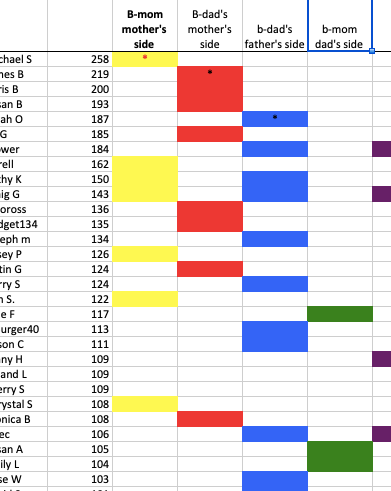
            Finally the test came in! One of the first things I did was to make a Leeds Chart. By considering close matches, those with a high number of shared centi-Morgans (cM), I would be able to identify descendants of the four grandparents. Then I could narrow down my search and focus on Kathy’s paternal grandfather’s line. Out of 38 close cousins, 30 of them were all from one branch of the family! Leaving 8 other cousins from the remaining three branches of the family! And only one of these was from Kathy’s paternal grandfather’s line! The amount of cM this person shared with Kathy indicted that they were a half niece/nephew! Which obviously indicated Kathy’s dad had half-siblings! And to make it worse, this person had a private tree! Luckily, this person named their test kit using (what appeared to be) their first initial and their surname followed by a series of numbers. At least I had a clue to follow.

A peek at Kathy’s :eeds Chart.

            I used Google to see if I could find a person with the surname I was seeing, who was related to Kathy’s surname. Bingo! I found the obituary of one of Kathy’s half-uncles who had a granddaughter whose name started with the first initial….and had the same surname as the test taker. I sent Kathy an email with the obituary linked in the text, saying meet your uncle! When Kathy called me their first comment was how much of a family resemblance there was, between this uncle and her Dad (and siblings).

            With this clue, I was able to begin to build out a tree with this branch of the family to see were they intersect with Kathy’s branch. Turns out the half uncle’s father had the same name as Kathy’s birth grandfather. As I worked my way through a tree with this side of the family, what became clear was that Kathy’s birth grandfather was a local boy, not someone who was stationed in town working with the CCC. In the 1930 census, census takers recorded the street address of the respondents. Using that information, I entered both grandma and birth grandfather’s 1930 addresses into a online map program….and well, they lived about 18 blocks apart from each other. The census further indicated that birth grandpa was married at that time, to the half uncle’s mother. This census, certainly begins to show why this man had been a mystery to Kathy’s family.

            Suddenly, Kathy’s dad went from being an only child, to being a middle child, as records show, the birth grandpa had two sons, one older and one younger than Kathy’s dad. So I must say hanging all your research on only one DNA cousin, it well tricky and certainly leaves room for errors. But as I was researching this family, another DNA half-niece popped up in Kathy’s DNA family list! This person named their kit using their first and surname, and wouldn’t you know, she too is a granddaughter of the same half-uncle. So the DNA and paper records show, the same name for birth-grandpa as half-uncle dad’s name, plus 1930 locality would indicate that both grandma and birth-grandpa could have met either social functions or through work, and with now two DNA half-nieces, indicates this mystery man is no longer a mystery!

            Please note, I used a made up name for my friend. As you can see, this is an extremely personal story. One that Kathy is planning on telling her dad in time, if he is comfortable hearing, as he is now in his nineties!
Building a big DNA Match Tree

Ancestry DNA logo

            So you’ve taken a DNA test, mailed it off and now you wait. Sometimes that six-week wait seems like a lifetime, especially if you are hoping to solve a family mystery. The thing is you want to be prepared when those results are in your in-box. You are going to end up with a long list of cousins. Those that you share a higher cM with are most likely going to be people you actually know, and when you get into the third or fourth cousin realm, well, they will be people that you don’t know. So you are going to want to be ready to recognize who these cousins are and how they fit into your tree.

            I believe that when someone is new to genealogy, they build a rather skinny tree. Basically, self, parents, grandparents, great-grandparents and so on; perhaps with a goal to see how far they can go back. So thinking about your DNA results are going to give you a list of people who are here now….kind of like a family tree in reverse. So it is time to fill out your skinny tree and make it as robust as you possibly can!

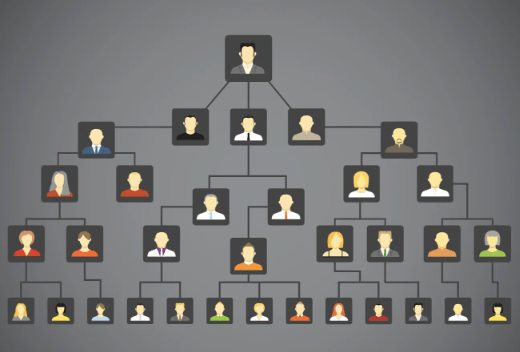
A graphic showing an upside down family tree.

            Starting with you, add in your siblings and their children. Then go to your parents and add in all your aunts & uncles and (your first) cousins, and their (your first cousins once removed) children. Then go to your grandparents, add their siblings, and their children, and their children’s children (your second cousins), and their children (your second cousins once removed). Go back for several generations, bringing each line forward, so your third cousins and fourth cousins are now in your tree. Look at the records you are using to fill out your tree. Primary sources are key to having an accurate tree. Don’t accept someone else’s tree…they just may have some errors in their tree that will infect your growing tree. If you get stuck, well that is OK. Don’t enter wrong information. Stop there and start growing another branch. If you have a question, like “who is my birth grandfather?”- there will be a branch in your tree that has not sprouted yet, and that is fine. Once you have filled out all these new branches, it will help you feel knowledgeable about the some of the matches you see when your results come in.

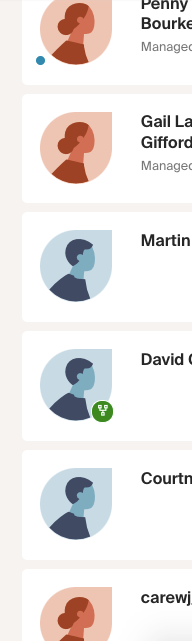
My son’s matches. His 2 grandmothes, a couple of great-uncles and a 2 first cousins once removed. Note: “David” has a little logo on his name. he has been attached to my tree.

            I have used several DNA sites and really like Ancestry the best. They encourage people to build trees, and they have a very large DNA database. So, you will get a ton of new cousins! Ancestry’s database + family trees + the tools they have, is fabulous for figuring out all these new cousins and how they are related to you! You can sort your matches, by parent, and then you can sort those matches again by surname, or if you have a shared ancestor, or by shared DNA. You can attach a (private) notes to these matches, (they cannot see it), you can color code matches. Play with the tools they have to offer, see how they work and what works best for you. There is a tool for you to identify your cousins (“do you recognize this person”) and attach them to your tree. You will defiantly have cousins you cannot figure out where they fit into your tree. If they have a family tree linked to their DNA kit, you can click on it and check for common ancestors…or common surnames.

            Having such a robust family tree will certainly help you understand your family tree better, and bring a whole new level to the results you will get. Sure, it is fun to know about your ethnic percentages…. but having a tree with all these new cousins it can take your DNA findings to a whole other level!

            Please note, If you are trying to find a mystery ancestor, there are many search angels out there who can help you find a missing family member and help you with the best way to approach them. Having an accurate robust family tree will help them with your search too! You can find a search angel on may Facebook DNA sites.

Genealogy Conferences – a Gift you Give Yourself

         I think as learners we all get to a place where we need to turn to someone for help. There are plenty of online sites that have information that may hold the key to your questions – Facebook, YouTube, and blog posts are just a few that come to mind, and they may indeed have the answer you are looking for….but they can just as easily give you what you think is the answer, but it only confuses you more. As genealogical researcher, your questions may go from what does this word mean? To how do I break down a brick wall? And pretty much everything in between. The very best thing for you to do is to consider attending a genealogical club or conference to teach YOU how to do something new, instead of relying on input from a stranger. Over the years I have attended many genealogical conferences that not only simply educated me on a new technique or showed me a better way to find records, but these conference presentations fortified my research skills and has continued to assist me as a researcher, because I know what I am looking at.

            When DNA first came on the scene as a way to find wayward ancestors, I was not interested. I had a friend who was lovin’ it! And even she could not convince me to give it a whirl. Then one weekend I found my schedule was free AND my husband was willing to hang out with the kids, so I went to nearby Genealogy Conference….it was being held at a facility less then an hour from my home. I showed up as a walk in. There were booths to peruse, and books for sale, but best of all there were programs to attend. I decided to take in the DNA presentation, which was a two-part presentation.

            The presenter really started with the basics, starting with the vocabulary and then moved into using that vocabulary to explain what a DNA report was showing, and how to use that information to find family connections. She had a family mystery she was hoping to solve. She took us through her search step by step, showing us the breadcrumbs she discovered along the way. As her presentation progressed, she began to show us how she then put these pieces together to find her answer. I walked away with a new appreciation of DNA and how it can be used to break down a brick wall. I played with it for a couple of years, before I decided I needed to attend another conference. This was a week long one, and sadly because of COVID, I ended up attending it from the comfort of my own couch. We had presentations from several genealogical DNA rock stars. Their information added to my DNA tool kit, giving me a deeper understanding, as well as some new techniques that strengthened my skills.

            These conferences have been very helpful to me! Plus, hanging out with a bunch of Genealogists for a couple of days is fun! Imagine talking to someone who shares your enthusiasm! My poor husband has listened me, trying to be excited for my discoveries, but I know he is not. The conference that kicked off my DNA journey is only one of many conferences I have attended. I have taken in an all day “how to search and find Irish records,” a program I though would be helpful finding my husband’s Kearney ancestors. Another presentation I took in was “how to use ArkivDigital” Sweden’s Archives, which I figured would be helpful researching my grandmother’s line.

            As genealogists, we need to think of ourselves as life long learners. The more you learn….the better genealogist you will become!

(NOTE: All pictures are from RootsTech. A large in person/virtual Genealogy Conference. It happens every year in Frebrary. Some day I plan to go!)

Learning about Leeds Charts

This is not a “how-to” discussion, as I am a newbie to this technique. Plus, there are so many wonderful how-to videos on this topic, AND the person who created this technique has their own blog page (here). Who better to learn this method from than the person who developed it!

I had read on several genealogical DNA Facebook pages where I am a member, about how helpful Dana Leeds’ technique was for organizing DNA matches. Bonus, it is a color-coding technique and I am a person who finds visual practices very helpful to understand, or to “see” a new concept. Admittedly, I tend not to fortify my mind before I research. Sometimes I like to delve in and see where my research takes me, and learn as I go along.

My first experience was working with my college roommates DNA to answer a genealogical question: who was her birthfather? Like so many people, when the results first came in, I did not know where or how to start. What I was looking at was somewhat over whelming. I clicked on many of the matches and looked at their trees (if they had them). I googled for information on some of the matches, hoping I would discover a clue…or two, that might help. Finally, I turned to YouTube for guidance and learned about mirror trees. Actually not a technique that would be helpful in this case, but I liked the idea of building a tree that would contain the matches. Perhaps that might lead me to this elusive birthfather. I learned as I went along and was eventually able to figure out how my friend fit into this genetic tree.

From experiencing some success, I wanted to have more opportunities to use DNA in genealogical research. A couple of summers back, I took a DNA class (online because of the pandemic) at the Genealogical Research Institute of Pittsburgh (GRIP), where one of the presenters was none other than Dana Leeds! She lead us through her method step by step, then gave us a homework assignment to try it on our own. Now, not having a lot of DNA in my account to work with, I thought I would use my college roommate’s DNA results, as I already knew what the answers should be. I thought this would be a self-correcting way of using the Leeds Method. If I did not fully understand this technique, then my chart would be wrong, and then I could go back and re-try this method to get it right.

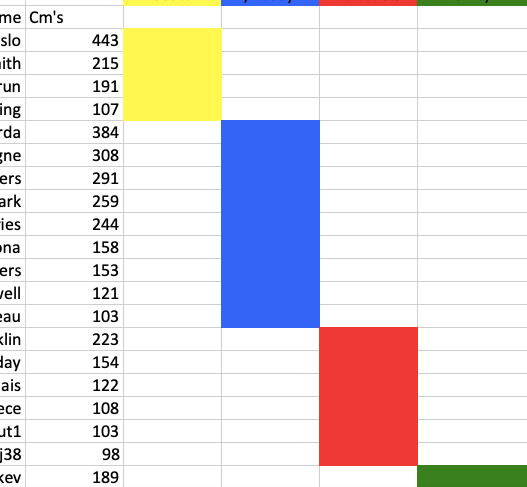
Basically, you consider a small subset of DNA matches, people with whom the test taker shares approximately 400cM to 90cMs with; their second and third cousins. Using a spreadsheet to record your matches, you click on the 1st second cousin in the list who shares about 400cMs with your test taker, then you click on “Shared Matches.” That is the list you record in your spreadsheet, assigning all those in this column a certain color. Arrow out. Then click on the next cousin (who you have not entered into you spreadsheet), then click on “Shared Matches” and record that list assigning them another color. Work you way through the cousin list until you get to your last cousin with whom the test taker shares 90cMs with. You will end up with at least four columns…and sometimes more, but don’t panic. With is information you will discover the surnames of the test takers grandparents. (If this technique intrigues you, I would encourage you to find another site that can explain it better!)

This is an excellent place to start your research. It gives you a snapshot of the test takers family. Basically you know the surnames of the grandparents. The next thing I do is build family trees using the trees the shared matches built and building them out to include siblings and cross referencing them to primary documents. If I am lucky, I will find a marriage of two people with the grandparents surnames…perhaps THE grandparents, but it could be another couple with the same names….so check and double check your research!

I love the Leeds Method and highly encourage people to learn more about it!

My DNA Journey: The Gift that keeps on giving!

Having had several positive outcomes using DNA to solve genealogical questions, I felt empowered, but I knew I needed more experience using it. Enter my friend Tracy. She was adopted. She “met” her birth mother’s family many years earlier, but did not know any thing about her birth father’s family…. and her birth mom was not giving up the information. It was a question she pondered about, but had no burning desire to know more. When I asked her if she was willing to take a DNA test for me so I could figure out this question, she graciously accepted.

I asked Tracy not to give me any information about her birth family. Knowing that many adoptees do not have any information on their birth families, I thought having empty slate, would be an excellent challenge for me. Now, I have known Tracy for approximately twenty years now; our children grew up together. So I remembered a few bits of information, like she had occasional phone visits with a half-sister named Rhoda, who lived in another state…but that was all I basically recalled, and it was not enough information to attempt a Google search.

It took a while for the results to come in, as the first test failed and Tracy had to send another sample. When she received the results, she shared them to my Ancestry account…and I was off and running! I thought I would resolve familial questions quickly, but that was not the case. The very first thing I did was to make a Leeds Chart. This technique should yield the surnames of the grandparents of the test taker, which ultimately it did…but it also created a few questions for me!

Who was Tracy’s birth father? Well seeing as his brother and daughter had taken Ancestry DNA tests, I figured out who he was very quickly. In fact, it was so quick, that I actually second-guessed myself and dug a little deeper. I spent a few more hours on this question, and confirmed the bio-dad’s identity to my satisfaction. Tracy’s birth mom told Tracy stories about him, and the only thing that appeared to be true, was he had served in the military.

OK, now on to the identity of Tracy’s bio-mom. For some reason, I thought this would be the easiest question for me to answer. I don’t know why. Perhaps it was because I had the notion that Tracy already knew the answer. I know that doesn’t make sense, because not knowing, is not knowing, even if some else has the answer. Tracy had a lot of DNA test takers on her maternal side. So I started building a family tree based on the trees these test takers had started to build, carefully linking everyone together. As the tree grew and grew, I did not feel I was getting any closer to figuring out her bio-mom’s identity. It was SO frustrating!

The paper trail was not leading me to a bio-trail. I posted questions on a Facebook genealogical DNA site I belong to, hoping for guidance. I was certainly given feedback, which I took to heart. Taking these suggestions, I worked the tree, referring back to the DNA results, but I was not getting any closer to an answer. Finally, I had to call “uncle” and ask Tracy for the answer. She told me the name of her bio-mom. Turns out I had her in the tree, but I was nowhere near discovering she was the bio-mom.

This is where Tracy’s DNA branches get all twisty (hence my confusion). Turns out, Tracy’s bio-maternal grandfather was illegitimate and was raised by his grandparents. So he carried his mother’s maiden name. She went on to marry and have more nine children, and both her maiden name and her married name were in my Leeds Chart. I should be note that discovering “just” the four surnames of grandparent is the Leeds Chart is not a given…. usually you end up with several more surnames, but if you look carefully for commonalities, your results can be narrowed down to four surnames. In this case, many descendants of bio-grandpa’s half-siblings, as well as his aunts & uncles had taken DNA tests, but by looking carefully at the family tree, I saw how I got confused as these families all twisted together!

So the lesson I learned here was to look more closely at the documents. In the 1920 census, bio-grandpa was just a year old and living with his grandparents. This is the only time he is listed as their “grandson” in other censuses; he is listed as their son. These grandparents also raised another grandson as their “son,” after his mother (their daughter) died. Interestingly, this grandson’s known father appears to be (possibly) the brother of bio-grandpa’s dad…just to add further confusion to this family! As I dug deeper into bio-grandpa’s records, I found an image of his birth certificate online, and the name of his mother is listed…but not the dad.

This gave me a new DNA question of answer! Who was bio-grandpa’s birthfather? I knew who his family was, but candidates of the appropriate age were not indicating they were the father. Many descendants of these possible candidates had taken DNA tests. I expected to see a close-ish match…. like a first or second cousin (possibly or actually once removed). But the DNA numbers were showing a slightly more distant relationship. Rats! Once again, I turn for some guidance on a Facebook genealogical DNA page. There some one suggested I try WATO…. what? Turns out this is a new feature on the DNA Painter site, where you can build a scaled back tree to see if your familial hypothesis is correct. WATO, or What Are The Odds, is an interesting tool. After I gave it a try, it was clear I needed to learn more about how to use this tool.

So Tracy graciously allowed me to use her DNA as a learning experience. And boy did I learn a few things! And now I have more to learn!!! Tracy’s gift is definitely a gift that keeps on giving!!

Thank you Tracy!

My DNA Journey: A Journey of Discovery

I’ve been dabbling in DNA to solve genealogical questions for a couple of years now. About 5 years ago, a fellow genie friend began using DNA in her searches, and she thought it was a wonderful tool. I remained skeptical and was unsure if I wanted to invest time and energy into learning how to use DNA to solve genealogical questions. Then in 2018, I attended an educational conference sponsored by the Massachusetts Genealogical Council, where Jennifer Zinck gave a wonderful presentation on using DNA. OK, now I’m intrigued.

I reached out to a dear friend from college who had always wanted to know the identity of her birthfather…. (Last name “Smith”…. oh, please!). I asked her if she would be willing to take a DNA test so that I could learn a new technique. She agreed and my education began. I read what I could find online and watched several “how-to” videos, and when the results were finally in I began creating a giant family tree of her matches…. well, its more like a blob because she comes from a relatively insular community where families intermarried. Eventually I had had this giant blobby family tree and still could not figure out where her birthfather fit in. Then I found a video by the Barefoot Genealogist (Christa Cowan) on making a simple chart to visually see how your genetic matches fit in (video is here: https://www.youtube.com/watch?v=VP8rUlZbmeA&t=1011s). Once I did this…. I solved my first DNA mystery. Boy did I feel empowered!

My Grammy, Hope at 6 years old….and her birth mother, Hilda.

Next, I used my son and mother’s DNA to begin solving a family mystery…. my grandmother (Hope) was adopted and as luck would have it, after good old fashioned sleuthing I believe I found her birth family…. a DNA test proved I found a ½ second Cousin! This cousin informed me that my grandmother’s birthmother (Hilda) was also adopted (oh boy). After a free weekend on AkivDigital, Sweden’s Archives, I found that the birth grandmother mother (Elda), who was born out of wedlock (on no!), but DNA helped me figure out who her birthfather was. However, as you can see there is still a lot to figure out in this line!

Cross section of a Leeds Chart

Then attended and week long (online…because, you know, pandemic) class on DNA led by Blaine Bettinger, with guest presenters Dana Leeds, Karen Stanbary and Paula Williams. By the end of the week, I knew I needed to “play” with more DNA, do a lot more studying and circle back for another class. I asked another friend if she would take a DNA test. She was adopted and had long ago met her birthmother and knew the name of her birthfather. She didn’t actually have any questions she wanted answered, but agreed to let me learn from her DNA. I knew quite a bit about her birth mom, so I asked my friend not to divulge any information on her birth dad to see if I could figure out who he was. When the DNA results rolled in, I first made a Leeds Chart…. a wonderful technique! If done correctly, you should discover the surnames of all four grandparents. I googled for the birth moms obituary, hoping that might lead to the names of her parents…. it did. Then I began building a family tree with this information and DNA matches. As my friend’s tree grew, possible birth father candidates emerged (three brothers). They grew up many states away from where my friend’s birth parents met. I needed to connect one of the brothers to a far away state from their home state. With the help of Google, and some primary documentation found on Ancestry, I was able to nail down the birth father. Because my friend knew his name, she was able to confirm I was correct! Woohoo!

With my objective solved, another by-product of this research emerged. As I was building my friends genetic family tree, a wonderful story about strength and perseverance emerged! Turns out her birth grandmother was widowed at twenty-seven and had two children under ten with one on the way. Within a couple of years she moved her family from a Southern State, clear across the county to the Northwest. She appears to have followed some of her siblings there. She remarried later in life; long after her children had grown. This means she was a single mother of three, working and raising her children during a time when the United States was trying to recover from a World War and from the after effects of the Great Depression. This was a wonderful story to tell my friend about her birth family.

It is interesting to think that by using DNA to answer a genealogical genetic question, you can also discover familial histories and stories!

Warning! DNA Results Ahead! Proceed with Caution!

DNA is a wonderful tool, especially when used to answer genealogical questions. However, it should come with a warning label attached, because the test taker may uncover a long lost family secret, which may blow them and their family out of the water!

A couple of years ago Ancestry.com had an advertising campaign to sell their DNA kits. This advertisement they aired on webpages and in traditional media, had a man who was dressed in lederhosen, who said he was so proud of his German heritage. His DNA results showed he was Scottish and now he was embracing this “new” heritage. The ad ends showing the man wearing a kilt and holding a bagpipe. People were fascinated by the notion of learning more about their ethnic heritage and purchased DNA kits….in fact, for a while they were a very popular gift to give a loved one.

Today Ancestry’s DNA database is one of the largest DNA databases out there. This is really awesome, especially if you are hoping to find birth parents or grandparents of an adopted person. However, it can be a shock to someone who had taken a DNA test a few years back to learn about their ethnic heritage, and now they are getting messages from a stranger saying DNA indicates you are my dad!

I belong to several DNA Facebook pages. Here people can ask for help understanding DNA results, discuss their DNA brick walls and ask how they should proceed with their research, or to find a Search Angel to help them. However, very often these sites are a place for people to share their experiences and surprises. Some are folks who took the test to hopefully discover their birth family, some are folks who just discovered their dad is not their dad, and others share their experiences reaching out and meeting long lost family. So many of these stories are heart wrenching, either because of a wonderful new connection or because of a horrible rejection.

When Ancestry.com began offering DNA test kits as a tool to learn about an ethnic background, or perhaps answer a genealogical question, or break down a brick wall, they may have not realized the possible can of worms they might open for their customers. A recent posting on at least two FaceBook pages that I belong to, was from a test taker who had been told long ago, they were not their father’s child. After dad’s death the test taker took a DNA test with their sibling and discovered they were 100% siblings! Hooray! Her dad WAS her dad! Dad may never know, but at least the family knows! Fast forward a few years and the test taker took an Ancestry DNA test to further their research….and guess what? None of the results showed a familiar paternal line, but listed a bunch of unknown surnames. Indicating that dad was not the birth dad. This meant that neither, the test taker nor their sibling were the children of the man that raised them. The test taker now had an interesting dilemma….tell mom and sib the truth….or keep it a secret, as they felt neither could handle the truth. Respondents on one page recommended they keep the secret, and those on another page felt is was more important to take a few more DNA tests (including other relatives) before they jumped to a possibly wrong conclusion.

If you are a genealogist suggesting a client take a DNA test to help further your research to answer your client’s research question, you should most definitely discuss all the possible implications of this test, as it may lead to surprise information that could be upsetting. If you are someone who wants to take a DNA test to confirm your ethnicity, be warned, you too may find an upsetting surprise. It could be anything from a new genetic relative who is searching for their birth family, to a whole new branch of your tree because a parent or grandparent is not the biological child of one of their parents!

WARNING: So if you are wanting to take a DNA test…..proceed with caution!