
Creating A Online Presence – How To Attract Visitors

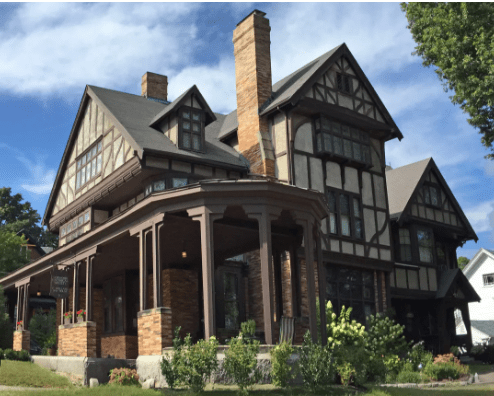
The beautiful Fred Holland Day House, the home of the Norwood Historical Society

            A few years ago, I was asked if I would join the Board of Directors of a local Historical Society. I became part of a dynamic group of people, each who bring a special interest or ability to the table, and together, I think we make a pretty good team. We have a beautiful old Victorian House that is our society’s headquarters, and we are always trying to come up with novel and interesting ways to physically bring people in our doors. Those that come to visit often say, “I grew up in this town and this is the first time I have been here.” Honestly, from being an active member of a couple of other local historical societies, I know this is a refrain heard over and over again. It seems our culture values the places and people who keep history alive in town, but they rarely have anything to do with that local history. When COVID hit, we, like everyone else, had to shutter our doors to guests. Although our physical home was closed, we still wanted visitors, so we went virtual.

This Day in Norwood History. A fun graphic created by George Curtis.

            One member of our Board of Directors created a daily posting he called “This Day in Norwood History.” Part of our collection contains bound copies of our local newspapers, going back for several decades. Taking a cue from today’s date, he looked through our collection for interesting newspaper articles with the same date. He usually selected a short article that may have featured a business or a person or a location. He transcribed it and posted it to our home page, then linked that posting to our Facebook page….of course he included a picture to catch someone’s eye. The response was incredible! Our Facebook post was shared and shared again. People often started threads discussing their memories of topic posted, and the traffic to our home page increased tremendously! We were reaching not only local folks, but those who had moved out of town settling in far way communities.

            Another local historical society where I volunteer did something similar. They thought it might be fun to photograph items from their collection, and post them on their Facebook account asking people if they can identify what the item was and/or what it was used for. This was an excellent way to not only show off their collection, and to spark conversations, but an even better way to attract virtual visitors. Another take on this is posting local places long gone, and asking visitors if they know where this place was…and what is there now.  Sparking a memory often will engage people, and bring you virtual visitors, who if in the area may physically walk though your doors someday.
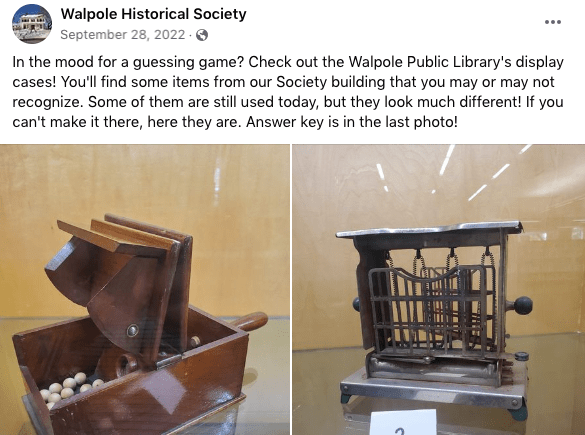
A fun Game from the Walpole Historical Society’s Facebook page.

            Today, so many historical societies struggle finding ways to share a their history and trying to engage people. Using the internet effectively a small society can potentially reach millions of people. Yes, using social media like Facebook, Tik Tok and Twitter (now X), can reach a large amount of people, but your society wants to have their robust own home page. One that offers visitors online exhibits to peruse, history article to read, and a place to join or buy society swag. Using social media will catch the attention of interested people, but linking those posts to your society’s home page will bring in virtual foot traffic and educate the public on your unique history.

            Initially “This Day in Norwood History,” was planned to be a program we were going to run during COVID, it has been wildly successful, and is still going today! The “What is this Item” the other historical society was doing, continues but at a more sporadically. Mostly because they are fun and engaging…which I think is exactly what history should be!

Genealogy Merit Badge

I have had the pleasure of being a merit badge counselor for Walpole Troop 44 for several years. I helped scouts earn their Fingerprinting, Cooking, Citizenship in the Community, Disabilities Awareness merit badges and yes, the Genealogy merit badge. 

I must say, getting kids interested in their heritage is not an easy task. The Boy Scouts have put together an list of requirements for the genealogy merit badge which if the leader does it correctly, a scout will enjoy working on this badge.

I would recommend working on this badge at a time when families get together….like Thanksgiving. This provides the scout with an opportunity to interview his family.

First, I like to prepare folders for each of the boys. I print copies of pedigree charts and family group sheets, and the Genealogy merit badge requirement worksheets, and provide lined paper for each folder.

At the first meeting have the boys write down the words ancestor, genealogy and descendent, then give them a few minutes to look the words up on their cell phones and write down the definitions. For the next portion of the meeting have the boys brainstorm interview questions. This activity may lead to several interesting discussions. Note, you will want to keep a list of their ideas so you (or a scout) can create a master list of questions for the boys to take with them when their family gathers. This can segue into a discussion of timelines, give the boys some lined paper to write down some of the events that have occurred in their lives. (Homework, have them turn their notes into a proper timeline and have them include a written biography to accompany their timeline). Before you end the session, have them tell you the definition of the three words they looked up at the beginning to the merit badge meeting.

At the second meeting have the boys begin by sharing their timelines and reading their biographies. When all the boys have had a turn, ask them if now they have heard other boys timelines, did that make them think of stuff they left out of their time line. Next have the boys fill in some family group sheets. The boys should know about their own family and perhaps their parent’s families. Then have them begin to fill out a pedigree chart, starting with them selves and go back a few generations. The boys will only be able to get one or two generation back, but not to worry, when the meet with their family, a grandparent may know a few more generations. Give the scouts copies of the complied interview questions they discussed at the last meeting. You can have them look them over and discuss them for a little bit. (Homework, have the boys plan to meet with a family member to be interviewed and to help filling in more family group sheets and extending their pedigree chart.)

Scouts from troop 44 Walpole (MA) take a break to pose for a photograph from working on an Eagle Scout project. (from the collection of Laurie Kerns)

Plan a field trip to the local historical society. Most historical societies have a genealogical repository/library on site, and the historian can show the boys the kinds of books and documents they have in their collections for genealogical research. Perhaps you can arrange for a professional genealogist to be on hand, either in person or online. (Homework, have the boys get a copy of a birth, marriage, death or baptismal certificate and bring a copy (not the original) of it to the next meeting.)

At the next meeting, give the boys an old document, like a will. Challenge them to see if they can read the old handwriting. They may find this activity fun as they struggle to read the document. Then provide the boys with a transcription so they can see/learn about what they were trying to read! Make sure the document has some useful genealogical information in it. Next have the boys present their vital record certificates; also provide a few other documents like obituaries and a death or birth notice, maybe a Bible entry. Have the boys discuss if each document is useful or not for charting a family tree. (Homework, have the boys log on to FamilySearch.org and to findagrave.com to see if they can extend their family trees. Have them bring their research findings and trees to the next meeting along with a few family pictures)

Scouts from Troop 44 Walpole (MA). Drew Cormier, Emerson Kerns, Ben Kerns ans Nick Kearney, are now all Eagle Scouts! (from the collection of Laurie Kerns)

Last meeting, have the boys discuss their findings, both from online and from family interviews. What was the most helpful? Ask how computers and photography has influenced genealogical research. Have them share their trees and tell what they learned about their family. Provide a few sheet protectors to the boys can assemble their findings, interviews, pictures, family group sheets and pedigree charts into a book they can keep.

Link to Genealogy Merit Badge requirements (this link will also give you genealogy charts)