
So, a few hundred years ago, my ancestors stepped off the boat on the shores of New England and never left. My husband is a fifth generation Californian. He ancestors stepped off the boat at ports up and down the Eastern Seaboard…and moved about all over the United States. They moved at different times and for myriad of reasons; in search of free land, to offer support services the ‘49ers, to get away from the Dust Bowl, to find jobs and to follow Joseph Smith. Studying his family is a study of American History!
This is how I found Abel Prior. My husband’s great-great-great-grandmother was one of my brick-walls. I took years to gather information on her. My big break occurred when a third cousin put up images from the family bible. This answered a lot of questions and filled in a lot of blanks. Bit by bit I was able to argue with primary facts and connect it to family lore, thus proving who her parents were. I even used this study for and assignment in my ProGen group. Then about a year later, I had access to Newspapers.com and found her obituary! I was right! But gee, it would have been nice to have found this obituary about twenty years earlier!!!!

So, when one brick-wall breaks down, very often you gain a new brick-wall, and this is true for my husband’s great-great-great-great-grandmother, Marina Prior. After her first husband died, she married three more times, and in all those records I have not been able to find any clues as to who her parents were. She consistently indicates she was born in Ohio around 1825. One interesting fact is in 1842 Marina Prior appears in a Later Day Saints Census in Nauvoo, IL, plus her first two husbands were early members of the Later Day Saints, but it appears her next two husbands were not.
Knowing the family lived in Kirtland Ohio, and was associated with the Latter Day Saints (aka Mormons), I began looking for a Prior family who also lived in Kirtland and Nauvoo the years that Marina lived there and were possibly followers of Joseph Smith. Best candidate I found was Abel Prior—now I just needed to connect them.
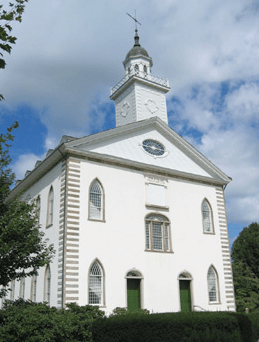
Looking for documents on Abel and tracking him through Ohio, Missouri and Illinois all the way back to Vermont where he was born, has been a long and interesting process. But it also highlights some of the early struggles the Saints endured.
First some facts about Abel discovered through a lot of research. In 1839, Abel testified about an incident that occurred in 1833, he stated that at that time he was 63 years old, making his birth year 1770/71. In 1841, he had (at least) two family members baptized, noting his connection to them: Desire Prior, he was her “son” and Ebenezer Prior; he was his “gd. son”. This means he was the son of Jedediah Prior and Desire Cook and was born in Vermont. Census records and local historical books that Abel is mentioned in confirmed where he lived. In 1790 he was in Vermont living in his father’s home. In 1800, he was living in Augusta, NY, next door to his parents. Augusta history says Abel arrived in 1794. In 1810, Abel was living in Pomfret, NY. History of Chautauqua County, New York, note Abel arrived in April of 1809 and that he had come from Oneida County. County deed records show Abel sold his land in Pomfret 1818, and in 1820 he and his family were living in Kirtland, Ohio. They arrived there some ten years before the Saints came to town.

Abel most likely joined the Latter Day Saints soon after they arrived in Kirtland in 1831. Some tine after the Saints arrived in Ohio, Joseph Smith announced that western Missouri was “Zion” where the faithful should “gather” to await the second coming of Christ. Abel was part of a group of pioneers who went to Jackson County, Missouri to settle Zion in the wilderness. The settlement area was an extensive stretch of land around Independence. Abel was part of the Prairie Branch Settlement. Here he had 22 acres of land, a house and “good improvements” (out buildings, fences, etc.), along the Grand River, it was located in the Southern Part of Jackson County (now Cass County) Missouri. The Saints soon established their new community that grew quickly. They started a weekly Newspaper in Independence, the first in the area, which told of wonderful things for the Saints and denounced the “Gentiles” (or “Old-Settlers”). Angered by the frequent criticism, the Old-Settlers broke into the newspaper’s office, took the printing press and threw it into the Missouri River and tarred and feathered the Saint’s bishops. The Saints decided to retaliate for this injustice. In October 1833, just two miles east of Westport, Missouri the Saints attacked Old-Settlers in a violent confrontation, which left two Old-Settlers and one Saint dead, and ultimately driving off the Old-Settlers. The Saints were fortified by this win, decided to drive out the rest of the “wicked” from Independence. On November 2, they put their plan into action, arriving just outside of town at dawn. However, the Old-Settlers, who out numbered them, met them there. The Old-Settlers forced them to surrender and agree to leave Independence by January 1834. However, a few days later on November 8th, Abel and his family were forced out of their home by a mob that threatened Abel’s life. In May of 1839, he testified:
“A memorandom of the Damage Done to me in Jackson County and else where Able Prior. November t[h]e 8 1833 A mob Came to my house headed by Stephen Cantril two by the name of Patterson the others not known by me they cocked a pistol at me and told me if I opend my mouth they would blow me through the same Day between fifty and sixty Came and gave the same order headed by Elder MC Coye A Baptist Pries[t] here I had 22 Acres of land with a house thereon and a good improvement of which I had to leave imediately or lose my life and fled into the wilderness not seeing a house until about Chrismas having my rist partly cut off at the time allso being about 63 years old the suferings were indiscribeable having Counted up my losses and Damages [——] I make out my bill against the mauraurders of Jackson county-$2000: Dollars”
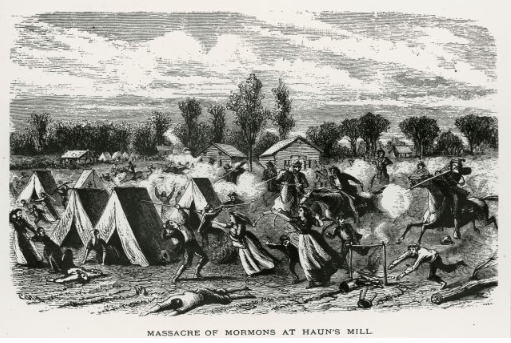
The governor of Missouri believed that Mormons and non-Mormons could not live side by side in peace. He carved out a new county, Caldwell County, in the Northwest corner of the state for Saints to settle. However, as the Saint population grew and grew, they began settling in neighboring counties. Violence continued to break out between the two groups. In 1838, anger on both sides turned to violence; this time is referred to as “The Mormon War,” which came to a head in the fall of 1838. On October 24th The Missouri State Militia and a Mormon militia engaged in the Battle of Crooked River. The Mormon militia had marched some twelve miles during the night and met up with the state militia who was camping on the banks of the Crooked River. A brief firefight ensued, leaving four dead. This encounter lead to the Missouri Governor issuing Missouri Executive Order 44, referred to as the “Mormon Extermination Order,” which called for all Mormons to leave the state. Governor Boggs said “The Mormons must be treated as enemies and must be exterminated or driven from the state, if necessary for the public good.” The worst violence occurred a few days later, on October 30th when the Mormon village of Haun’s Mill was attacked by an angry mob of about 200 non-Mormons that killed eighteen men and boys. This violence reached Abel Prior and his family a few days later on November 8th.
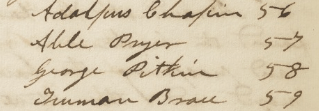
In February of 1834 Abel Prior was part of a group of 10 to 15 Mormon families who relocated to Clay County under the leadership of Sandford Porter. His 1836 marriage to widow Sabra (Mount) Voorhees is recorded here. The Saints were driven from this area, relocating to Daviess County, were Abel established a new farm. Again, he was forced to leave then settling in Caldwell County. However, soon after this move, in 1838 Missouri’s Governor Boggs issued the Extermination Order to expel all Mormons from the state of Missouri. Over the next year approximately 8,000 Saints left Missouri, often loosing everything, and settled in Illinois. Abel and his family settled in Nauvoo, where he appears in the 1840 census.
In 1840 Able Prior testified again stating:
I do hereby Certify that I removed with my family into Jackson County Missouri, in the year 1831, and owned a tract of land on which I made an improvement, and while peaseably employed at my own business I was assailed by a lawless Mob and driven from my home and compelled to leave the county, and then went into Clay Co. and after a short time was driven from that county, and then went to Davis County (sic) and made animprovement there and built me a house and in 1838 was driven from that county by a mob, who rose up against us as a people, Called Mormons, and then I went to Far West in Caldwell Co. and did not get to stay there long till I was compelled to leave the State by the Exterminating Order of Govener Boggs, and was obliged to suffer all this abuse and loss without any cause, not having offended in any way against the laws of that State, and for which I have never recieved any remuneration, and now appeal to your honorable boddy for redress” Abel Prior
[Sworn to before C. M. Woods, C.C.C., Adams Co., IL, 8 Jan 1840.]
It is not known when Abel died. He testified in 1839 and 1840 about his experience in Missouri. He appears in the 1840 census in Nauvoo, and in 1841 he had his mother and grandfather baptized. Then on May 13, 1842 he received an Elder’s license in the church, this is the last time Abel appears in any record. His wife (and possible daughter) both appear in a June 1842 the Nauvoo list of members in the Relief Society Minutes Book.
By digging deeper then just what census and vital records have to say, I discovered a possible ancestor of my husband lived an amazing life. Googling for information is fantastic! Abel started life in Vermont. He moved with his parents (and possible siblings) from New York to Ohio to Missouri and finally to Illinois. Along the way he became part of history at a time when the United States was young and growing.
Some day I hope to prove that we are related to Abel Prior.
Sources:
Ashcroft, John R. Missouri Secretary of State. The Missouri Mormon War. Jefferson City, MO: Missouri State Archives, n.d.
Downs, John. P. The History of Chautauqua County, New York, and Its People. Vol 1. New York: The American Historical Society, 1921.
Hartley, William G. “The Saints Forced Exodus from Missouri.” Joseph Smith, the Profit and the Seer. Richard Neitzel Holzapfel and Kent P. Jackson (ed). Provo, UT: Religious Studies Center, Brigham Young University; Salt Lake City: Desert Book, 2010, 347-90
The History of Oneida County, New York, with Illustrations and Biographical Sketches. Philadelphia: The Press of J.B. Lippincott, 1878.
Johnson, Clark V. Mormon Redress Petitions: Documents of the 1833-1838 Missouri Conflict. Salt Lake City: Religious Study Center, Brigham Young University, 1992.
North, F.A. (Ed.), The History of Johnson County Missouri: Including Reliable History of the Townships, Cities and Towns. Kansas City: The Kansas City Historical Society, 1881
Porter, Larry C. and Ronald E. Romig. The Prairie Branch Jackson County, Missouri: Emergence, Flourishing and Demise, 1831-1834. Salt Lake City: The Ensign Peak Foundation, 2007.


 Laurie L. Kearney