DNA question solved— A Mystery Man no longer a Mystery

Some of my Genealogy books

            A couple of years ago, a friend asked me to answer a genealogical question. She wanted to know the identity of her birth grandfather. Her dad, at that time was in his 80s, and had been curious about his birth father on and off over the years. Kathy provided me with as much detail as she knew, and hoped I would be able to figure this family question out by following the paper trail. She knew when and where her father was born. She was not so sure if her grandmother married this mystery man, and she believed he was in town while working on a CCC project….oh yeah, she also had his name! Unfortunately it was a rather generic name, not one that was unusual. There were at least five candidates, who had that name and of the right age to have been in the CCC at that time. With several CCC camps located within a relatively short distance from grandma’s home, it would not have been worth it to ask the National Archives to search for this mystery man. The paper trail was a dead end.

Ancestry DNA test kit

            I suggested Kathy take a DNA test. Perhaps that would hold the answer. A couple of years passed, and finally Kathy decided to take an Ancestry DNA test. I happen to like Ancestry as they have a large database of DNA results and family trees. While we waited for the results to come in, I began to build out Kathy’s tree. Knowing that we would get a large number of first to fourth cousins (because they are the ones alive today to be able to take a test), and I wanted to have a good idea how they all fit into Kathy’s family. Also, back when I was searching the paper trail, I did not look at Kathy’s mom’s side. That needed to be added into the tree too, as most certainly there would be DNA matches on her side too. Plus, by building out Kathy’s tree, I was reacquainting myself with her family.

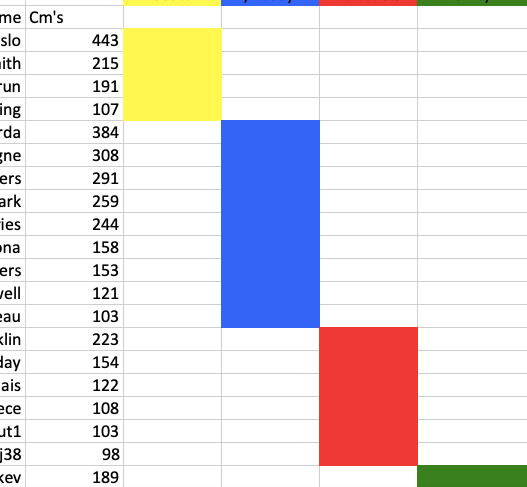
            Finally the test came in! One of the first things I did was to make a Leeds Chart. By considering close matches, those with a high number of shared centi-Morgans (cM), I would be able to identify descendants of the four grandparents. Then I could narrow down my search and focus on Kathy’s paternal grandfather’s line. Out of 38 close cousins, 30 of them were all from one branch of the family! Leaving 8 other cousins from the remaining three branches of the family! And only one of these was from Kathy’s paternal grandfather’s line! The amount of cM this person shared with Kathy indicted that they were a half niece/nephew! Which obviously indicated Kathy’s dad had half-siblings! And to make it worse, this person had a private tree! Luckily, this person named their test kit using (what appeared to be) their first initial and their surname followed by a series of numbers. At least I had a clue to follow.

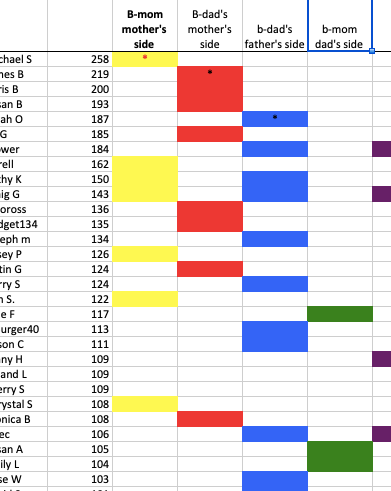
A peek at Kathy’s :eeds Chart.

            I used Google to see if I could find a person with the surname I was seeing, who was related to Kathy’s surname. Bingo! I found the obituary of one of Kathy’s half-uncles who had a granddaughter whose name started with the first initial….and had the same surname as the test taker. I sent Kathy an email with the obituary linked in the text, saying meet your uncle! When Kathy called me their first comment was how much of a family resemblance there was, between this uncle and her Dad (and siblings).

            With this clue, I was able to begin to build out a tree with this branch of the family to see were they intersect with Kathy’s branch. Turns out the half uncle’s father had the same name as Kathy’s birth grandfather. As I worked my way through a tree with this side of the family, what became clear was that Kathy’s birth grandfather was a local boy, not someone who was stationed in town working with the CCC. In the 1930 census, census takers recorded the street address of the respondents. Using that information, I entered both grandma and birth grandfather’s 1930 addresses into a online map program….and well, they lived about 18 blocks apart from each other. The census further indicated that birth grandpa was married at that time, to the half uncle’s mother. This census, certainly begins to show why this man had been a mystery to Kathy’s family.

            Suddenly, Kathy’s dad went from being an only child, to being a middle child, as records show, the birth grandpa had two sons, one older and one younger than Kathy’s dad. So I must say hanging all your research on only one DNA cousin, it well tricky and certainly leaves room for errors. But as I was researching this family, another DNA half-niece popped up in Kathy’s DNA family list! This person named their kit using their first and surname, and wouldn’t you know, she too is a granddaughter of the same half-uncle. So the DNA and paper records show, the same name for birth-grandpa as half-uncle dad’s name, plus 1930 locality would indicate that both grandma and birth-grandpa could have met either social functions or through work, and with now two DNA half-nieces, indicates this mystery man is no longer a mystery!

            Please note, I used a made up name for my friend. As you can see, this is an extremely personal story. One that Kathy is planning on telling her dad in time, if he is comfortable hearing, as he is now in his nineties!
Building a big DNA Match Tree

Ancestry DNA logo

            So you’ve taken a DNA test, mailed it off and now you wait. Sometimes that six-week wait seems like a lifetime, especially if you are hoping to solve a family mystery. The thing is you want to be prepared when those results are in your in-box. You are going to end up with a long list of cousins. Those that you share a higher cM with are most likely going to be people you actually know, and when you get into the third or fourth cousin realm, well, they will be people that you don’t know. So you are going to want to be ready to recognize who these cousins are and how they fit into your tree.

            I believe that when someone is new to genealogy, they build a rather skinny tree. Basically, self, parents, grandparents, great-grandparents and so on; perhaps with a goal to see how far they can go back. So thinking about your DNA results are going to give you a list of people who are here now….kind of like a family tree in reverse. So it is time to fill out your skinny tree and make it as robust as you possibly can!

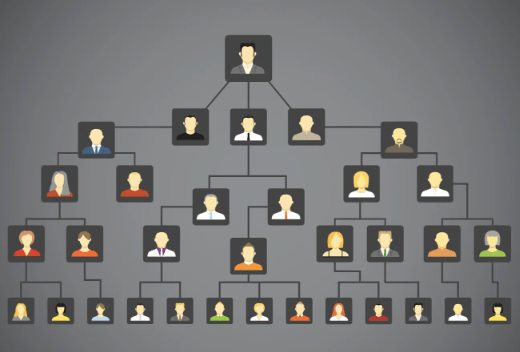
A graphic showing an upside down family tree.

            Starting with you, add in your siblings and their children. Then go to your parents and add in all your aunts & uncles and (your first) cousins, and their (your first cousins once removed) children. Then go to your grandparents, add their siblings, and their children, and their children’s children (your second cousins), and their children (your second cousins once removed). Go back for several generations, bringing each line forward, so your third cousins and fourth cousins are now in your tree. Look at the records you are using to fill out your tree. Primary sources are key to having an accurate tree. Don’t accept someone else’s tree…they just may have some errors in their tree that will infect your growing tree. If you get stuck, well that is OK. Don’t enter wrong information. Stop there and start growing another branch. If you have a question, like “who is my birth grandfather?”- there will be a branch in your tree that has not sprouted yet, and that is fine. Once you have filled out all these new branches, it will help you feel knowledgeable about the some of the matches you see when your results come in.

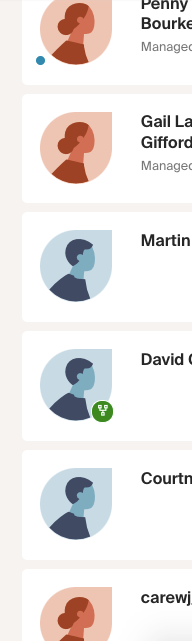
My son’s matches. His 2 grandmothes, a couple of great-uncles and a 2 first cousins once removed. Note: “David” has a little logo on his name. he has been attached to my tree.

            I have used several DNA sites and really like Ancestry the best. They encourage people to build trees, and they have a very large DNA database. So, you will get a ton of new cousins! Ancestry’s database + family trees + the tools they have, is fabulous for figuring out all these new cousins and how they are related to you! You can sort your matches, by parent, and then you can sort those matches again by surname, or if you have a shared ancestor, or by shared DNA. You can attach a (private) notes to these matches, (they cannot see it), you can color code matches. Play with the tools they have to offer, see how they work and what works best for you. There is a tool for you to identify your cousins (“do you recognize this person”) and attach them to your tree. You will defiantly have cousins you cannot figure out where they fit into your tree. If they have a family tree linked to their DNA kit, you can click on it and check for common ancestors…or common surnames.

            Having such a robust family tree will certainly help you understand your family tree better, and bring a whole new level to the results you will get. Sure, it is fun to know about your ethnic percentages…. but having a tree with all these new cousins it can take your DNA findings to a whole other level!

            Please note, If you are trying to find a mystery ancestor, there are many search angels out there who can help you find a missing family member and help you with the best way to approach them. Having an accurate robust family tree will help them with your search too! You can find a search angel on may Facebook DNA sites.

FamilySearch FamilyTrees

            FamilySearch is one of the best sites out there for researching genealogy. They came online almost twenty-five years ago, with a simple format that basically coughed up lists. Originally this included some census records, a couple of databases and their International Genealogy Index (IGI), which is a database that included many primary records as well as many undocumented sources. Over the years, they have continued to update and improve their website eventually doing away with the IGI and now offering digitized records. About eleven years ago, they added a family tree component to their page, which is basically a crowd-sourced tree. So if you realize that the tree you are adding to is NOT your tree and that anyone can add whatever they like to the tree….even if it is not accurate information about your grandfather – Then go ahead and add to it!

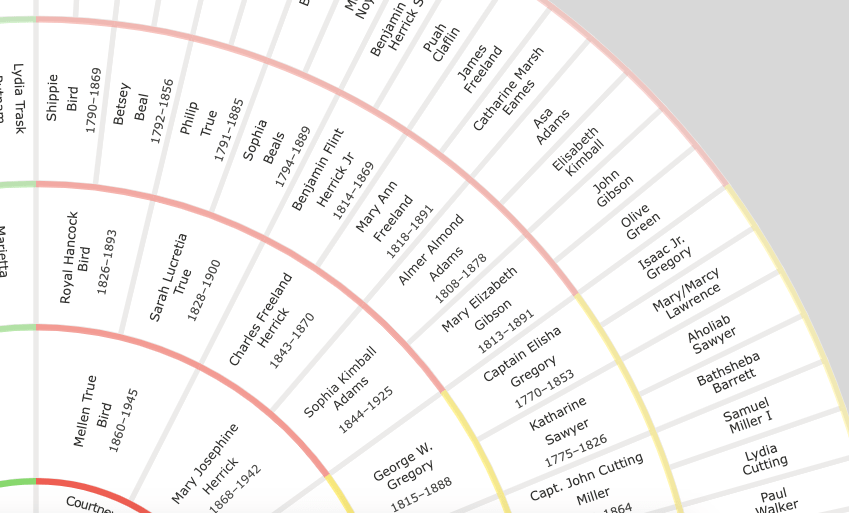
A section of my family tree fan chart on FamilySearch

            I initially was apprehensive about contributing to the tree. So apprehensive in fact, that I did not even look at it for almost ten years, mostly because wrong information drives me wacky! I can fix it of course…but someone can fix it back too. But eventually I thought why not. At least I could enter the information that pertains directly to me. I’ve added picture of ancestors, and some stories too, I have even added to branches of family lines to the tree that I am researching.

The tools FamilySearch has to help edit, merge and attach sources to your tree

            If you do not want to buy an Ancestry membership, then I would recommend keeping your tree on your computer, so do not rely on the FamilySearch tree to keep your research; mostly because someone can change it. Consider the FamilySearch tree as a clue and not fact. Do your own research and find your own documents (proof). The FamilySearch tree initially seems easy to use, first you will have to sign up for a membership. It’s free (I love free!), and therefore, they will not ask you for a credit card. The tree also has ways of attaching sources to it, which is nice as it helps prove the line. There is also a way to change information, delete people (or move them to another branch), and merge duplicate records, but I admit it is tricky to do. The learning curve is huge, and you will make mistakes. When I get stuck, I stop trying to fix it and hope someone will come along who knows how to fix my errors…I also imagine them cursing me out!

            I think the FamilySearch tree is worth a try. It is a great source that can point you in a new direction…or confirm you are on the right track. But keep in mind just as easily it can be right…it can be wrong! Think of it as a clue and not fact…it is just another tool in you toolkit.

Using Census Records to Maximize your Genealogical Research

Census records are extremely helpful went researching your family. The census has been taken in the United States every ten years since 1790, and they contain a wealth of information. When I first started using online databases to help in my genealogical research, I loved census records, especially the 1850 census and those that followed it! This is because they list every one in the home. The more I delved into my genealogy I felt it was important to assemble the whole family, not just my direct ancestors.  I have discovered that sometimes documentation does not add new information regarding a direct ancestor, but knowing your direct ancestor’s siblings may lead to the clue that opens up an ancestral line. Also, in the home may have extended family, grandparents, aunt and uncles, as well as cousins, all of these connections can be the clue you need to find more information on your line.

However, there are pit falls you need to watch out for, such as inconsistencies that may occur from census to census. These can include misspellings of the surname. This does not mean that your family changed the spelling of the name, but it is most likely it is how the census taker thought the name was spelled. Often, you will see a change in the place of birth column. One year you find your ancestor shows they were born in Vermont and ten years later it notes New York, or fluctuating age can be another problem with census records. These errors can be contributed to whoever provided the answers to the census taker, and they may or may not necessarily known the correct answer and simply guessed. In the case of countries, one year might say “Ireland” and in the following census “Scotland” or “England” might be recorded. This fluctuation can most likely be caulked up to the notion that people from certain countries of origins often experienced prejudice, and listing a more acceptable country of origin may have made things easier.

One sage genealogist once pointed out to me not to assume all the children in the home belonged to the two adults listed. So if four-year-old Tom Lynch is in the home of John & Sarah Lynch, who appears ten years later and ten years after that, it would be safe to think he was John & Sarah’s son, but when you pull the death certificate for Tom and discover the names of his parents were George & Abigail! After some research, you discover George and Abigail died before little Tom was two-years-old, you realize Tom was raised by his uncle and aunt! So be aware of these inconsistencies and your tree will be built on accurate information.

Useful information collected and noted in these census records, can lead to finding further information on your ancestors; this may include parents place of birth, language spoken in the home, number of years married, number of children born and number of children alive (today), and (if born in another country) when arrived in US, are they naturalized & year. This information can point you to ship manifests, naturalization records and more. In the case of the 1900 census, it can help to assemble a family, because the 1890 was destroyed, so there is a 20 year span between censuses, and if you see four children in the 1900 home and the mother states she gave birth to 10 children and six are alive, you may want to begin searching for birth and death records of the missing children.

Between 1790 and 1840 the US census record forms were more a check-off format. The form looks life graph paper or an excel spreadsheet. The rows contain ages (ex. Males 5-10, females 20-30), the first column was reserved to list the head of household. This is the only name listed and following that name, would be the number of people in each row category….2 males 5-10 and 1 female 20-30. It is just as important to study the information on these censuses as it is in the later censuses because they contain a wealth of information…but of course it can be a bit more tricky.

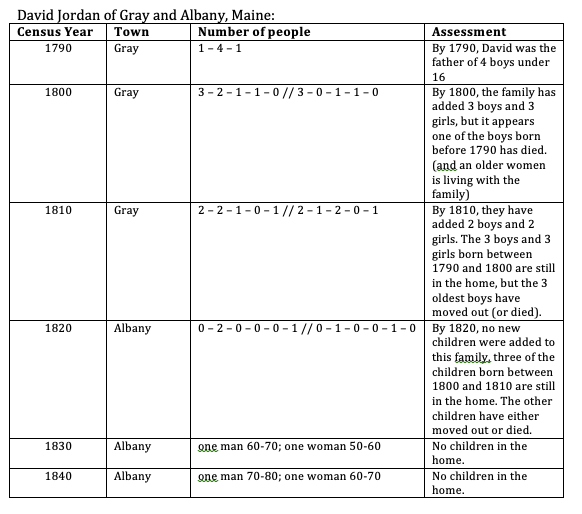
First locate your ancestor in the census and make a note of the number of people recorded in the home and where the family is living. If they never leave a particular town, well that is easy to follow, but if they move around, check maps and make sure the moves make sense. For demonstration purposes, we will study David Jordon of Maine. He was born about 1760 and died 30 May 1847 in Waterford, ME. He married twice, once in 1782 and again in 1785. Not all the names of all of his children are known. By studing the censuses we may be able to figure out how many children he had, total amount as well as number of boys and girls.

With this information, we can start to develop a skeleton outline of children born to David Jordan and his wives. Once a visual outline with number of children and their sexes is developed with these census records, we can start to search for records to fill in the blanks. David and his wives had:

By creating such a chart, we have an idea that we are looking for about 14 children born to David Jordan. Now we need to change “boy, born b/w 1782 &1790” to a name of a son. However, there are not any vital record entries for this family in either Gray or Albany, Maine, searching for documentation in less obvious places is required; published genealogies found on Google books, probate records and pension applications provided a source of information on this family. Then it was important to look at all these possible children to see if they note their parent’s names in their marriage and death records, and to check Find A Grave (.com) for gravestones to figure out birth order.

Documentation:

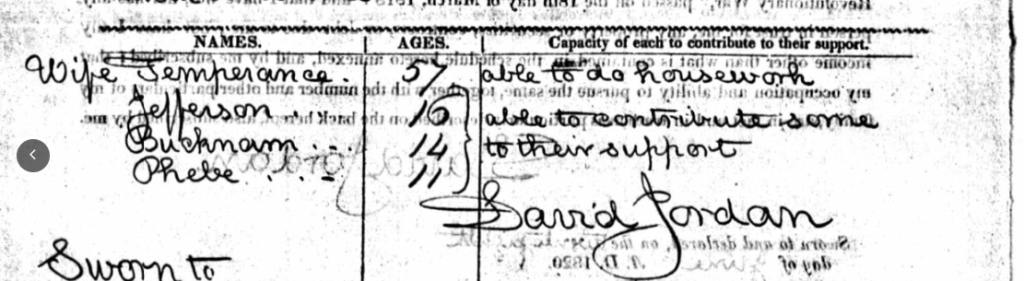
  • David applied for a pension (in 1820). Lists himself at 59, wife Temperance 57, children: Jefferson 16, Buckman 14, and Phebe 11.
  • Ruth (Jordan) Abbott’s death record list names of parents
  • Wales is noted as son in Proctor genealogy
  • Lydia (Jordan) LeBarron & Joanna (Jordan) LeBarron are noted in LeBarron genealogy
  • Afidavit filed to the Oxford County Probate Court 24 Aug 1847 by Obed Abbot (husband of Ruth) States David died 30 May 1847, leaving no widow, but these surviving children: Elijah Jordan, David Jordan, Calvin Jordan, Ruth Abbot, Jefferson Jordan, James Jordan, Wales Jordan, Russell Jordan, Lydia LaBaron and Joan LaBaron.
Page from David Jordan’s pension application naming the family he had living with him at that time.

Now with this information and the outline we created we can develop David’s family:

Children of David & first wife are:

  1. David Jordan, born abt 1783 in Grey, ME; died 1868 Denmark, ME
  2. Elijah Jordan, born 1785 in Grey, ME; died Oct 1860 Paris, ME.

Children of David & second wife are:

  1. Calvin Jordan, born 1787; died 20 Dec 1859 Portland, ME
  2. son Jordan, born abt 1789; died young
  3. Ruth Jordan, born 1791; died 29 Nov 1865 Albany, ME.
  4. son, born about 1793; died bef 1810
  5. Wales Jordan, born 9 Dec 1794; died 30 Jul 1877 Albany, ME.
  6. Temperance, born abt 1796; died 1842.
  7. Lydia Jordan, born 1798; died 8 Jan 1855 Harrison, ME.
  8. James R Jordan, born 1800; died in Chicago.
  9. Joanna Jordan, born 1801; died 18 Sept 1856 Lovell, ME.
  10. Thomas Jefferson Jordan, born 9 Oct 1803;
  11. Russell Buckman Jordan, born Aug 1806; died 5 Dec 1875 Andover, MA
  12. Phebe Jordan, born 1809; died bef 1847.

Locating the probate record was a wonderful find! It confirmed what the various genealogies had to say and made it very easy to fill in the blanks. Knowing how to best utilize and analyze census records and then taking the kernals of information they provide and knowing where to look for new information may lead to answers. However, it make take years of searching to find missing ancestors, but don’t give up!

Learning about Leeds Charts

This is not a “how-to” discussion, as I am a newbie to this technique. Plus, there are so many wonderful how-to videos on this topic, AND the person who created this technique has their own blog page (here). Who better to learn this method from than the person who developed it!

I had read on several genealogical DNA Facebook pages where I am a member, about how helpful Dana Leeds’ technique was for organizing DNA matches. Bonus, it is a color-coding technique and I am a person who finds visual practices very helpful to understand, or to “see” a new concept. Admittedly, I tend not to fortify my mind before I research. Sometimes I like to delve in and see where my research takes me, and learn as I go along.

My first experience was working with my college roommates DNA to answer a genealogical question: who was her birthfather? Like so many people, when the results first came in, I did not know where or how to start. What I was looking at was somewhat over whelming. I clicked on many of the matches and looked at their trees (if they had them). I googled for information on some of the matches, hoping I would discover a clue…or two, that might help. Finally, I turned to YouTube for guidance and learned about mirror trees. Actually not a technique that would be helpful in this case, but I liked the idea of building a tree that would contain the matches. Perhaps that might lead me to this elusive birthfather. I learned as I went along and was eventually able to figure out how my friend fit into this genetic tree.

From experiencing some success, I wanted to have more opportunities to use DNA in genealogical research. A couple of summers back, I took a DNA class (online because of the pandemic) at the Genealogical Research Institute of Pittsburgh (GRIP), where one of the presenters was none other than Dana Leeds! She lead us through her method step by step, then gave us a homework assignment to try it on our own. Now, not having a lot of DNA in my account to work with, I thought I would use my college roommate’s DNA results, as I already knew what the answers should be. I thought this would be a self-correcting way of using the Leeds Method. If I did not fully understand this technique, then my chart would be wrong, and then I could go back and re-try this method to get it right.

Basically, you consider a small subset of DNA matches, people with whom the test taker shares approximately 400cM to 90cMs with; their second and third cousins. Using a spreadsheet to record your matches, you click on the 1st second cousin in the list who shares about 400cMs with your test taker, then you click on “Shared Matches.” That is the list you record in your spreadsheet, assigning all those in this column a certain color. Arrow out. Then click on the next cousin (who you have not entered into you spreadsheet), then click on “Shared Matches” and record that list assigning them another color. Work you way through the cousin list until you get to your last cousin with whom the test taker shares 90cMs with. You will end up with at least four columns…and sometimes more, but don’t panic. With is information you will discover the surnames of the test takers grandparents. (If this technique intrigues you, I would encourage you to find another site that can explain it better!)

This is an excellent place to start your research. It gives you a snapshot of the test takers family. Basically you know the surnames of the grandparents. The next thing I do is build family trees using the trees the shared matches built and building them out to include siblings and cross referencing them to primary documents. If I am lucky, I will find a marriage of two people with the grandparents surnames…perhaps THE grandparents, but it could be another couple with the same names….so check and double check your research!

I love the Leeds Method and highly encourage people to learn more about it!

My DNA Journey: The Gift that keeps on giving!

Having had several positive outcomes using DNA to solve genealogical questions, I felt empowered, but I knew I needed more experience using it. Enter my friend Tracy. She was adopted. She “met” her birth mother’s family many years earlier, but did not know any thing about her birth father’s family…. and her birth mom was not giving up the information. It was a question she pondered about, but had no burning desire to know more. When I asked her if she was willing to take a DNA test for me so I could figure out this question, she graciously accepted.

I asked Tracy not to give me any information about her birth family. Knowing that many adoptees do not have any information on their birth families, I thought having empty slate, would be an excellent challenge for me. Now, I have known Tracy for approximately twenty years now; our children grew up together. So I remembered a few bits of information, like she had occasional phone visits with a half-sister named Rhoda, who lived in another state…but that was all I basically recalled, and it was not enough information to attempt a Google search.

It took a while for the results to come in, as the first test failed and Tracy had to send another sample. When she received the results, she shared them to my Ancestry account…and I was off and running! I thought I would resolve familial questions quickly, but that was not the case. The very first thing I did was to make a Leeds Chart. This technique should yield the surnames of the grandparents of the test taker, which ultimately it did…but it also created a few questions for me!

Who was Tracy’s birth father? Well seeing as his brother and daughter had taken Ancestry DNA tests, I figured out who he was very quickly. In fact, it was so quick, that I actually second-guessed myself and dug a little deeper. I spent a few more hours on this question, and confirmed the bio-dad’s identity to my satisfaction. Tracy’s birth mom told Tracy stories about him, and the only thing that appeared to be true, was he had served in the military.

OK, now on to the identity of Tracy’s bio-mom. For some reason, I thought this would be the easiest question for me to answer. I don’t know why. Perhaps it was because I had the notion that Tracy already knew the answer. I know that doesn’t make sense, because not knowing, is not knowing, even if some else has the answer. Tracy had a lot of DNA test takers on her maternal side. So I started building a family tree based on the trees these test takers had started to build, carefully linking everyone together. As the tree grew and grew, I did not feel I was getting any closer to figuring out her bio-mom’s identity. It was SO frustrating!

The paper trail was not leading me to a bio-trail. I posted questions on a Facebook genealogical DNA site I belong to, hoping for guidance. I was certainly given feedback, which I took to heart. Taking these suggestions, I worked the tree, referring back to the DNA results, but I was not getting any closer to an answer. Finally, I had to call “uncle” and ask Tracy for the answer. She told me the name of her bio-mom. Turns out I had her in the tree, but I was nowhere near discovering she was the bio-mom.

This is where Tracy’s DNA branches get all twisty (hence my confusion). Turns out, Tracy’s bio-maternal grandfather was illegitimate and was raised by his grandparents. So he carried his mother’s maiden name. She went on to marry and have more nine children, and both her maiden name and her married name were in my Leeds Chart. I should be note that discovering “just” the four surnames of grandparent is the Leeds Chart is not a given…. usually you end up with several more surnames, but if you look carefully for commonalities, your results can be narrowed down to four surnames. In this case, many descendants of bio-grandpa’s half-siblings, as well as his aunts & uncles had taken DNA tests, but by looking carefully at the family tree, I saw how I got confused as these families all twisted together!

So the lesson I learned here was to look more closely at the documents. In the 1920 census, bio-grandpa was just a year old and living with his grandparents. This is the only time he is listed as their “grandson” in other censuses; he is listed as their son. These grandparents also raised another grandson as their “son,” after his mother (their daughter) died. Interestingly, this grandson’s known father appears to be (possibly) the brother of bio-grandpa’s dad…just to add further confusion to this family! As I dug deeper into bio-grandpa’s records, I found an image of his birth certificate online, and the name of his mother is listed…but not the dad.

This gave me a new DNA question of answer! Who was bio-grandpa’s birthfather? I knew who his family was, but candidates of the appropriate age were not indicating they were the father. Many descendants of these possible candidates had taken DNA tests. I expected to see a close-ish match…. like a first or second cousin (possibly or actually once removed). But the DNA numbers were showing a slightly more distant relationship. Rats! Once again, I turn for some guidance on a Facebook genealogical DNA page. There some one suggested I try WATO…. what? Turns out this is a new feature on the DNA Painter site, where you can build a scaled back tree to see if your familial hypothesis is correct. WATO, or What Are The Odds, is an interesting tool. After I gave it a try, it was clear I needed to learn more about how to use this tool.

So Tracy graciously allowed me to use her DNA as a learning experience. And boy did I learn a few things! And now I have more to learn!!! Tracy’s gift is definitely a gift that keeps on giving!!

Thank you Tracy!

My DNA Journey: A Journey of Discovery

I’ve been dabbling in DNA to solve genealogical questions for a couple of years now. About 5 years ago, a fellow genie friend began using DNA in her searches, and she thought it was a wonderful tool. I remained skeptical and was unsure if I wanted to invest time and energy into learning how to use DNA to solve genealogical questions. Then in 2018, I attended an educational conference sponsored by the Massachusetts Genealogical Council, where Jennifer Zinck gave a wonderful presentation on using DNA. OK, now I’m intrigued.

I reached out to a dear friend from college who had always wanted to know the identity of her birthfather…. (Last name “Smith”…. oh, please!). I asked her if she would be willing to take a DNA test so that I could learn a new technique. She agreed and my education began. I read what I could find online and watched several “how-to” videos, and when the results were finally in I began creating a giant family tree of her matches…. well, its more like a blob because she comes from a relatively insular community where families intermarried. Eventually I had had this giant blobby family tree and still could not figure out where her birthfather fit in. Then I found a video by the Barefoot Genealogist (Christa Cowan) on making a simple chart to visually see how your genetic matches fit in (video is here: https://www.youtube.com/watch?v=VP8rUlZbmeA&t=1011s). Once I did this…. I solved my first DNA mystery. Boy did I feel empowered!

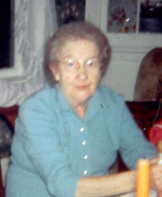
My Grammy, Hope at 6 years old….and her birth mother, Hilda.

Next, I used my son and mother’s DNA to begin solving a family mystery…. my grandmother (Hope) was adopted and as luck would have it, after good old fashioned sleuthing I believe I found her birth family…. a DNA test proved I found a ½ second Cousin! This cousin informed me that my grandmother’s birthmother (Hilda) was also adopted (oh boy). After a free weekend on AkivDigital, Sweden’s Archives, I found that the birth grandmother mother (Elda), who was born out of wedlock (on no!), but DNA helped me figure out who her birthfather was. However, as you can see there is still a lot to figure out in this line!

Cross section of a Leeds Chart

Then attended and week long (online…because, you know, pandemic) class on DNA led by Blaine Bettinger, with guest presenters Dana Leeds, Karen Stanbary and Paula Williams. By the end of the week, I knew I needed to “play” with more DNA, do a lot more studying and circle back for another class. I asked another friend if she would take a DNA test. She was adopted and had long ago met her birthmother and knew the name of her birthfather. She didn’t actually have any questions she wanted answered, but agreed to let me learn from her DNA. I knew quite a bit about her birth mom, so I asked my friend not to divulge any information on her birth dad to see if I could figure out who he was. When the DNA results rolled in, I first made a Leeds Chart…. a wonderful technique! If done correctly, you should discover the surnames of all four grandparents. I googled for the birth moms obituary, hoping that might lead to the names of her parents…. it did. Then I began building a family tree with this information and DNA matches. As my friend’s tree grew, possible birth father candidates emerged (three brothers). They grew up many states away from where my friend’s birth parents met. I needed to connect one of the brothers to a far away state from their home state. With the help of Google, and some primary documentation found on Ancestry, I was able to nail down the birth father. Because my friend knew his name, she was able to confirm I was correct! Woohoo!

With my objective solved, another by-product of this research emerged. As I was building my friends genetic family tree, a wonderful story about strength and perseverance emerged! Turns out her birth grandmother was widowed at twenty-seven and had two children under ten with one on the way. Within a couple of years she moved her family from a Southern State, clear across the county to the Northwest. She appears to have followed some of her siblings there. She remarried later in life; long after her children had grown. This means she was a single mother of three, working and raising her children during a time when the United States was trying to recover from a World War and from the after effects of the Great Depression. This was a wonderful story to tell my friend about her birth family.

It is interesting to think that by using DNA to answer a genealogical genetic question, you can also discover familial histories and stories!
Warning! DNA Results Ahead! Proceed with Caution!

DNA is a wonderful tool, especially when used to answer genealogical questions. However, it should come with a warning label attached, because the test taker may uncover a long lost family secret, which may blow them and their family out of the water!

A couple of years ago Ancestry.com had an advertising campaign to sell their DNA kits. This advertisement they aired on webpages and in traditional media, had a man who was dressed in lederhosen, who said he was so proud of his German heritage. His DNA results showed he was Scottish and now he was embracing this “new” heritage. The ad ends showing the man wearing a kilt and holding a bagpipe. People were fascinated by the notion of learning more about their ethnic heritage and purchased DNA kits….in fact, for a while they were a very popular gift to give a loved one.

Today Ancestry’s DNA database is one of the largest DNA databases out there. This is really awesome, especially if you are hoping to find birth parents or grandparents of an adopted person. However, it can be a shock to someone who had taken a DNA test a few years back to learn about their ethnic heritage, and now they are getting messages from a stranger saying DNA indicates you are my dad!

I belong to several DNA Facebook pages. Here people can ask for help understanding DNA results, discuss their DNA brick walls and ask how they should proceed with their research, or to find a Search Angel to help them. However, very often these sites are a place for people to share their experiences and surprises. Some are folks who took the test to hopefully discover their birth family, some are folks who just discovered their dad is not their dad, and others share their experiences reaching out and meeting long lost family. So many of these stories are heart wrenching, either because of a wonderful new connection or because of a horrible rejection.

When Ancestry.com began offering DNA test kits as a tool to learn about an ethnic background, or perhaps answer a genealogical question, or break down a brick wall, they may have not realized the possible can of worms they might open for their customers. A recent posting on at least two FaceBook pages that I belong to, was from a test taker who had been told long ago, they were not their father’s child. After dad’s death the test taker took a DNA test with their sibling and discovered they were 100% siblings! Hooray! Her dad WAS her dad! Dad may never know, but at least the family knows! Fast forward a few years and the test taker took an Ancestry DNA test to further their research….and guess what? None of the results showed a familiar paternal line, but listed a bunch of unknown surnames. Indicating that dad was not the birth dad. This meant that neither, the test taker nor their sibling were the children of the man that raised them. The test taker now had an interesting dilemma….tell mom and sib the truth….or keep it a secret, as they felt neither could handle the truth. Respondents on one page recommended they keep the secret, and those on another page felt is was more important to take a few more DNA tests (including other relatives) before they jumped to a possibly wrong conclusion.

If you are a genealogist suggesting a client take a DNA test to help further your research to answer your client’s research question, you should most definitely discuss all the possible implications of this test, as it may lead to surprise information that could be upsetting. If you are someone who wants to take a DNA test to confirm your ethnicity, be warned, you too may find an upsetting surprise. It could be anything from a new genetic relative who is searching for their birth family, to a whole new branch of your tree because a parent or grandparent is not the biological child of one of their parents!

WARNING: So if you are wanting to take a DNA test…..proceed with caution!

Where to Start, Where to Start?

So, you think you would like to discover your roots and you don’t know where to start? Well that is easy! Start with yourself, your parents and your grandparents!  Jot down birthdates, marriage dates and death dates (if you know them!). Then have a conversation with the older generations in your family. Having all this personal first hand knowledge is a great place to start.

With your notes firmly in hand, you are ready to begin to search in earnest! I recommend starting the FamilySearch.org site. They will want you to sign up for a free account. They do not ask for any payment information (i.e. your credit card), and they do not flood your email account with unwanted emails. FamilySearch is owned and operated by the Latter Day Saints (the Mormons). Part of their belief system is that families are very important in this life as well as in the after life, and by finding (and baptizing them as Mormons) long dead relatives, they all will be reunited in heaven. The nice thing about their website is that they have imaged thousands of original documents (primary sources). It is these primary sources that prove your line, some secondary sources or a story passed down for a few generations may be false! My great-grandmother told my dad and his brothers we were related to Pocahontas. When I was little, I thought that was pretty cool, and indeed it was one of those facts I went searching for when I first started researching my family. It took a while, but I found my great-grandmother’s grandmother maiden name was “Rolfe.” That was clearly where the story came from, but my Rolfes were in no way related to the family into which Pocahontas married.

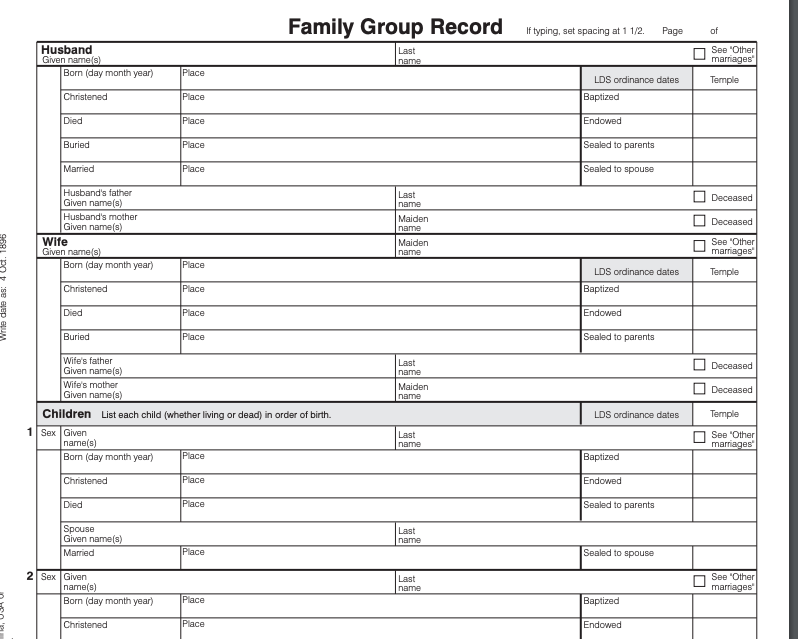
One of the most important things you can do is to keep accurate records. Notes of your conversations, family group sheets, pedigree charts, when and where you researched (so you do not repeat your searches!). You can keep these records in a binder or invest is some genealogy software. (There is free software out there, but I would research it before you download it!). I often start a new search by opening a Microsoft Word document, and take my notes there before I start making a tree. I can also cut and paste links in this document, so if I go back and revisit this family, I can re-visit the links!

It is very important to Document, Document, Document! Keep track of all your sources. By doing so you can show your proof, you can return to your searches if you need to re-evaluate the accuracy of your source, and it will also prevent you from doing the same searches over and over again. Once on a genealogy Facebook page (consider joining one!), I came across a fellow who posted that he had just started tracing his family tree and had already managed to trace back to Adam and Eve. He most likely copied someone else’s tree, who did not have any sources. Genealogists on the page had to gently explain to him that this was very unlikely.

Evaluate your sources for accuracy. Very often some sources are questionable. I have seen people document a marriage, which occurred in the 1600s between someone in New England and someone in Virginia…although in theory possible, the distance would have made it difficult. In tracking that pesky Rolfe line, I found a Rolfe raised in Massachusetts in the mid 1700s, relocated to New Jersey. I thought this maybe untrue, but the more I looked, the more primary sources I found, and it turned out to be true! So, double and triple the sources, especially if you found the information on someone else’s tree. If it does not make sense, it is probably wrong.

Genealogy is a fun pursuit. I love to untangle a historical question. Sometimes the information comes to you very easily and other times it may take years before you find the next generation, but don’t give up!

So keep this in mind:
            Gather what you know.
            Research can begin.
            Accurate Records must be kept.
            Document your sources.
            Evaluate your sources for accuracy.
 
And you’ll have good GRADEs!

Google: A Wonderful Genealogical Research Tool

Many years ago, long before genealogists began blogging, the best way to learn and grow online as a genealogist was to sign up to receive emails from professional genealogists.  This is exactly what I did! One email I received intrigued me; it was on how to use Google to find genealogical information. At the time, genealogical databases were still in their infancy; GenWeb seemed to offer the most information, FamilySearch.org and Ancestry.com were new, and Find A Grave had not been thought of yet. In fact, most of my research was done via snail mail! A free source of online information was welcome, and to date I use Google regularly to aid in my genealogical research.

The Google logo

Very often you will find scanned books that can be read online, local historical society’s websites that offer blogs on histories or genealogies, posted queries on old message boards, or a descendent family organizations that may offer a well researched genealogy.

I must admit, researching an unusual name is best, but don’t worry, if you have a common name like “John Smith” you will find results. It will take patience and perseverance.

First, using quotes around your research name will help you find information on “John Smith,” versus not using quotes you will get information on every “John” and every “Smith!” Yikes! That’s potentially a lot of useless information. To further narrow down your search answers add the name of his wife or the place(s) he lived: “John Smith” “Experience Jones”…..or “John Smith” Dedham, MA. Mix it up! You know your John Smith, and there might be pertinent information to YOUR John Smith that you could use in your Google searches to narrow down your answers and find the information you are seeking.
Google main page

I think the best piece of Google voodoo is using a minus (-) sign. For years now, I have been researching the Wormwood family of York County, Maine. Early on if I just used the surname “Wormwood” and “Maine”…or “obituary”…or “genealogy,” I found exactly what I was searching. Then about ten years ago, absinthe again became legal to sell in this country. Absinthe is made from the wormwood plant, and yup you guessed it, all of a sudden I got people selling absinthe in Maine! By using the minus sign…”Wormwood” “Maine”  “–absinthe”… my Google results are about the Wormwood family of Maine, and zero results on absinthe.

Now as you are reviewing your search results, do not forget to use the pull-down menu labeled “more.” When you click on it, a little drop down menu appears with the words video, books, flights and finance. Click on “books” and that will take you to a list of books your search-person may be in. Google has scanned many books that are out of copyright that you can fully read! But be wary, just because it is written in a book does not necessarily mean it is true or correct. Sometimes authors like to embellish a story to make the genealogy tale more interesting…so check and double check sources.

Google pull down menu

Google also offers Google Maps, which is a useful tool for genealogists. If you know your “John Smith” lived in Dedham, Massachusetts, but you are finding results for him in Needham, Massachusetts, a quick peek at Google Maps and you will see Dedham and Needham are abutting towns, so chances are you found YOUR John Smith. You can also use Google Maps to get directions, and this will also tell you the distance between towns. In my recent search on Abel Prior, I found him in Weathersfield, Vermont; then Augusta, New York; then Chautauqua County (near Charlotte Center), New York; and finally Kirtland, Ohio. Using Google Maps, I could visualize his straight progression from Vermont to Ohio.  Then pairing these findings with census records, I was able to verify his twenty-year migration.

Over the years, I have found Google to be very useful genealogical research tool. I would encourage everyone to experiment with it to see what you can find! Who knows, you may find the answer to a long held family secret or even break down one of your brick walls!

Perseverance: How to Break Down a Brick Wall

Oh boy, Brick walls are frustrating! They often take years to resolve, and once resolved they often lead to another brick wall…or it may completely open up a new long genealogical line. Over the years, I have run headlong into several brick walls, and two took me about twenty years to find the answers.

Abigail (Butler) Hubbard

Abigail (Butler) Hubbard is my 4x’s great-grandmother. She was the wife of Rev. Zaddock Hubbard. They came from Middletown, Connecticut, moved to Lenox, Massachusetts and finally to Moretown, Vermont. Two pieces of paper I found in Zaddock’s autobiography had Abigail’s birth date on them, as well as those of Zaddock and their children. Only problem was one listed Abigail’s birthdate as May 6, 1773 and the other had her birthdate as May 6, 1768. The Barber Collection had the baptism of an Abigail Butler in Middletown, but it listed her birthdate as May 6, 1774! Was this a clue? Was she possibly the daughter of Dorney Houghton Butler and his wife Mindwell Clark? Research on this line did not yield any answers, and I searched for years! There were no Butler friends or family that traveled with the Hubbards as they moved around New England, and there were no clues in the names Zaddock and Abigail chose for their children. Then about five years ago, Ancestry.com added “Connecticut Wills and Probate Records, 1609-1999” to their databases. Although Dorney did not leave a will, there was an administration of estate for Mindwell Butler’s, and lo and behold Abigail, wife of Zaddock Hubbard is mentioned in the estate! And just like that my brick wall was knocked down! Solving the mystery of Abigail (Butler) Hubbard ultimately took patience, because the answer was hiding in a document, I just had to wait for it to come online.

Solving the brick wall of another ancestor took perseverance and a lot of research. Mary [?] Simons, is my husband’s 3x’s great grandmother. She was the wife of Charles Rodney Simons, and as a young married couple, they came to Sacramento, California from Ohio in the late 1800s. The family knew very little about Mary and early research on my part did not produce any answers. Then a third cousin put up on his Ancestry family tree two scanned pages from the Simons family Bible. These pages gave me Mary’s maiden name (Bassett), the name of her first husband (James Malonee), and a notation that their daughter, Carrie Malonee, was born in Kirtland, Ohio.

Mary Ellen (Bassett) Malonee-Simons

Although this information did not immediately knock down the brick wall, it did give a place to begin searching – Kirtland Ohio. Looking for Mary Malonee and her baby daughter in the 1870 US federal census, a Mary & Carrie Malong (the “g” zoomed-in, is a “y”), was found in Kirtland. Taking a chance, I searched for a Mary Bassett in the 1850 US federal census, and a Mary “Balseth” (Bassett) was found with her parents, Harmon & Maria and a brother Oliver in Kirtland. Harmon, I love unusual names! Checking to see if another transcription error befell this family, a Google search for “Harmon Bassett” found a marriage record for Oliver Harmon Bassett and Marina Prior. A further Google search for this couple led to an online Bassett family tree listing tons of credible sources. However, this Bassett tree did not know what happened to Mary or her mother Marina.

Following Marina Bassett led to the discovery several remarriages. Her second husband was Leonard Rich. Leonard & Marina Rich’s family are in Kirtland (OH) in the 1860 census, and it indicated a third child, Sarah, from her pervious marriage to Oliver Harmon Bassett. Next marriage for Marina Rich was to Simeon Hall, then Marina Hall married Green Parker, and a Marina Parker’s death record is recorded as August 11, 1891 in Mentor, Ohio. (It should be noted the deaths of all Marina’s husbands can be found online, supporting the timeline of her marriages.) An old family story about a possible relationship to a James Flood, is the lynch pin in proving that Marina Prior is Mary’s mother, because Marina shares a cemetery plot with her daughter, Sarah (Bassett) Flood, and her husband, James Flood.

All of these informational pieces of Mary Ellen (Bassett) Malonee-Simons mother’s life come together to break down this brick wall. So if you are struggling with a brick wall, do not give up. You never know if the answer will be handed to you or through dogged research you find the answer yourself!

A Tale of Two Huldahs

Headstone of Huldah (Wormwood) Witham. Find A Grave, database with images, memorial no 94660761, citing Congregational Church Cemetery, Alfred, ME

When I do genealogical research I like to assemble the entire family. Who were all the siblings/children? Where were all the places a family lived? Where did they go to church? Did the family have an important role in their town? Did anyone serve in the military? Asking these questions not only helps to know and understand the family, but also may give research clues when trying to trace a particular family member. This especially is true if you come across two or more people with the same name.

Years ago, I added Huldah Wormwood, daughter of Amos and Lydia (Storer) Wormwood, into my family tree because she was the sister of my direct ancestor. From what I could find, she lived her whole life in the town of Alfred, Maine. However, another online researcher had a Huldah Wormwood in their tree. She was born in Vermont (or New York) and lived her adult life in New York State, but this researcher had her entered in their tree as the Huldah Wormwood born in Alfred, Maine. Trying to figure out which Huldah was actually the daughter of Amos and Lydia (Storer) Wormwood meant careful study of available records.

Headstone of Huldah (Wormwood) Oliver. Find A Grave, database with images, memorial no. 89919566, citing Fairview Cemetery, Brasher Falls, NY

The other researcher theorized that Amos and Lydia (Storer) Wormwood moved briefly to Vermont in 1797, had Huldah, then returned to Alfred, Maine by the time of the 1800 census. Then, she believes Huldah moved to upstate New York by 1820 when she married Alfred Oliver. Although to me, this theory did not seem logical, to the other researcher it made sense. Theories are good. They give one a place to start. Once you have developed a theory, the next thing to do is to see (or to prove) if you are right or wrong. That is when you need to find all available records and to carefully consider each record as it pertains to your research question.

There are most definitely two Huldahs who were alive about the same time and were about the same age. Sometimes, I find it helpful to create a chart of available records. This makes it easier to compare and contrast information.

 Huldah Wormwood (wife of Jeremiah Witham)Huldah Wormwood (wife of Alfred Oliver)
born25 Dec 1806 (find a grave)1797/98 (1850 census/ find a grave)
married24 Aug 1829 (Maine Marriages)9 Nov 1820 (10,000 VR of eastern NY)
died22 Jul 1874 (find a grave)17 May 1854 (find a grave)
1850 censusb. 1807b. 1797
1860 censusb. 1807X
1870 censusb. 1807X

From looking at this chart, one can see the two Huldahs are about ten years apart in age. It should also be noted Huldah (Wormwood) Oliver’s children, in various records, either record her place of birth as Vermont or New York, but most records appear to agree with Huldah in the 1850 census that Vermont was her place of birth. Unfortunately, there are not any other records to add to this chart. So considering records regarding Amos and Lydia (Storer) Wormwood may lead to an answer.

Screen shot of a portion of Amos Wormwood’s will.

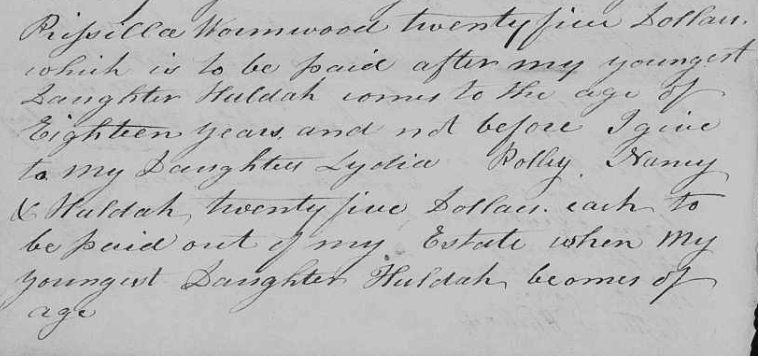
Amos and Lydia grew up in Wells, Maine and married there on August 30, 1781. Their first three children were born and baptized in Wells, before the family removed to Sanford, Maine (the part that is now Alfred). Unfortunately, the minister of the Alfred Congregational Church took the records with him when he left the church for another ministry. Amos had his daughter, Huldah baptized on June 18, 1807 by the new minister of the Alfred Church. Amos left a will naming all his children. The will establishes Amos and Lydia were the parents of nine children, their youngest is Huldah, as he wants the monies he left his children to be paid out when his “youngest daughter,” Huldah turns 18.

As for the notion of the other researcher that the family moved to Vermont and back to Maine over a very short time span, documents in York County, Maine illustrate a different story. Amos (then later Lydia) are enumerated in the 1790, 1800, 1810 and 1820 censuses. Amos is listed in the Massachusetts and Maine Direct Tax list in 1798. The town of Alfred records the deaths of three of Amos and Lydia’s children in 1797, 1800 and 1801. Also, land deeds show Amos bought land in 1797 Maine (York County deed book 88; page 256). All these records indicate Amos was living in Alfred, Maine in the late 1790s and early 1800s and did not move temporarily to Vermont. Plus, the Alfred Historical Society and Fred R. Boyle, author of Early Families of Alfred, Maine, believe Amos and Lydia (Storer) Wormwood are the parents of Huldah (Wormwood) Witham, wife of Jeremiah.

These documents seem to answer the research question that Huldah (Wormwood) Witham is the daughter of Amos and Lydia (Storer) Wormwood but they do not tell us who the parents of Huldah (Wormwood) Oliver were. She was most likely born in Vermont, she quite possibly is the daughter of Joseph Wormwood (brother of Amos) or one of their nephews Daniel Wormwood or Ezra Wormwood, all three men moved to Vermont in the late 1790s/early 1800s.

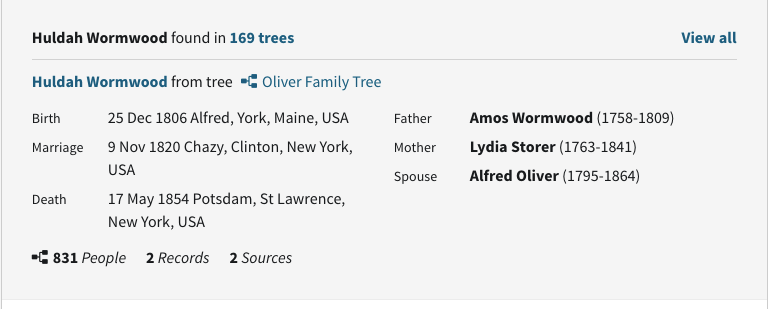
Screen shot of an Ancestry.com family tree search showing there are 169 trees with the wrong information!

It should also be noted that 169 online trees erroneously show Huldah (Wormwood) Oliver as the daughter of Amos and Lydia! Next time you run across two people with the same name, study all the information you can find on them. Don’t just click and add the wrong person to your database. Accuracy is key!