

Census records are extremely helpful went researching your family. The census has been taken in the United States every ten years since 1790, and they contain a wealth of information. When I first started using online databases to help in my genealogical research, I loved census records, especially the 1850 census and those that followed it! This is because they list every one in the home. The more I delved into my genealogy I felt it was important to assemble the whole family, not just my direct ancestors. I have discovered that sometimes documentation does not add new information regarding a direct ancestor, but knowing your direct ancestor’s siblings may lead to the clue that opens up an ancestral line. Also, in the home may have extended family, grandparents, aunt and uncles, as well as cousins, all of these connections can be the clue you need to find more information on your line.
However, there are pit falls you need to watch out for, such as inconsistencies that may occur from census to census. These can include misspellings of the surname. This does not mean that your family changed the spelling of the name, but it is most likely it is how the census taker thought the name was spelled. Often, you will see a change in the place of birth column. One year you find your ancestor shows they were born in Vermont and ten years later it notes New York, or fluctuating age can be another problem with census records. These errors can be contributed to whoever provided the answers to the census taker, and they may or may not necessarily known the correct answer and simply guessed. In the case of countries, one year might say “Ireland” and in the following census “Scotland” or “England” might be recorded. This fluctuation can most likely be caulked up to the notion that people from certain countries of origins often experienced prejudice, and listing a more acceptable country of origin may have made things easier.



One sage genealogist once pointed out to me not to assume all the children in the home belonged to the two adults listed. So if four-year-old Tom Lynch is in the home of John & Sarah Lynch, who appears ten years later and ten years after that, it would be safe to think he was John & Sarah’s son, but when you pull the death certificate for Tom and discover the names of his parents were George & Abigail! After some research, you discover George and Abigail died before little Tom was two-years-old, you realize Tom was raised by his uncle and aunt! So be aware of these inconsistencies and your tree will be built on accurate information.
Useful information collected and noted in these census records, can lead to finding further information on your ancestors; this may include parents place of birth, language spoken in the home, number of years married, number of children born and number of children alive (today), and (if born in another country) when arrived in US, are they naturalized & year. This information can point you to ship manifests, naturalization records and more. In the case of the 1900 census, it can help to assemble a family, because the 1890 was destroyed, so there is a 20 year span between censuses, and if you see four children in the 1900 home and the mother states she gave birth to 10 children and six are alive, you may want to begin searching for birth and death records of the missing children.

Between 1790 and 1840 the US census record forms were more a check-off format. The form looks life graph paper or an excel spreadsheet. The rows contain ages (ex. Males 5-10, females 20-30), the first column was reserved to list the head of household. This is the only name listed and following that name, would be the number of people in each row category….2 males 5-10 and 1 female 20-30. It is just as important to study the information on these censuses as it is in the later censuses because they contain a wealth of information…but of course it can be a bit more tricky.
First locate your ancestor in the census and make a note of the number of people recorded in the home and where the family is living. If they never leave a particular town, well that is easy to follow, but if they move around, check maps and make sure the moves make sense. For demonstration purposes, we will study David Jordon of Maine. He was born about 1760 and died 30 May 1847 in Waterford, ME. He married twice, once in 1782 and again in 1785. Not all the names of all of his children are known. By studing the censuses we may be able to figure out how many children he had, total amount as well as number of boys and girls.
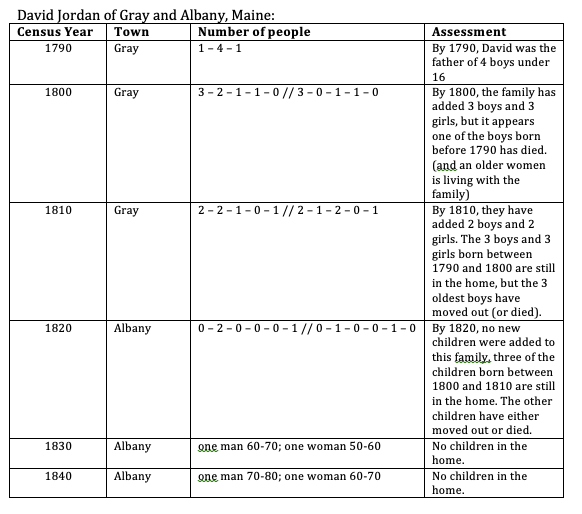
With this information, we can start to develop a skeleton outline of children born to David Jordan and his wives. Once a visual outline with number of children and their sexes is developed with these census records, we can start to search for records to fill in the blanks. David and his wives had:

By creating such a chart, we have an idea that we are looking for about 14 children born to David Jordan. Now we need to change “boy, born b/w 1782 &1790” to a name of a son. However, there are not any vital record entries for this family in either Gray or Albany, Maine, searching for documentation in less obvious places is required; published genealogies found on Google books, probate records and pension applications provided a source of information on this family. Then it was important to look at all these possible children to see if they note their parent’s names in their marriage and death records, and to check Find A Grave (.com) for gravestones to figure out birth order.
Documentation:
- David applied for a pension (in 1820). Lists himself at 59, wife Temperance 57, children: Jefferson 16, Buckman 14, and Phebe 11.
- Ruth (Jordan) Abbott’s death record list names of parents
- Wales is noted as son in Proctor genealogy
- Lydia (Jordan) LeBarron & Joanna (Jordan) LeBarron are noted in LeBarron genealogy
- Afidavit filed to the Oxford County Probate Court 24 Aug 1847 by Obed Abbot (husband of Ruth) States David died 30 May 1847, leaving no widow, but these surviving children: Elijah Jordan, David Jordan, Calvin Jordan, Ruth Abbot, Jefferson Jordan, James Jordan, Wales Jordan, Russell Jordan, Lydia LaBaron and Joan LaBaron.
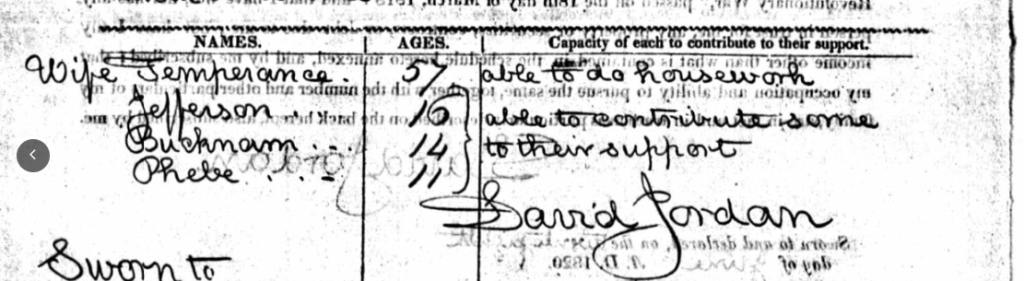
Now with this information and the outline we created we can develop David’s family:
Children of David & first wife are:
- David Jordan, born abt 1783 in Grey, ME; died 1868 Denmark, ME
- Elijah Jordan, born 1785 in Grey, ME; died Oct 1860 Paris, ME.
Children of David & second wife are:
- Calvin Jordan, born 1787; died 20 Dec 1859 Portland, ME
- son Jordan, born abt 1789; died young
- Ruth Jordan, born 1791; died 29 Nov 1865 Albany, ME.
- son, born about 1793; died bef 1810
- Wales Jordan, born 9 Dec 1794; died 30 Jul 1877 Albany, ME.
- Temperance, born abt 1796; died 1842.
- Lydia Jordan, born 1798; died 8 Jan 1855 Harrison, ME.
- James R Jordan, born 1800; died in Chicago.
- Joanna Jordan, born 1801; died 18 Sept 1856 Lovell, ME.
- Thomas Jefferson Jordan, born 9 Oct 1803;
- Russell Buckman Jordan, born Aug 1806; died 5 Dec 1875 Andover, MA
- Phebe Jordan, born 1809; died bef 1847.
Locating the probate record was a wonderful find! It confirmed what the various genealogies had to say and made it very easy to fill in the blanks. Knowing how to best utilize and analyze census records and then taking the kernals of information they provide and knowing where to look for new information may lead to answers. However, it make take years of searching to find missing ancestors, but don’t give up!

 Laurie L. Kearney