
So, you think you would like to discover your roots and you don’t know where to start? Well that is easy! Start with yourself, your parents and your grandparents! Jot down birthdates, marriage dates and death dates (if you know them!). Then have a conversation with the older generations in your family. Having all this personal first hand knowledge is a great place to start.

With your notes firmly in hand, you are ready to begin to search in earnest! I recommend starting the FamilySearch.org site. They will want you to sign up for a free account. They do not ask for any payment information (i.e. your credit card), and they do not flood your email account with unwanted emails. FamilySearch is owned and operated by the Latter Day Saints (the Mormons). Part of their belief system is that families are very important in this life as well as in the after life, and by finding (and baptizing them as Mormons) long dead relatives, they all will be reunited in heaven. The nice thing about their website is that they have imaged thousands of original documents (primary sources). It is these primary sources that prove your line, some secondary sources or a story passed down for a few generations may be false! My great-grandmother told my dad and his brothers we were related to Pocahontas. When I was little, I thought that was pretty cool, and indeed it was one of those facts I went searching for when I first started researching my family. It took a while, but I found my great-grandmother’s grandmother maiden name was “Rolfe.” That was clearly where the story came from, but my Rolfes were in no way related to the family into which Pocahontas married.
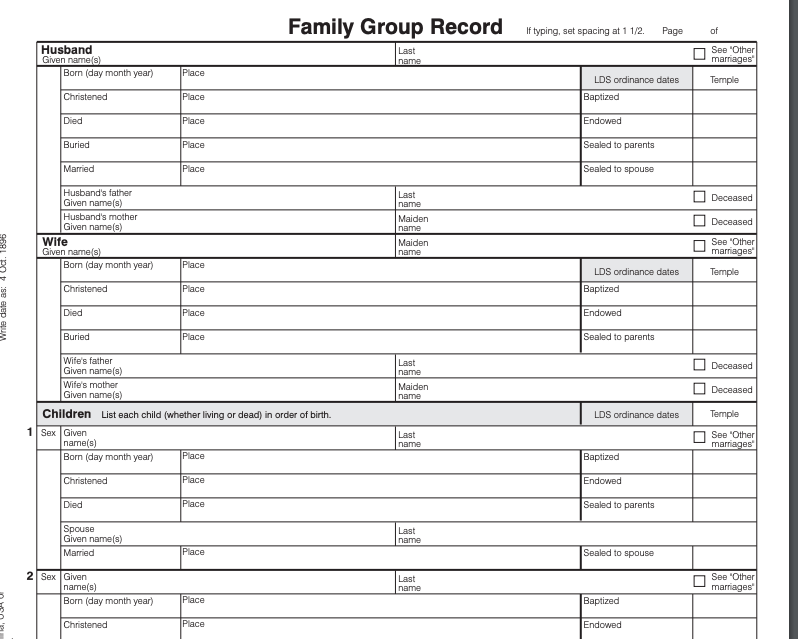
One of the most important things you can do is to keep accurate records. Notes of your conversations, family group sheets, pedigree charts, when and where you researched (so you do not repeat your searches!). You can keep these records in a binder or invest is some genealogy software. (There is free software out there, but I would research it before you download it!). I often start a new search by opening a Microsoft Word document, and take my notes there before I start making a tree. I can also cut and paste links in this document, so if I go back and revisit this family, I can re-visit the links!
It is very important to Document, Document, Document! Keep track of all your sources. By doing so you can show your proof, you can return to your searches if you need to re-evaluate the accuracy of your source, and it will also prevent you from doing the same searches over and over again. Once on a genealogy Facebook page (consider joining one!), I came across a fellow who posted that he had just started tracing his family tree and had already managed to trace back to Adam and Eve. He most likely copied someone else’s tree, who did not have any sources. Genealogists on the page had to gently explain to him that this was very unlikely.

Evaluate your sources for accuracy. Very often some sources are questionable. I have seen people document a marriage, which occurred in the 1600s between someone in New England and someone in Virginia…although in theory possible, the distance would have made it difficult. In tracking that pesky Rolfe line, I found a Rolfe raised in Massachusetts in the mid 1700s, relocated to New Jersey. I thought this maybe untrue, but the more I looked, the more primary sources I found, and it turned out to be true! So, double and triple the sources, especially if you found the information on someone else’s tree. If it does not make sense, it is probably wrong.
Genealogy is a fun pursuit. I love to untangle a historical question. Sometimes the information comes to you very easily and other times it may take years before you find the next generation, but don’t give up!
So keep this in mind:
            Gather what you know.
            Research can begin.
            Accurate Records must be kept.
            Document your sources.
            Evaluate your sources for accuracy.

And you’ll have good GRADEs!

 Laurie L. Kearney