
I’ve been dabbling in DNA to solve genealogical questions for a couple of years now. About 5 years ago, a fellow genie friend began using DNA in her searches, and she thought it was a wonderful tool. I remained skeptical and was unsure if I wanted to invest time and energy into learning how to use DNA to solve genealogical questions. Then in 2018, I attended an educational conference sponsored by the Massachusetts Genealogical Council, where Jennifer Zinck gave a wonderful presentation on using DNA. OK, now I’m intrigued.

I reached out to a dear friend from college who had always wanted to know the identity of her birthfather…. (Last name “Smith”…. oh, please!). I asked her if she would be willing to take a DNA test so that I could learn a new technique. She agreed and my education began. I read what I could find online and watched several “how-to” videos, and when the results were finally in I began creating a giant family tree of her matches…. well, its more like a blob because she comes from a relatively insular community where families intermarried. Eventually I had had this giant blobby family tree and still could not figure out where her birthfather fit in. Then I found a video by the Barefoot Genealogist (Christa Cowan) on making a simple chart to visually see how your genetic matches fit in (video is here: https://www.youtube.com/watch?v=VP8rUlZbmeA&t=1011s). Once I did this…. I solved my first DNA mystery. Boy did I feel empowered!

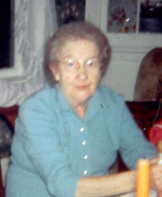
My Grammy, Hope at 6 years old….and her birth mother, Hilda.
Next, I used my son and mother’s DNA to begin solving a family mystery…. my grandmother (Hope) was adopted and as luck would have it, after good old fashioned sleuthing I believe I found her birth family…. a DNA test proved I found a ½ second Cousin! This cousin informed me that my grandmother’s birthmother (Hilda) was also adopted (oh boy). After a free weekend on AkivDigital, Sweden’s Archives, I found that the birth grandmother mother (Elda), who was born out of wedlock (on no!), but DNA helped me figure out who her birthfather was. However, as you can see there is still a lot to figure out in this line!
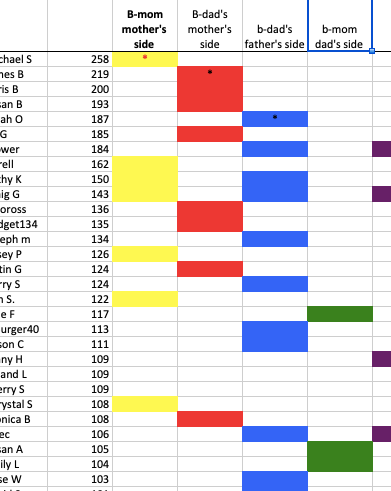
Then attended and week long (online…because, you know, pandemic) class on DNA led by Blaine Bettinger, with guest presenters Dana Leeds, Karen Stanbary and Paula Williams. By the end of the week, I knew I needed to “play” with more DNA, do a lot more studying and circle back for another class. I asked another friend if she would take a DNA test. She was adopted and had long ago met her birthmother and knew the name of her birthfather. She didn’t actually have any questions she wanted answered, but agreed to let me learn from her DNA. I knew quite a bit about her birth mom, so I asked my friend not to divulge any information on her birth dad to see if I could figure out who he was. When the DNA results rolled in, I first made a Leeds Chart…. a wonderful technique! If done correctly, you should discover the surnames of all four grandparents. I googled for the birth moms obituary, hoping that might lead to the names of her parents…. it did. Then I began building a family tree with this information and DNA matches. As my friend’s tree grew, possible birth father candidates emerged (three brothers). They grew up many states away from where my friend’s birth parents met. I needed to connect one of the brothers to a far away state from their home state. With the help of Google, and some primary documentation found on Ancestry, I was able to nail down the birth father. Because my friend knew his name, she was able to confirm I was correct! Woohoo!
With my objective solved, another by-product of this research emerged. As I was building my friends genetic family tree, a wonderful story about strength and perseverance emerged! Turns out her birth grandmother was widowed at twenty-seven and had two children under ten with one on the way. Within a couple of years she moved her family from a Southern State, clear across the county to the Northwest. She appears to have followed some of her siblings there. She remarried later in life; long after her children had grown. This means she was a single mother of three, working and raising her children during a time when the United States was trying to recover from a World War and from the after effects of the Great Depression. This was a wonderful story to tell my friend about her birth family.
It is interesting to think that by using DNA to answer a genealogical genetic question, you can also discover familial histories and stories!

 Laurie L. Kearney