
This is not a “how-to” discussion, as I am a newbie to this technique. Plus, there are so many wonderful how-to videos on this topic, AND the person who created this technique has their own blog page (here). Who better to learn this method from than the person who developed it!

I had read on several genealogical DNA Facebook pages where I am a member, about how helpful Dana Leeds’ technique was for organizing DNA matches. Bonus, it is a color-coding technique and I am a person who finds visual practices very helpful to understand, or to “see” a new concept. Admittedly, I tend not to fortify my mind before I research. Sometimes I like to delve in and see where my research takes me, and learn as I go along.
My first experience was working with my college roommates DNA to answer a genealogical question: who was her birthfather? Like so many people, when the results first came in, I did not know where or how to start. What I was looking at was somewhat over whelming. I clicked on many of the matches and looked at their trees (if they had them). I googled for information on some of the matches, hoping I would discover a clue…or two, that might help. Finally, I turned to YouTube for guidance and learned about mirror trees. Actually not a technique that would be helpful in this case, but I liked the idea of building a tree that would contain the matches. Perhaps that might lead me to this elusive birthfather. I learned as I went along and was eventually able to figure out how my friend fit into this genetic tree.

From experiencing some success, I wanted to have more opportunities to use DNA in genealogical research. A couple of summers back, I took a DNA class (online because of the pandemic) at the Genealogical Research Institute of Pittsburgh (GRIP), where one of the presenters was none other than Dana Leeds! She lead us through her method step by step, then gave us a homework assignment to try it on our own. Now, not having a lot of DNA in my account to work with, I thought I would use my college roommate’s DNA results, as I already knew what the answers should be. I thought this would be a self-correcting way of using the Leeds Method. If I did not fully understand this technique, then my chart would be wrong, and then I could go back and re-try this method to get it right.
Basically, you consider a small subset of DNA matches, people with whom the test taker shares approximately 400cM to 90cMs with; their second and third cousins. Using a spreadsheet to record your matches, you click on the 1st second cousin in the list who shares about 400cMs with your test taker, then you click on “Shared Matches.” That is the list you record in your spreadsheet, assigning all those in this column a certain color. Arrow out. Then click on the next cousin (who you have not entered into you spreadsheet), then click on “Shared Matches” and record that list assigning them another color. Work you way through the cousin list until you get to your last cousin with whom the test taker shares 90cMs with. You will end up with at least four columns…and sometimes more, but don’t panic. With is information you will discover the surnames of the test takers grandparents. (If this technique intrigues you, I would encourage you to find another site that can explain it better!)
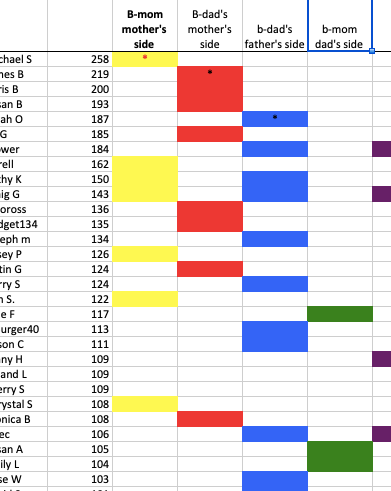
This is an excellent place to start your research. It gives you a snapshot of the test takers family. Basically you know the surnames of the grandparents. The next thing I do is build family trees using the trees the shared matches built and building them out to include siblings and cross referencing them to primary documents. If I am lucky, I will find a marriage of two people with the grandparents surnames…perhaps THE grandparents, but it could be another couple with the same names….so check and double check your research!
I love the Leeds Method and highly encourage people to learn more about it!

 Laurie L. Kearney