
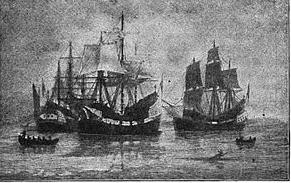
The Settlement of Massachusetts
| Date: | Event: | Notes: | Source: |
| 1620 | The Separatists (aka Pilgrims) establish Plimouth Colony | General knowledge | |
| August 1622 | Wessagussett Colony was settled. Near present day Weymouth. | Settled by 50 to 60 colonists, who were unprepared to establish a new colony in NE. They did not bring enough supplies. The colony dissolved in March 1623. Some of these colonists returned to England and others joined the Plymouth Colony. | “Thomas Weston and the Early Settlers of Wessagussett.” The Weymouth Historical Society. Online article: https://weymouthhistoricalsociety.org /early_settlers.htm |
| 1630 | The Winthrop fleets begin arriving | The first of John Winthrop’s Great Migration ships arrive and establish the Massachusetts Bay Colony | General knowledge |
| 1636 | Dedham is settled. | To relieve the burgeoning population in Boston, Watertown, & Cambridge, The General Court of Massachusetts allowed for the establishment of several new towns in 1635; Concord & Dedham. Dedham area was large, extending all the way down to Rhode Island. Eventually 15 towns would be set off from Dedham | William Francis Galvin. “Massachusetts City and Town Incorporation and Settlement Dates.” Online interactive exhibit. https://www.sec.state.ma.us/cis/ cisctlist/ctlistalph.htm |
Slavery in Massachusetts
| Date: | Event: | Notes: | Source: |
| 1636-1638 | The Pequot War. | Native New Englanders captured and enslaved. Some locally and some exported. | “February 26, 1638: The First Slaves Arrive in Massachusetts” MassMoments.org online exhibit |
| 26 Feb 1638 | First Enslaved people arrive on the “Desire” | Notation is in the diary of John Winthrop | General knowledge |
| 1638 | Samuel Maverick is recorded as buying two slaves. He is said to be one of the first slave holders in Massachusetts | Samuel was in Massachusetts before Winthrop settled Boston (abt 1624). He was lived in Winnissimet (near part of the failed Wessagusset settlement), before moving to Boston | Anna Marie Hoey, “Maverick Square, which Honors States First Slave Owner, Should be Renamed.” Commonwealth Magazine, April 21, 2021. (Boston: commonwealthmagazine.org) AND “Samuel Maverick Writes a Guide to the Wonders of New England: in 1660” The New England Historical Society. https://www.newenglandhistoricalsociety.com/samuel-maverick-writes-a-guide-to-the-wonders-of-new-england-in-1660/ |
| 1641 | Bodies of Liberties written: Massachusetts becomes the first colony to legalize slavery | Written by Puritan minister Nathaniel Ward. This law is said to be the first law in the colonies to legalize slavery | See: Mass.gov “Massachusetts Bodies of Liberties: Synopsis of the History of the Massachusetts Bodies of Liberties” |
| 1643 | The Massachusetts Bay Colony, the Plymouth Colony, Connecticut and New Haven adopt the fugitive slave law | This law provided for the return of a fugitive slave back to the colony from which the slave had fled. | thirteen.org/wnet/slavery /timeline |
| 1644 | Massachusetts participates in the “Triangle Trade” | Boston merchants began to import slaves directly from Africa, selling them in the West Indies, then bringing sugar to Boston to make rum. | “Triangular Trade in the New England Colonies” The Boston Tea Party Historical Society. Online article: http://www.boston-tea-party.org/triangular-trade.html |
| 1652 | Law | Massachusetts requires all black and Indian servants to receive military training | thirteen.org/wnet/slavery /timeline AND https://www.nps.gov/articles/000/slavery-and-law-in-early-ma.htm |
| 1662 (or 1656) | Law reversal | Massachusetts reverses law regarding military training for black and Indian servants | thirteen.org/wnet/slavery /timeline AND https://www.nps.gov/articles/000/slavery-and-law-in-early-ma.htm |
| 1670 | Bodies of Liberties amended | It now notes that all children born to enslaved women were also enslaved. | Johnson, Timeline of Slavery |
| 1675 | Slaves were considered property in Massachusetts | Robert Spector. The Quock Walker Cases (1781-83). | |
| 1675-1678 | King Philip’s War. | Many Native Americans were captured and enslaved | General knowledge |
| 1680 | Laws enacted | The Commonwealth begins to enact laws restricting the movements of people of color | Lorenzo Greene. The Negro in Colonial New England: 162-1776. (New York: Columbia University Press, 1946) |
| 1700 | An enslaved man, Adam, sued his owner, John Saffin, for his promised freedom. He won in 1703 | “Eighteenth Century” The African American Trail Project. Tufts University | |
| 1703 | Manumission Bond order | Massachusetts requires every master who liberates a slave to pay a bond of £50 or more in case the freedman becomes a public charge. | Lorenzo Greene. The Negro in Colonial New England: 162-1776. (New York: Columbia University Press, 1946) |
| 1703 | Curfew established | A law enacted that barred people of color (enslaved and free alike) from being out past 9pm. | https://arlingtonhistorical.org/slavery-in-colonial-new-england…AND Robert Spector. The Quock Walker Cases (1781-83). |
| 1705 | census | Approximately 500 black residents, both enslaved and free, were living in Boston. | “Eighteenth Century” The African American Trail Project. Tufts University |
| 1705 | Law | Massachusetts makes marriage and sexual relations between blacks and whites illegal. | Lorenzo Greene. The Negro in Colonial New England: 162-1776. (New York: Columbia University Press, 1946) |
| 1713-1714 | Peace of Utrecht | “Once Britain acquired the Asiento from Spain by the Peace of Utrecht in 1713-14, giving her the right to supply thousands of slaves to the Spanish colonies in the New World, the slave trade became a major commercial enterprise for some of Boston’s best families.” | Robert Spector. The Quock Walker Cases (1781-83). |
| 1723 | Law | Boston passed a law forbidding enslaved men and women to be on the streets or on Boston Common, at night or to be found “idling or lurking together.” | https://www.massmoments.org/moment-details/first-slaves-arrive-in-massachusetts.html |
| 1728 | Law | Prohibited from carrying sticks and canes | Robert Spector. The Quock Walker Cases (1781-83). |
| 1754 | Massachusetts Slave population census. It listed approximately 4,500 enslaved people in Massachusetts over 16 years old. | The Commonwealth ordered a census of all enslaved people over the age of 16 to he taken. Total of enslaved people over 16 living in the original Dedham area: 51 | W. Dean Eastman and Kevin McGrath, “1754 Massachusetts Slave Census.” primaryresearch.org. Online interactive exhibit. |
| 1764-1774 | 17 Freedom Cases heard in Massachusetts courts | Lorenzo Greene. The Negro in Colonial New England: 162-1776. (New York: Columbia University Press, 1946) | |
| 5 Mar 1770 | The Boston Massacre | Escaped slave, Crispus Attucks, is killed by British forces in Boston, Massachusetts. He is one of the first colonists to die in the war for independence. Crispus was part African and part Wampanoag and it is believed he was from Framingham | See: National Park Service. “Crispus Attucks” https://www.nps.gov/people/crispus-attucks.htm |
| 1 Sept 1773 | “Poems on Various Subjects, Religious and Moral” Phillis Wheatley’s first book is published | Phillis Wheatley becomes the first published African-American poet when a London publishing company releases a collection of her verse | Carretta, Vincent. “Phillis Wheatley: Biography of a Genius in Bondage.” (Athens, GA: The University of Georgia Press, 2014). |
| April 1775 | Battle of Lexington and Concord | The first battles of the Revolutionary war are waged between the British and Colonial armies at Lexington and Concord, Massachusetts. Black Minutemen participate in the fighting. | General knowledge |
| July 1775 | George Washington announces a ban on the enlistment of free blacks and slaves in the colonial army. By the end of the year, he reverses the ban, ordering the Continental Army to accept the service of free blacks. | It is estimated that approximately 5,000 African Americans participated (American side) in the Revolutionary War. And approximately 100,000 fled and served on the English side | thirteen.org/wnet/slavery /timeline AND “African Americans and the End of Slavery in Massachusetts,” online exhibit, Massachusetts Historical Society. “Revolutionary Participation.” |
| 1780 | Massachusetts State Constitution is written and voted in. It states all men are born free and equal. | General knowledge | |
| 1781 | Brom and Bett v Ashley | Mum Bett & Brom sue for their freedom based on Mass Constitution, arguing they were being held in slavery unlawfully. And they won. | “The Revolution and the End of Slavery in Massachusetts.” Online exhibit The Royall House & Slave Quarters, Medford, MA |
| 1783 | Commonwealth v Jennison (aka “The Quock Walker Case”) | Judge Cushing rules the Mass Constitution does not allow slavery in Mass. This makes Massachusetts the first state to judiciously “abolish” slavery. | Robert Spector. The Quock Walker Cases (1781-83). |
| 1783 | Gradual Emancipation begins in Massachusetts | Although slavery was judiciously abolished, it did not immediately end slavery in Mass. It is believed it took over 10 years to occur | |
| 1787 | African Mason Lodge, in Boston, MA is founded | Prince Hall founds the first black fraternal organization, the African Mason Lodge, in Boston, Massachusetts. It provides services to the black community and lobbies against slavery and discrimination | Lorenzo Greene. The Negro in Colonial New England: 162-1776. (New York: Columbia University Press, 1946) |
| 1790 | The first US Federal Census is taken. No slaves recorded in Massachusetts (and Maine) | Total of “All other People” living in the original Dedham area: 118 | 1790 United States Federal Census |
 Laurie L. Kearney