
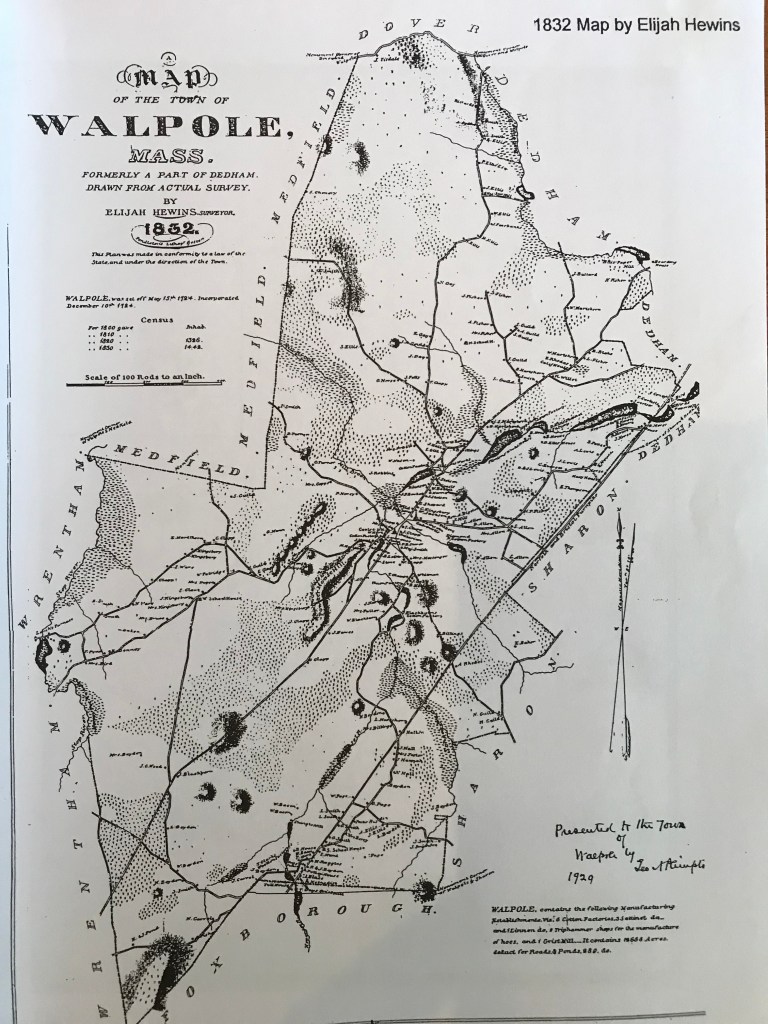
The town of Walpole was set off from Dedham in 1724, originally settled in the 1659 when a sawmill was built near the junction of Spring Meadow Brook and the Neponset River to cut lumber harvested from the Cedar Swamp. By 1721, the families that were living in this part of Dedham requested from the Great and General Court of Massachusetts to be set off into their own town. Their reason for this request was that the church in Dedham village was too far away for them to attend Sunday services, and that it was a hardship to make that weekly trip. In 1724, the town was officially set off, and the name Walpole was selected in honor of Sir Robert Walpole. Now all that this fledging town had to do was to build a church and call a minister.

Searching for information on slavery in Walpole, an obscure fact comes to light; Thomas Clap, one of the original settlers in the area, had an enslaved “maid” in 1681. She would have been white, and quite possibly an orphan who he took in as an indentured servant, but before he could free her he had to put up some money so she would not become a charge on the towns poor rolls. However, a search on slavery in Walpole leads to the story of Jack Robbins, who in 1783 became a ward of the Walpole church. What is obvious is that slavery most likely existed in Walpole, years before is it was found to be incompatible with the Massachusetts Constitution, and yet Jack Robbins’s mention is merely a historical footnote on slavery in Walpole. Looking at church, town and probate records give an answer as to whom Walpole’s slave owners were; ministers and small business operators. One of the earliest records found is from 1745, some twenty years after Walpole was established, when Rev. Payson inherited a “Negro servant” from his father-in-law. This does not necessarily mean this is the first incidence of people of color being enslaved in Walpole; there is a good possibility a few enslaved people were part of the life of Walpole between 1724 and 1745. The 1754 Massachusetts Slave census only recorded one female slave in Walpole, but several records have been uncovered which show that a few enslaved people were there from the 1760s through 1783.
Rev. Philips Payson was the second minister called to serve Walpole. The first minister, Rev. Joseph Belcher served for just over a year, from April 1728 to May 1729; apparently not happy with his arrangement with the church, he asked to be dismissed from his duties. Payson was called in the fall of 1729 and served the Walpole church for almost forty-eight years. Phillips Payson (1704/5-1778) was the son of Samuel Payson and Mary Phillips of Dorchester. He graduated from Harvard in 1724 and soon after was called to Walpole. He married three times, first to Ann Swift of Framingham, then to Keziah (Bullen) Morse of Medfield, and lastly to Sarah (Payson) Mather. He died 22 Jan 1778 in Walpole and is buried in the Old Burial Ground. He shares his tomb with his wife, Anna and his best friend, Deacon Ezekiel Robbins and his wife Mary (Clap) Robbins.
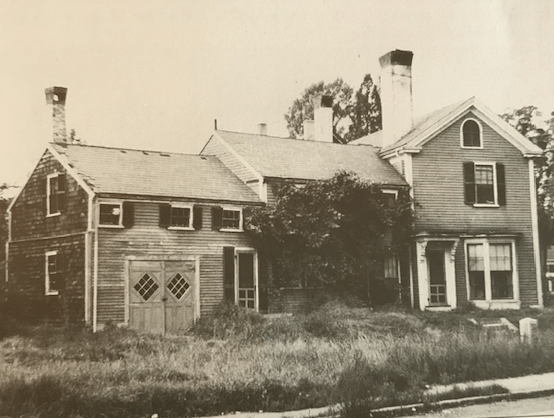
Payson’s first wife, Ann Swift, was the daughter of Rev. John Swift, the first minister of the Framingham church. Swift graduated from Harvard in 1697 and was called to Framingham in 1701, where he served until his death in 1745. To entice Swift to come to Framingham, the new town gave him over 100 acres of land and money to build a house, as well as an annual salary. By the time Swift died he had accrued a substantial estate, which included five slaves. One of which was Guy, who was probably a teenager at the time, and was left to Swift’s son-in-law “Mr. Philips Payson (minister of Walpole) & to his heirs.” This is the only record of Guy. The Framingham church records the marriage of Guy’s parents, Nero and Dido, who are also mentioned in Swift’s will; he gives Nero to Dr. Ebenezer Roby (also Swift’s son-in-law) and his mother, Dido and sister Esther to his wife (then to daughter at death of wife). The will also disposes of Guy’s brother, Francis to John Swift (Jr). William Benson, another son of Nero and Dido, had already been sold off before Rev. Swift’s death.

The family of Nero and Dido used the surname “Benson,” and can be traced in vital records of Middlesex County (MA). Nero & Dido were born probably in the mid to late 1690s, and quite possibly came from Africa. They married in Framingham March 26, 1721. Nero served as a trumpeter in Capt. Isaac Clark’s Company entering the service August 27, 1723 and was still recorded serving through 1725. He was the first documented black army musician in the army. Nero was a member in good standing in Rev. Swift’s church, but switched is membership to the church in Hopkinton stating his spiritual liberty had been restricted. He joined the church in Sudbury, as that was where he lived with the Roby family. In 1747, Nero belonged to Samuel Wood of Sudbury. Wood granted Nero his freedom. Nero’s death is recorded in Rev. Loring’s records on 3 Jul 1757 in Sudbury. It is said Dido Benson received her freedom too, and came to live with Nero in Sudbury. She can be found on the town’s poor rolls several years after her husband had died. Their son William was eventually freed as well although in 1764, he had to bring a freedom suit against his enslaver (William Benson, et al. v Joseph Collins) in order to make his freedom official. William’s son, Abel served in the American Revolution as a trumpeter.
What happened to Guy Benson is unclear. It is highly probable he came to Walpole, as he was someone Ann (Swift) Payson knew from her childhood home. She also would have been used to having slaves working in the home, because her father owned the entire Benson family. She also might have welcomed having an extra set of hands to help out around the Payson homestead. Guy most certainly had died by 1757, as the minister of Nero’s Sudbury church noted upon Nero’s death that he left behind a wife and three children. Because there continue to be records of Esther, William and Francis “Frank” through out the late 1700s, it would seem to indicate Guy died before his father.
Historians note that very often slaveholders were doctors. Walpole’s first Doctor was Ebenezer Doggett, he lived and practiced in Walpole between 1757 and 1772, when he moved to Wrentham. He continued to practice medicine in Wrentham until his death in 1782. A check of the administration of his estate indicates he did not own slave. Over the next several years Walpole was serviced by visiting several doctors; Dr. James Gerauld, of Medfield, Dr. Seth Mann, and Dr. James Messinger, before Dr. Jonathan Wild set up his medical practice in Walpole in 1780. Wild practiced for over forty years here, dying in October 1833. In 1797, Wild reported to the town, that he “took into his home Soffa Ridgway, a black girl.” Soffa most likely was not enslaved to Wild, as slavery had essentially ended in 1783, but Wild was obliged to inform the town of strangers, to allay any worry that they may become a town charge. Two years later, in the 1800 US Census, Dr. Wild did not report any “all other persons” living in his home, indicating Soffa had moved out of his home.
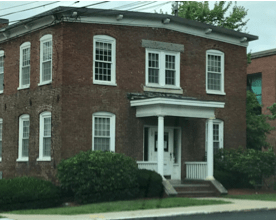
There are several business owners in Walpole that relied on the labor of enslaved people to help run their establishments. A couple of those establishment owners that owned slaves in Walpole were the tavern keepers. On West Street was a tavern run by Deacon Ezekiel Robbins. Sometime before 1760 he bought Jack Robbins, a “negro man servant” he enslaved. At the time Jack came to Walpole, Robbins and his wife were in their sixties and did not have any children to help them. With a 243-acre farm and a tavern to run, they most definitely would have needed an extra pair of helping hands. Jack would have worked both on the farm as well as in the tavern. A description of Jack, provided by a Robbins family researcher, notes him as being a “large, strong man who could easily clear the tavern of unruly patrons.” Ezekiel Robbins left his entire estate (both real & personal) to his wife, but upon her death his land was to be given to the church. He set out three conditions for the church to follow if they wanted to inherit the land; (1) maintain an orthodox minister, (2) pay a legacy to his great niece and nephew a year after his wife died and (3) to take tender care of Jack until the day he dies. When Jack became too old to work, the church met all his physical needs; shelter, food and clothing.

The other tavern keeper-slave owner in Walpole was Shubael Downs. Downs was born in Harwich, Massachusetts in 1741. In early documents he is listed as a mariner, but after he runs a business in Walpole and then in Boston, he is called merchant. Downs came to Walpole by 1779, buying Dr. Ebenezer Doggett’s property on Main Street. Here he opened a tavern. Both Robbins’ tavern and Down’s tavern were situated on the main road from Boston to Providence. Walpole was the halfway point between these two towns. It was an excellent place to stop and water the horses, get a bite to eat and to have a break from what must have been a very bumpy ride. One of Downs’ enslaved men was Francis Cooler, who served during the Revolutionary War in the stead of Nathaniel Sumner of Dedham. By doing this, he would have earned in freedom. Another enslaved man Downs owned was a teenager named Fife, who ran away in May of 1783. Downs took out an advertisement in local Boston papers for his return, and even offered a reward of one guinea. In the 1790 census, Downs is enumerated in Walpole, with his family and three “all other persons” in his home. Soon after this census was taken, Downs sold his Walpole property and moved into the city of Boston, where he died in 1796, leaving behind a wife, Lydia (Bangs) Downs and eight children ranging in age from two to nineteen.
Two other Walpole men reported to the Selectman that they had taken into their homes people of color. It was required that strangers to Walpole wishing to live there, be reported to the town. If they were indigent, a town resident would need to notify the town they were caring for these people. The town did not want to add people to their poor rolls, especially if the “belonged to” another town. In 1770 Jonathan Boyden informed the town he had taken a “mulatto child named Benjamin Brown born in Attleborough” into his household. Then in 1779, Ezekiel Needham notified the town he had “put upon my place in Walpole (torn) Daniels and his wife and two negros last from Franklin.” Needham lived in Wrentham (the part that is now Norfolk), on the Walpole border. Needham recorded in the 1771 tax valuation for the town of Wrentham (the part that is now Norfolk) that he had 1 “servant for life.” He came from Boston, and in early records he is noted as being a blacksmith. It is unclear what he did once he came to Wrentham/Walpole, but his son, John was a tavern keeper, it is possible Ezekiel worked with his son, or it is possible continued smithing.
The most interesting fact regarding Walpole slave owners is that Isaac Royall, Jr. (1719-1781), one of the largest known slave owners in Massachusetts owned 500 acres of land here. Royall was a wealthy and influential businessman. At the age of 23, he inherited his father’s a large estate. His father was of humble beginnings, but as a young man became part owner of a slave ship and grew his business empire through the triangle trade – rum, sugar and slaves. In the 1720s after experiencing political and environmental troubles at his Antiqua estate, Royall’s father returned to Massachusetts, buying 500 acres in Charlestown (now Medford). He built a large Georgian style house, and out buildings, which included a large structure to house his slaves. The house and slave quarters still stand. Today the site is operated as a museum and is also on the National Historic Register. Royall bequeathed a hefty endowment that established Harvard Law School, plus much of his Medford land is now Tufts University…and all of Royall’s success was built on the backs of enslaved people, which would have included his Walpole farm.

In researching the land Royall owned in Walpole, it was discovered this farm was also about 500 acres. Initially, this farm was located in Stoughton (the part that became Foxboro). Royall had refused to pay taxes to the Stoughton Church to support their minister. He stated his property was too far away from the Stoughton Church for the people who lived on the farm to attended Sunday services. In 1753, his farmland was annexed to Walpole (the South Walpole area), but when Foxboro was established in 1778, the Royall farm was annexed to Foxboro. So, for about twenty-five years the Royall farm and lands south of Boston were part of the town of Walpole.
It does not appear any enslaved people lived on this farm, as the 1754 Massachusetts slave census indicates only one enslaved female living in Walpole. (Where this woman lived has not yet been discovered). The two men who rented the farm are not familiar (to this historian) Dedham/Dorchester surnames. It is possible, these renters were actually employees of Royall, hired to run and manage the Walpole farm. It is interesting to note is when Royall’s farm was part of Walpole, Royall would have been obliged to pay his taxes to the Church in Walpole to support the minister.
As industrialization began to take hold, several of the mills built along the main rivers in Walpole made a variety of products from cotton; which may have come from slave plantations of the American south or may have been imported from other cotton growing countries. Walpole’s history of slavery is hidden deep with in a variety of records, but once information is found it becomes clear that Walpole indeed had slaves living within its borders.
 Laurie L. Kearney